Can the Democrats Take Back the Senate?
Amy Davidson Sorkin The New Yorker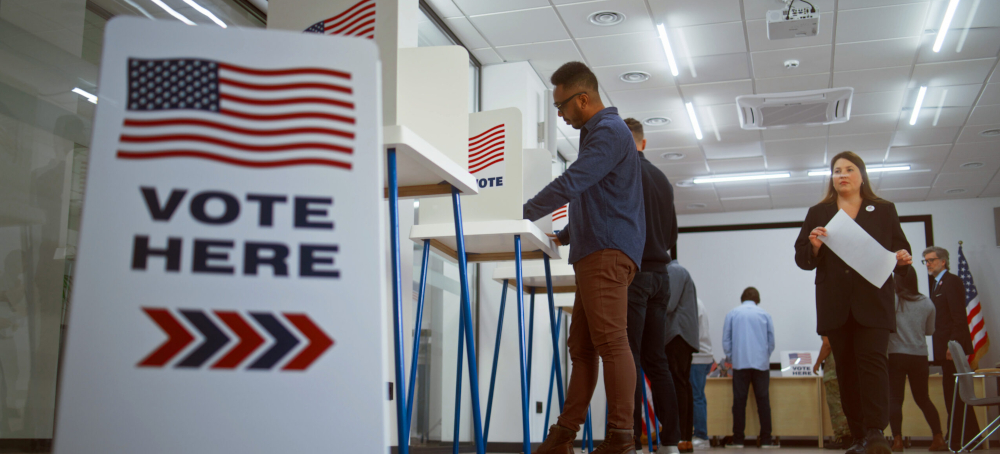 Americans exercising their right to vote at a polling station. (photo: Shutterstock)
Their electoral prospects are finally improving, but opportunities can quickly give way to divisions. Does the Party have a plan?
Iowa is a state where Donald Trump beat Kamala Harris by thirteen points, and where registered Republicans outnumber Democrats by nearly two hundred thousand. But Turek’s answer was a serious one. Something has changed lately in the dynamics of the Democrats’ drive to reclaim the Senate, or, at least, in the Party’s mood. Trump’s approval ratings have fallen to below forty per cent, the Iran war grinds on, and gas prices have been rising, as has inflation. More than that, there is a general sense of anger and suspicion about entrenched élites. A comment that Trump made last week about how much he considered Americans’ financial situation when negotiating with Iran—“not even a little bit”—encapsulates how recklessly he is willing to alienate even his own supporters.
Disillusionment with Trump, however, does not necessarily translate into enthusiasm for any given Democrat. The Party’s approval ratings are at forty per cent, about the same as the G.O.P.’s. Riding a wave of outrage in an era of MAGA-inflected conspiratorial thinking is a different task than, say, hoping that a blue drift in Texas could get Beto O’Rourke elected. (That said, Texas has a Senate race that Democrats think they can win this year; a runoff on May 26th will determine whether James Talarico, a progressive, will face the incumbent, John Cornyn, or Texas’s scandal-ridden attorney general, Ken Paxton.) Democrats are also fighting among themselves. In Michigan, a primary for the Senate seat left open by the retirement of Gary Peters, a Democrat, has been marked by disputes related to Gaza and economic populism. Opportunities can quickly give way to divisions.
The G.O.P.’s current margin in the House is so slim that Democrats may not need to go deep in red states to overcome it, even factoring in the current redistricting battles. In the Senate, though, Republicans will have to lose a net four seats for the Democrats to gain control, and so they need a plan. Assuming that the Democratic senator Jon Ossoff can hang on in Georgia, the main targets are Alaska, Iowa, North Carolina, Ohio, and Texas, all of which Trump won, plus purple Maine. Democrats can at least make a case for any of them, based on the polling.
In Iowa, for example, Wahls and Turek are vying for a seat that is open because the Republican senator Joni Ernst is retiring; the likely G.O.P. nominee, Representative Ashley Hinson, has based her campaign on unalloyed support for Trump. Wahls has been an object of liberal excitement since 2011, when, at the age of nineteen, he delivered a viral speech at the Iowa statehouse about marriage equality and his two mothers. He has since been elected to the state Senate twice, in one of Iowa’s bluest areas; both times, no Republican bothered to run. Senator Elizabeth Warren has endorsed him. Turek, his opponent, describes himself as a “prairie populist” but comes across as more tempered than Wahls. He was born with spina bifida, after his father was exposed to Agent Orange while serving in Vietnam, and he has won two wheelchair-basketball gold medals for the United States in the Paralympics. (His campaign logo includes a medal.) Pete Buttigieg, the former Transportation Secretary, has endorsed Turek.
During the primary debate, Turek emphasized that he had won his seat in a district that Trump carried, and was thus “battle-tested.” Wahls took the position that voters are so unhappy about the “corruption of our politics” that traditional calculations hardly matter—a stance that other Democrats may find tempting, but risks leaving more moderate voters behind. (In Maine, Graham Platner, a polarizing populist with a complex backstory, who will face the Republican Susan Collins, represents a similar gamble.) “I’m the only person on the stage here tonight who has said that I will not vote for Senator Schumer for leader,” Wahls said, and attacked Turek for not joining him in that pledge. (Turek was noncommittal.) Frustration with Senate Minority Leader Chuck Schumer, which many Democrats share, reflects a sense that the Party is factious and indecisive—even as its electoral prospects are finally improving.
In other states, the Democrats have opted for more familiar names: former Governor Roy Cooper and former Representative Mary Peltola are well positioned in North Carolina and Alaska, respectively. In Ohio, former Senator Sherrod Brown, who has a long record as a populist, easily won his primary. He is seventy-three, and lost his last Senate bid, in 2024, as Ohio turned a deeper shade of red. But the Cook Political Report now calls the race a tossup.
Still, this may be an election where some of the certainties of the two-party system are rewritten. In Nebraska, Dan Osborn, a veteran and a former union leader at a Kellogg’s plant, is running as an independent. Like Turek, he identifies as a prairie populist, though he has said that he will not caucus with either party, because both are caught in a “doom loop.” Nonetheless, a local Democrat, Cindy Burbank, won last week’s primary on the strength of an unusual campaign promise: to drop out and give Osborn a clear field in the general-election race against the incumbent Republican, Pete Ricketts, who is the son of the billionaire behind TD Ameritrade and is endorsed by Trump. Local Democrats were credited for their discipline, which might help to secure a majority.
Yet there is something unsettling about the fact that it might take such an act of self-erasure for the Party to win the Senate. The country’s discontent gives Democrats an opening to change the terrible trajectory of Trump’s Presidency. Control of the Senate, for example, would allow them to block an extreme Supreme Court nominee. Now might not seem the moment for Democrats to be quarrelling, but many of them believe that the only way to build the Party back up is to remake it. November will tell. ♦