Can the Democrats Get It Together?
Amy Davidson Sorkin The New Yorker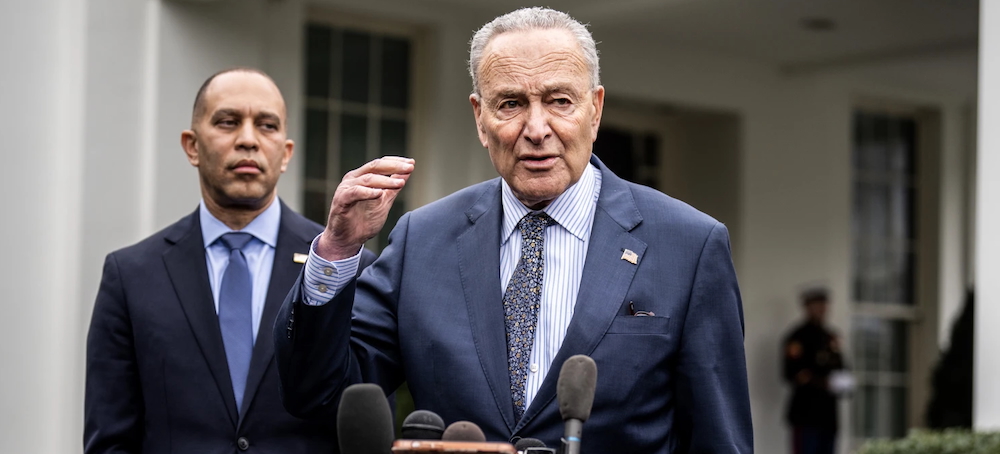 Senate Minority Leader Chuck Schumer and House Minority Leader Hakeem Jeffries. (photo: NBC)
The fight over the 2028 primary calendar is one of several proxies for a broader battle about the future of the Party—and the search for the best nominee.
Those fine sentiments aside, Biden wanted to reward South Carolina, which had changed his fortunes in the 2020 primaries, by moving it from the fourth spot on the calendar to the first. And his team discouraged the participation of any Democratic candidate not named Biden, while being far from forthright about his striking decline. To an extent, the process did what the people around the President designed it to do: nationwide, Biden got eighty-seven per cent of the primary vote. Then, six weeks after the last contest, he was forced to drop out.
Now the Party is again looking at the Presidential-primary calendar. On January 31st, the Rules and Bylaws Committee met in San Juan, Puerto Rico, to begin considering twelve states for what will be four regional “early window” primary slots: the East (the choices are Delaware or New Hampshire), the Midwest (Illinois, Iowa, Michigan), the South (Georgia, North Carolina, South Carolina, Tennessee, Virginia), and the West (Nevada, New Mexico), with room for a possible fifth at-large state. In the next few months, the states will be making presentations to the committee members, as if they were potential Olympic host cities. Minyon Moore, a former adviser to Hillary Clinton who co-chairs the committee, spoke, as Biden had, about the Party’s values. But she added that the goal this time was a schedule that yielded a candidate who could win. “I want to repeat that,” Moore said. “The strongest possible Democratic nominee for President.”
A good number of elected officials seem to think that Moore means them. California’s governor, Gavin Newsom; Pennsylvania’s governor, Josh Shapiro; and, yes, former Vice-President Kamala Harris are all on the road promoting books. Last week, both Harris and Vice-President J. D. Vance, a top prospect on the Republican side (Secretary of State Marco Rubio, who might be another, has said that the nomination is Vance’s for the taking), held events in Wisconsin, a key swing state. Governor Andy Beshear, of Kentucky, has a book coming out, too. Representative Alexandria Ocasio-Cortez and Governor Gretchen Whitmer, of Michigan, showed up at the Munich Security Conference. Meanwhile, Senator Mark Kelly, of Arizona, a decorated Navy pilot, has been in court fighting the Pentagon’s efforts to reduce his retirement rank in retaliation for his public statement that troops don’t have to follow illegal orders—a reminder of the stakes in this contest.
Because some early states would favor certain candidates—J. B. Pritzker is the governor of Illinois; Jon Ossoff and Raphael Warnock are Georgia senators; former Transportation Secretary Pete Buttigieg has a following in New Hampshire—the fight over the primary calendar is one of several proxies for a broader battle about the future of the Party. Democrats are still testing their responses to Trump, both stylistically and in terms of substance, and watching and evaluating one another. (At last week’s State of the Union, some Democrats who chose to attend sat in quiet protest, some heckled, and others walked out.) The midterm primaries offer a parallel set of choices: A mild-mannered seminarian or a confrontation-ready congresswoman in Texas? A seasoned governor or a populist oyster farmer in Maine?
In San Juan, such calculations ran through the committee members’ discussion. What state might showcase a candidate’s appeal to young Latino men, to union members, to gun owners? Was the local media market too expensive for grassroots candidates? Was having a red state in the mix an advantage, or might a G.O.P.-controlled legislature sabotage any attempts to move the primary date? New Mexico has the southern border; Tennessee, a committee member said, “doesn’t touch water,” and thus might keep the Party from being too “coastal.”
One danger of this exercise is that the Democrats will overlearn the lessons of 2024. For example, Biden wasn’t wrong to emphasize the importance of diversity. When the committee member André Washington asked his colleagues in San Juan how he should assess a would-be early state that was small and affordable but whose population doesn’t “look like America,” the answer was that no single state had to do it all; put together, they would form “a story that we’re telling.” But the Democrats not only have to tell a story—they have to listen to the one that the country, in all its diversity, is telling them. The Party commissioned an “autopsy” of the 2024 loss, but the D.N.C. chair, Ken Martin, has declined to release it. “Getting into the granular detail doesn’t help us,” he told the Miami Herald, raising the question of why there had been a report. Better to focus on the price of television time in northern Virginia, perhaps.
There are other risks. The San Juan meeting took place three days after the F.B.I. raided an election facility in Fulton County, Georgia, seizing records from the 2020 race. What is extraordinary about this moment is that election-security concerns extend beyond matters such as hacking to a pending Supreme Court decision that could further gut the Voting Rights Act, and even to the prospect of unlawful actions by the federal government. Some of the talk in San Juan was about safety plans. Trump is not eligible to run in 2028, but his incessant staging of crises makes elections more fragile—and the primary results less predictable. It is hard to know how any given Democratic candidate, in responding to an emergency, might help the Party find its voice.
This is a cycle, in other words, in which there is not necessarily a benefit to locking in a front-runner early on. The Democrats need to be ready for anything, including a nominee who is very different from one they expect. Devising the best possible calendar is laudable. But a victory in 2028 can’t be engineered. It will have to be hard fought.