Can "Cop City" Be Stopped at the Ballot Box?
Charles Bethea The New Yorker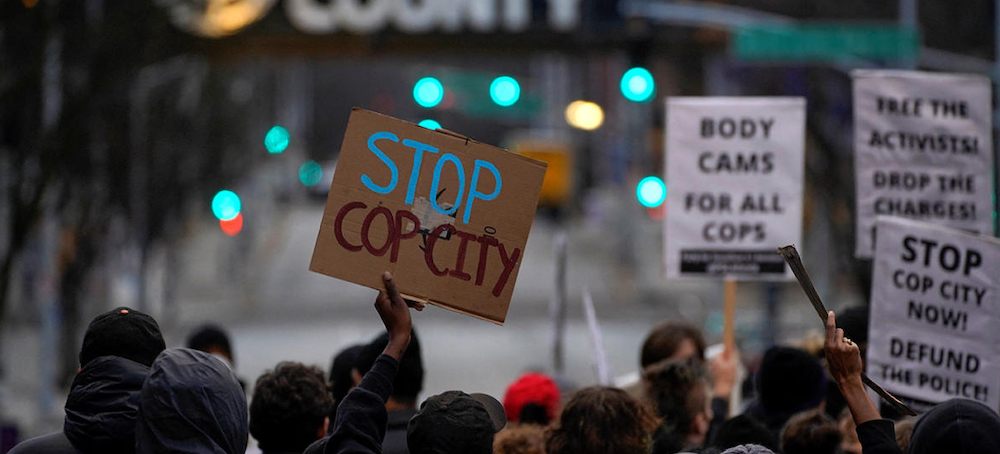 A demonstration in response to the death of Manuel Terán, who was killed during a police raid inside Weelaunee People's Park, the planned site of a "Cop City" project, in Atlanta. (photo: Cheney Orr/Reuters)
The fight over a massive police-training complex, set to be built outside Atlanta, has lasted more than two years. Now many people hope the proposal will be put to a vote.
By then, protesters calling themselves “forest defenders” had set up camp at the proposed site and were beginning to have skirmishes with police and construction crews. This past January, one of the protesters, Manuel (Tortuguita) Terán, was shot and killed by police officers, who fired at least fifty-seven rounds. Authorities claimed that Terán was armed and shot first, but an autopsy did not provide evidence that Terán discharged a weapon. (The officers involved were not wearing body cameras.) By May, more than forty protesters had been charged with domestic terrorism. A number of them had their bail paid by the Atlanta Solidarity Fund, which is run by a nonprofit. A month later, the Georgia Bureau of Investigation sent SWAT teams to arrest three of the fund’s organizers, on charges of money laundering and charity fraud.
“In terms of sustained damage to the body politic, this is the worst thing that’s ever happened to us,” Howard Shook, the city council’s longest-serving member, told me, on the phone, as I walked to City Hall. Nonetheless, Shook, who represents a wealthy district in north Atlanta, supports the project. “It got off on the wrong foot,” he said. “Everyone’s been paying the price for a bad first impression.” Two weeks before we spoke, the Atlanta Community Press Collective had revealed that the facility would cost taxpayers some sixty-seven million dollars, rather than thirty million, as the city had previously claimed. The total budget is ninety million; the rest will be paid by the Atlanta Police Foundation, a nonprofit that raises money for the Atlanta Police Department from some of the largest corporations in the city. The proposed facility’s chief fund-raiser was Alex Taylor, a member of the super-wealthy Cox family. The family’s company, Cox Enterprises, owns the city’s biggest newspaper, the Atlanta Journal-Constitution, and critics have charged that the paper’s coverage of Cop City has been less thorough than that of smaller local outlets. A spokesperson for the paper noted that the Journal-Constitution had published more than a hundred stories on the topic, by six different reporters. “Community members and others can have differing opinions on the conclusions of the reporting,” the spokesperson wrote in an e-mail, “but we operate with the highest journalistic standards.”
The budgetary discrepancy seemed typical of the project’s shifting nature—“I still don’t know what exactly is proposed,” Shirley Franklin, who was the mayor of Atlanta from 2002 to 2010, told me recently—and the collective’s reporting raised hopes among Cop City opponents that the council might send the proposal back to its finance committee. But Shook dismissed the idea. “We’ve got to have a state-of-the-art facility,” he said. “So I’m for it.” I asked him what would be lost by pausing a bit longer before building one of the largest such facilities in the country, even as violent crime, and homicide specifically, trends back down in the city. “Look, the baby is crowning,” he said. “We can’t shove it back up there for two more weeks.”
When I reached City Hall, it was packed with protesters, media, and at least three dozen uniformed police. I stood near a line that snaked into the council’s chamber, chatting with attendees and watching speakers on a big screen in the atrium. A period of public comment began—and lasted longer than fourteen hours, stretching into the next morning. More than three hundred people spoke, and nearly all were opposed to the facility, expressing concerns that ranged from the rise of a police state to the questionable wisdom of razing a forested area as climate change accelerates. The founder of a school, a local artist, and a descendant of the Indigenous Muscogee people who once lived in the forest each made their own cases against the project. A former federal prosecutor, Alex Joseph, suggested that an existing training facility, in another county, could suffice. Many of the speakers cited Atlanta’s role in the civil-rights movement, and noted that those who opposed the training facility appeared to be facing the same repressive tactics—police violence, dubious legal charges—that Martin Luther King, Jr., and his allies had faced sixty years before.
The fifteen council members watched mostly impassively at first, from a raised platform. As the day wore on, though, frustration mounted, along with hunger and fatigue. Sporadic shouting broke out. “If you build it, we will burn it,” a man said. A council member who opposes the project lamented that some of their colleagues had received death threats owing to their position on the issue. At one point, City Hall elevators stopped working; it seemed to some protesters that the building itself was pitted against them. (“They have not been shut down,” a council member told the crowd.) Around five-thirty in the morning, just before the sun began to rise, the council approved the facility’s funding by a vote of eleven to four—just about the margin that Howard Shook had predicted on the phone with me, eighteen hours earlier.
The core members of the Cop City opposition weren’t surprised, either, and had already hatched a backup plan. “Many of us had a Spidey sense that the council was going to vote to move on Cop City, and move the resources to it,” Mary Hooks, an Atlanta-based organizer with the Movement for Black Lives, told me. “That’s when we said, ‘All right, after that, within a day or two, we should go ahead and announce that this new tactic is going to emerge.’ ” The new tactic involved an old staple of direct democracy: the referendum. Within twenty-four hours of the council’s vote, a “Stop Cop City” referendum petition was filed and made public.
A paragraph in Georgia’s constitution grants residents what’s known as home rule: the right to challenge the decisions of local government through a referendum. Such referendums are rare in Georgia, and difficult to bring: at least fifteen per cent of a relevant municipality’s registered voters must sign a petition calling for one. Last year, however, a referendum was successfully brought in Camden County, five hours south of Atlanta, challenging a spaceport that Camden County’s board of commissioners had already approved. (A former governor had reportedly pitched the project to Elon Musk, the founder of SpaceX.) The necessary signatures were collected, and the project was voted down handily. The county challenged the referendum effort—pointing to, among other things, “duplicate and inconsistent” voter signatures—and, later, its result. But, in February, the Supreme Court of Georgia upheld the vote, and home rule. (Two of the court’s judges, in a concurring opinion, expressed concern that “groups within a community will be empowered to regularly subject their local community to the expense of a series of referenda as a means of either protest or in an attempt to thwart the will of a fatigued majority in a low turnout election.”)
Camden isn’t the only precedent, though. More than two decades ago, citizens of Claxton, in southeast Georgia, pushed for a referendum to reverse the closing of railroad crossings in their city, and, in 1998, Georgia’s Supreme Court ruled against them. I asked Zohra Ahmed, an assistant professor at the University of Georgia School of Law, about these conflicting precedents. The Claxton case, like the Cop City referendum, concerned a municipality, she said, but it’s older than the Camden decision, “and the more recent case, in general, is more persuasive.” Ahmed also felt that the court had “selectively read” the constitutional provision in the Claxton case.
The “Stop Cop City” referendum calls for a repeal of the ordinance authorizing the Atlanta Police Foundation’s lease on the land where the facility would be built. A coalition of groups, including the Community Movement Builders, Working Families Party, and the Movement for Black Lives, is now working to collect the needed signatures. The groups say they need about sixty thousand signatures, but are hoping to collect at least ten thousand more than that, as a buffer against potential challenges. They aim to have them by August 21st, with the goal of getting on the ballot in November. (A judge extended the deadline to late September, but, the later the signatures arrive, the more likely it is that the referendum will get pushed to a ballot early next year, amid the Republican Presidential primary. The City of Atlanta has appealed the extended deadline.)
A few hundred volunteers, plus some paid workers, fanned out across the city, heading to grocery stores, dog parks, skating rinks, bars, and a “church crawl.” In some places, they found that news of the referendum had preceded them. Hooks told me about stopping by a grocery store in the predominantly Black neighborhood of Westview and seeing a poster about the referendum up on the wall. “They had the petitions right at the checkout counter and had the palm cards already,” Hooks said. “They were already talking to folks coming through the line. I was, like, ‘Cool. I’ll go somewhere else.’ ”
In early July, I went to a neighborhood meeting to hear debate about limiting a road near my home to pedestrian traffic—and recognized Alex Joseph, the former federal prosecutor I’d seen offer comments at City Hall. She had seized on the opportunity to deliver a presentation on the “Stop Cop City” referendum. “I don’t get out of bed for fewer than five signatures,” she said, drawing laughter. Joseph’s ten-minute pitch touched on environmental disenfranchisement, the cost to taxpayers, and the recent news that Fulton County, which includes much of Atlanta, also plans to build a smaller-scale police-training academy, which would be “more convenient” to use, according to the county manager. “Fulton County taxpayers are gonna be paying for two of these,” Joseph said. “And the Fulton County one is fifteen million dollars. So why is the other one ninety?”
What’s more, Joseph went on, there was an existing training facility that local police could also use. “I used to send people to prison,” Joseph said, referring to her past career as a prosecutor, “and I want you to know that there is a perfectly good police-training facility in Forsyth, Georgia,” about an hour away from downtown Atlanta. “Not only does it exist—I’ve been there!” she went on. “I’ve taught there! It’s very funny to me when people say, ‘You don’t believe in police being trained!’ I’m, like, ‘I literally used to train them.’ ” Before ceding the floor, she said, “If you love democracy, sign! The next stage is we cancel this lease and we discuss a different solution.” She got fifteen signatures.
Meanwhile, the city of Atlanta has pushed back against the referendum effort in federal court. In mid-July, lawyers for the city argued that Atlanta cannot revoke its lease to the Atlanta Police Foundation, which has already been signed: “Repeal of a years’ old ordinance cannot retroactively revoke authorization to do something that has already been done,” they said in a court filing. When I asked Alex Joseph about this, she pointed to Camden County. “We are confident that we are on firm legal footing,” she said.
On a very hot afternoon a few days later, a twenty-eight-year-old named Jax Crowder went signature-collecting at a Trader Joe’s in midtown Atlanta. Crowder, who was raised in northern Kentucky in a family of law-enforcement officers, served in the Navy, worked as a wrestling coach, and, until recently, belonged to the Libertarian Party. Crowder and another volunteer got three signatures in the grocery store’s parking lot before a manager came outside and told them that, although he supported the effort, they needed to leave. At a nearby Starbucks, they got two more. “You want me to sign something? Because I will,” a therapist in her thirties told Crowder as she headed to a nearby UPS store. Crowder began explaining the facility’s price tag. “Yeah, it’s all fucking ridiculous,” the therapist said.
A short drive away, the canvass continued in a wealthy neighborhood where many yards had signs advertising the progressive beliefs of their residents. “We Believe Black Lives Matter, Love Is Love, Feminism Is for Everyone, No Human Being Is Illegal, Science Is Real, Be Kind to All” one sign announced. When Crowder rang the bell at that house, a middle-aged man opened the door, saw them, and turned away with a wave of his hand. It was the same sort of thing at a few more homes. For forty-five minutes, Crowder walked up and down long driveways without getting a single signature. One man said he planned to sign that weekend at a neighbor’s gathering about the effort; another had company; a woman said she needed her husband, a lawyer, to look at the fine print first. (She eventually signed the petition.)
Finally, Crowder found someone willing to talk: Nidhi Williams, a scientist who had just returned from picking up dinner. She told Crowder that she had worried about her son, who is now in his twenties, growing up in a more militarized world than she had grown up in. “The first thing I taught my child is, if a cop stops you, do not say a word, just say ‘I want to make my phone call, I want to call my father, call my mother,’ ” she said. “Cops are not considered safety people anymore.” She went on, “I have no idea what their job is anymore. . . . Give us community people. Go back to the times when we could talk things out.”
As Williams spoke to Crowder, her friend Deepika Bahri, a professor of English at Emory University, drove up. She’d recently hosted a signing party where she’d gathered about fifteen signatures, she said. “I think we shouldn’t dismiss the police force’s concerns about a viable training facility,” Bahri said. “But they could have it elsewhere.” The South River Forest was too precious. “That much canopy cover, this is one of the best things that Atlanta has going for it,” she said. “My relatives come from Toronto, and they can’t get over how green and wonderful it is. Like, no, we don’t give up that much coverage. . . . Everybody is affected by the loss of canopy.”
On August 9th, Bernice King, a daughter of Martin Luther King, Jr., and the C.E.O. of the King Center, threw her support behind the referendum campaign, signing a public letter that described the proposed location and public cost of the training center as a “misstep.” By then, the campaign reported having more than fifty thousand logged signatures sitting in a vault. Another ten thousand, they thought, perhaps with some optimism, were still out in the field, in the hands of the volunteers collecting them. But, in the final weeks, the campaign scrambled to get more, expecting plenty of challenges from the city, which would have nearly two months to review the signatures. I reached out to Mayor Dickens to ask whether he believes that Atlanta voters should be able to decide, after all the conflict and concern expressed in the past two years, whether to build the training center in the South River Forest. A spokesperson, in an e-mail, disputed the notion that a referendum could repeal a city ordinance. This initiative, he wrote, “would violate the constitutional prohibition on the impairment of contracts. That said,” he added, “we welcome public dialogue and engagement around our goal to build the most progressive Public Safety Training Center in the nation.” ♦