Brendan Carr, the FCC, and the Banality of Evil
Matt Bai Rolling Stone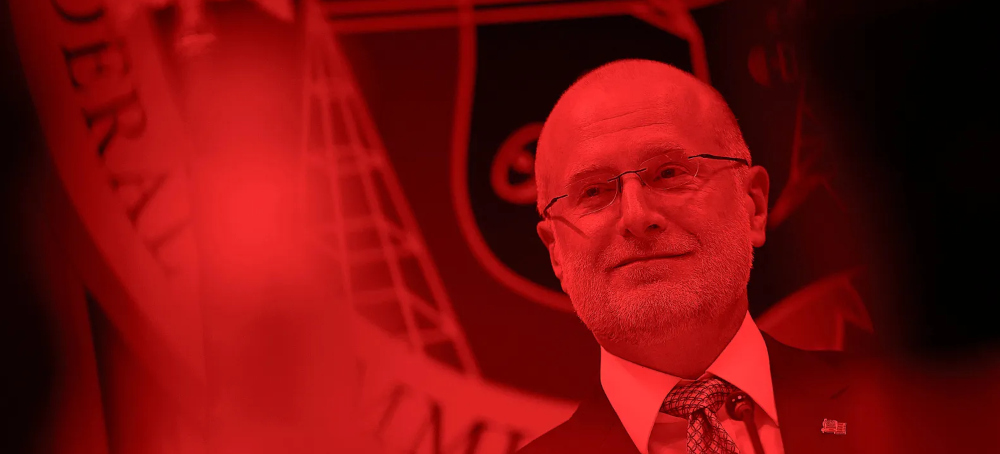 FCC Chair Brendan Carr. (photo: Kevin Dietsch/Getty)
The man leading Trump’s media vendetta is a brown-nosing bureaucrat. And that’s what makes him dangerous
Why was Carr afforded such an honor — after throwing out the ceremonial first pitch, no less? Because the Yankees’ broadcast network, YES, was at that moment in a long-running dispute with Comcast, who wanted to charge fans more to watch the games. Carr, a fierce critic of Comcast’s “DEI” policies, had decided to side with the Yankees, whose executives are close to Donald Trump. In his half-inning interview, Carr came across as bland and amiable, a nice enough guy with no obvious reason for being there. But his being there was the point.
No other FCC chair in memory would have so brazenly thrown around his influence or so publicly basked in the sucking-up. (Hell, there aren’t any FCC chairs in memory; you probably couldn’t name another one if I gave you pictures.) But unlike his predecessors, Carr isn’t just another corporate lawyer concerned with the business of licensing spectrum and averse to policing speech. He is a cultural claims adjuster, a pasty-faced, soft-spoken agent of Trump’s retribution.
If you were going to single out the most dangerous functionary in Trump’s little circle of Hell, you’d have plenty of candidates from which to choose: Stephen Miller, Kristi Noem, Pam Bondi. But don’t sleep on Brendan Carr. His legacy of awfulness may yet prove more durable.
Just this week, after Trump attacked the news media for its reporting on Iran, Carr immediately logged into his X account and threatened to revoke the licenses of the broadcast networks if they didn’t stop with their “hoaxes and news distortions.” His post — which sounded almost like an imitation of the boss, right down to the concluding exclamation point — earned him a public attaboy from Trump, who raised the startling possibility of prosecuting networks for treason.
Carr wouldn’t need much convincing. In addition to investigating networks for diversity policies and “news distortion,” Carr has expanded the FCC’s “equal time” doctrine to morning and late-night shows, threatening action if they interview Democrats. He blessed Skydance’s deal to buy Paramount, the parent company of CBS, only after the company agreed to rid its news of liberal bias, and he pressured ABC into temporarily taking Jimmy Kimmel off the air. (“We can do this the easy way or the hard way,” Carr said then, parroting every bad mobster movie ever made.) He has threatened networks that continue to edit their interviews — a practice previously known as “journalism.”
More recently, Carr has been laying down edicts for how American news media should celebrate the nation’s 250th birthday. He “suggests” that TV stations start the day with the “Star Spangled Banner” or the Pledge of Allegiance and feature “pro-America content” that “promotes civic education, national pride, and our shared history.” It’s like someone asked Claude to write a North Korean communiqué.
Inevitably, Carr’s crackdown on news outlets and tech platforms has drawn comparisons to some of history’s notorious repressive movements, including the most notorious of them all: the Third Reich. After the Kimmel dustup, Ty Cobb, one of Trump’s former lawyers, noted that the Nazis removed comedians from the airwaves in 1939. The satirist Gene Weingarten titled a Substack post: “Goebbels Drives a Carr.”
Personally, I’ve never gone in for Nazi comparisons in our politics. I heard a lot of it during the George W. Bush years, and it always struck me as hysterical. I certainly don’t think Carr is an American Goebbels. I’ve seen no evidence of his being that cruel or that sophisticated.
No, the only Nazi Carr brings to mind for me is an entirely fictional one — specifically, Golo Thomsen, the protagonist of Martin Amis’ brilliant novel The Zone of Interest. (You may have seen the haunting movie adaptation, which is very loosely based on the book.) Thomsen, a Nazi officer at Auschwitz, has no particular zeal for killing Jews and gives very little thought to the butchery all around him. Rather, his chief obsession (at least until he falls in love with the commandant’s wife) is to impress the boss and get himself transferred to a better post.
This was Amis’ entire point — that the basest forms of repression are mostly the province of insecure bureaucrats. His Thomsen isn’t a monster. He’s a careerist.
In the years immediately after the pandemic, when Carr was merely an FCC member, he championed the role of political satire and called it “one of the oldest and most important forms of free speech.” In 2021, responding to leftist pressure on the media, Carr said in a press release: “A newsroom’s decision about what stories to cover and how to frame them should be beyond the reach of any government official, not targeted by them.” He was, of course, 100 percent correct.
But then Carr was drafted to write a section of what became “Project 2025,” and soon he had become a rising officer in Trump’s regime of petty vengeance. He played the enforcer as the boss collected cash payments from ABC and CBS, “settlements” for lawsuits so obviously frivolous that no judge in America would have seen them to trial. (Well, maybe Aileen Cannon.) Carr seems to like all the attention. Like Golo Thomsen, he’s aping the big boss, echoing his grievances, angling for praise. If a few late-night shows get neutered in the process, then they deserved it anyway.
Carr isn’t trying to plunge American media into the dark void of statist suppression. But you know — he’s not not trying, either.
I’ve always been sympathetic — more so than most of my colleagues, anyway — to the longstanding conservative critique of mainstream media. (I’m old enough to remember the bumper sticker from 1988: “Annoy the media, elect Bush.”) Despite all the whining among Democrats about “bothsidesism” and “false equivalency” (dumb clichés that make my teeth hurt), the truth is that newsrooms have always been culturally and reflexively leftist. By and large, we grew up in the same cities, graduated from the same schools, absorbed the same orthodoxies.
Maybe that’s why we did such a shameful job, as an industry, in defending free speech at the height of what came to be called “cancel culture.” Too many careers were thoughtlessly ruined because virtually no one on the left — news outlets, universities, the ACLU — was willing to stand by the most basic principles of free expression if it meant you might get called racist or sexist and sent off to sensitivity training. This was Trump’s strongest indictment of the left, and of the media specifically, and it played no small part in enabling him to come roaring back from political purgatory.
But here’s what we’ve learned about Trump and his movement since then (not that it comes as any great shocker): no one on their side actually gives a goddamn about the First Amendment, either. The administration’s badgering of universities over “free expression” turns out to be little more than terror campaign aimed at punishing dissent. The Justice Department recently searched the home of a Washington Post reporter so it could seize her notes, which until now had only happened in totalitarian states. In the past year, Trump has personally steered no less than three major media businesses into the hands of his billionaire friends Larry and David Ellison, while repeatedly pressuring news outlets to fire journalists he doesn’t like.
Richard Nixon famously warned, at the apex of the Watergate scandal, that Washington Post owner Katherine Graham would get her “tit caught in a wringer.” Compared to Trump, he’s Thomas Jefferson.
No one embodies this duplicity — or enables it — as nicely as Brendan Carr. His rhetoric is all about ensuring a “diversity of viewpoints.” He holds himself out as an honest broker in search of a more balanced media. Which would be fine, except that Carr isn’t really interested in anything resembling balance or a free market for news; he’s interested in smashing the whole thing to pieces and letting a more docile and expedient group of executives pick through the shards. The only core freedom that energizes Carr is the freedom to please his boss.
And in this way, Carr also embodies something common to authoritarian regimes everywhere. It’s never the grand theorists or soaring orators who make government repression a daily reality. It’s the mild bureaucrats who execute the agenda, whose unexamined loyalty and neediness blind them to consequence, who make statism seem pedestrian. When all the independent thinkers have made their dash for the exits, it’s the Brendan Carrs of the world of the world, cosplayers in the costume of extremism, who stay at their posts and file their reports, eyeing the next promotion.
Like Martin Amis’ lieutenant, Carr is ambitious, and he is shrewd, and he is malleable. History knows of no combination more dangerous.