Bolivia’s Social Movements Mobilize Against Privatization
Olivia Arigho-Stiles Jacobin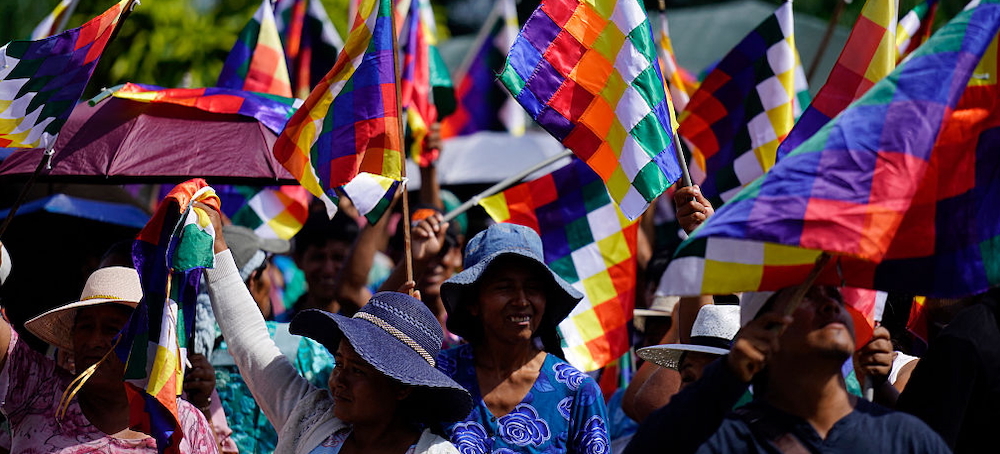 Indigenous movements in Bolivia are mobilizing against a land rights law, which they fear could be setting into motion the dissolution of their collective lands. (photo: Pablo Rivera/AFP/Getty Images)
In Bolivia, the unions representing miners and peasants have declared an indefinite strike, seeking the resignation of President Rodrigo Paz. They are protesting a new law that undermines peasant and indigenous land rights.
Marching for over twenty days from the tropics into freezing high-altitude terrain, many wearing nothing more substantial on their feet than plastic sandals, land workers and indigenous representatives arrived in the capital of La Paz this week to defend their territories. They were met by the miners’ union, the Federación Sindical de Trabajadores Mineros de Bolivia (FSTMB), and highland representatives from the peasant union, the Confederación Sindical Única de Trabajadores Campesinos de Bolivia (CSUTCB), in a loud welcome rally of solidarity on Monday.
“With valor, with courage, we have arrived here sisters, arriba las mujeres!” declared Miriam Palomeque, the head of the federation of women peasants in Beni, at the rally.
The marchers are from northern Amazonian territories of Beni and Pando and are protesting the new Law 1720, which will transform land rights in Bolivia and could herald the end of the plurinational model of land distribution that safeguards indigenous and peasant land holdings.
The march has been grueling. Many marchers suffered from dehydration and exhaustion; at least fifty indigenous marchers from the delegation of the Central of Ethnic Mojeño Peoples of Beni (CPMB) required medical treatment last week.
At a public meeting in La Paz this week, representative of the marchers and peasant union leader Oscar Cardozo declared, “Our life is collective, not individual. The land must be respected; it’s not for sale.”
Meanwhile, social unrest is rising in Bolivia. Road blockades have convulsed the country as social movements protest Law 1720, with the Central Obrera Boliviana (COB) and the CSUTCB this week declaring an indefinite strike until President Rodrigo Paz resigns. On Wednesday, representatives of ten of the country’s umbrella organizations signed an interinstitutional “Agreement of Unity and Loyalty” stating their aim to bring down the government.
Law 1720: Privatization Through the Back Door?
Law 1720 is the latest in a long-standing tendency in Bolivia toward the intensification of land inequalities with a view to benefiting large-scale agribusiness. Law 1720 supposedly benefits small-scale farmers by enabling them to convert their smallholdings into “medium-size” businesses and therefore to obtain mortgages. But in reality, Law 1720 sets a precedent for the encroachment on territories and communities by corporate interests.
The march is spearheaded by peasant organizations in Bolivia’s Pando and Beni departments. On the front line of the expanding agrarian frontier in the Amazon, these communities are more vulnerable to the growing reach of transnational agribusiness in this biodiverse region. “We have to protect our natural resources,” declared Pando CSUTCB leader Faifer Cuajera at the rally this week.
Roger Adan Chambi, an Aymara lawyer and specialist in indigenous land law, told Jacobin:
From the very beginning of Paz’s administration, his position was one of alliance with agribusiness, neglecting the popular sectors that had supported his rise to the presidency. Consistent with this capitulation, the government passed Law 1720 without consulting the sectors it was supposed to benefit (peasants and small producers), jeopardizing legal security and constitutional guarantees regarding land ownership.
“Far from being an opportunity for small producers to access credit, this law weakens the property rights of peasants and indigenous communities, especially those resisting on the agricultural frontier,” Chambi added. “Structural insecurity and the lack of basic services will, in the future, force them to mortgage or sell their plots, facilitating dispossession and the transfer of land to corporations.”
In the past decade, the Bolivian economy has virtually collapsed in the absence of rents from hydrocarbons and the failed promise of lithium. Law 1720 suggests that agrarian extractivism is the government’s preferred way out of this structural crisis and will be complemented by the broader package of extractive policies being adopted by the government, including gas extraction in the national reserve of Tariquía.
The law underscores intensifying land inequalities in Bolivia that are pushing indigenous communities to the brink. Many big landowners in the east received large titles of land as political favors — such as the oligarch Branko Marinković, who was awarded thirty-three thousand hectares of land under Jeanine Áñez’s short-lived dictatorship in 2020. Marinković, who is a senator for the department of Santa Cruz, is one of the proponents of the law. It was passed without any consultation with grassroots organizations or the communities in question, in violation of Article 30 of the Political Constitution of the State. As one of the marchers declared at the public meeting on Tuesday, “The people are not consulted, [and so] the people rise up!”
Wilfredo Plata, a researcher at the organization Fundación Tierra, told Jacobin, “The impact will be a more acute land market, especially in the lowlands of the east, where the growth of large landholdings, at the expense of smallholdings transformed into medium-sized properties, could be enormous.” He continued:
This law is based on linking credit to land for small landowners, who are mostly located in the Altiplano (highland) and valleys region. Rather, if the goal is to incentivize small-scale agriculture, the state should complement programs that provide more effective access to credit, but without making it conditional on land ownership. An alternative model could be precisely to promote a revitalized agriculture by giving peasant producers in the Altiplano and valleys the role of producing pharmaceutical-grade food.
Small subsistence farms are the foundation of indigenous and peasant life in rural Bolivia, providing food for local communities and cultivating the land in ways more ecologically enriching than large-scale farming, which makes extensive use of pesticides and monoculture practices. Furthermore, as peasant leader Oscar Cardozo pointed out, small-scale farms are intimately tied to indigenous visions of the cosmos and ways of life in which the natural world and agrarian cycles feature prominently.
Attempts by agribusiness to circumvent laws aimed at protecting small indigenous and peasant producers are nothing new. A notable tactic employed by large landowners is to manipulate agrarian records to state that the land is a smallholding owned by a small-scale “front person,” when in fact, it has been subdivided into plots and is owned by one large landowner. Moreover, much of this land has been acquired over several years without due process, such as during the dictatorship of Áñez. In other words, indigenous and peasant smallholders will likely lose out as Law 1720 will enable agribusiness to consolidate its control over territory.
“Law 1720 will transform land rights in Bolivia and could herald the end of the plurinational model of land distribution that safeguards indigenous and peasant land.”
Indigenous movements are also mobilizing because they fear the next step could be the dissolution of Tierras Comunitarias de Origen (TCOs) or indigenous collective lands, which are communally held and cannot be individualized. They are worried that the entire plurinational framework of Bolivian land stewardship is in question. For centuries, land and territory has been at the heart of social inequalities in Latin America. In 1953, as part of the peasant- and worker-led Bolivian National Revolution, the revolutionary government implemented an agrarian reform that dissolved the haciendas of the highlands, where quasi-feudal social relations had predominated, and redistributed land to indigenous peasants. However, over the course of the late twentieth century, land inequalities in the east intensified, as major landowners amassed large properties under the dictatorships of the 1960s and ’70s. In 2006, under Evo Morales, another major agrarian reform was passed that aimed to redistribute land from large landowners to indigenous peasants, with the purpose of boosting “productive” use of land by smallholders and giving them legal titles to land. The priority of the plurinational state was therefore to shift power away from oligarchs and toward indigenous and peasant producers.
Proponents of Law 1720 say that access to commercial mortgages will help small-scale farmers, but as Fundación Tierra points out, access to credit is not the only problem facing small farmers, and obtaining credit should not be dependent on being a “medium-size” property. Plus, many small farmers lack the ability to pay mortgages, so the law could lead to higher levels of indebtedness. Wildfires, poor soil quality, access to water, and climate change are major threats to Bolivian rural life, for example, none of which are addressed by the law.
Social Movements Beyond the MAS
The march this week was an unusual sight in Bolivia, in that it represents an impressive show of force from social movements in lowland and Amazonian territories. Historically, the highlands of Bolivia have produced the more visible peasant resistance movements, with a long history of miner and peasant mobilization and highly organized social movements.
However, in 1990, the famous March for Territory and Dignity, organized by the lowland indigenous groups, catapulted indigenous Amazonian peoples into the limelight and forced the government to introduce new agrarian reforms. Could the march this week do something similar?
In recent years, Bolivia’s social movements have been paralyzed by acrimonious internal conflict, a process that began under the later years of the Movement for Socialism (MAS) as dynamics of co-optation and clientelism took hold. Movements such as the CSUTCB have been de facto split down the middle, with factions loyal to ex-President Evo Morales and those to the former President Luis Arce in bitter conflict, for example. The highland indigenous organization, the National Council of Ayllus and Markas of Qullasuyu (CONAMAQ), was noticeably absent from the rally this week, indicative of a continued disarticulation of social movements in the post-MAS era.
The CSUTCB has historically been a bastion of resistance, such as against the dictatorship of Jeanine Áñez in 2020. Earlier this year in January, the CSUTCB joined forces with the trade union federation, the Central Obrera Boliviana, which is dominated by the miners’ union, the FTMSB, to protest the neoliberal decree 5503. This decree would have removed the fuel subsidy that keeps petrol prices artificially low; it also would have introduced a wide range of measures such as allowing the central bank to approve potentially high-risk financial programs, and a fast-track process for approving extractive projects by foreign companies without legislative approval. The impressive mobilization, which forced the government to concede, led many to speculate whether social movements were entering a new period of recalibration and restructuring post-MAS. This latest mobilization by lowland indigenous and peasant movements additionally suggests new patterns of resistance are emerging.
Where Next?
To add to President Paz’s woes, Bolivia is embroiled in a protracted diesel crisis. The transport workers’ unions have repeatedly called blockades and strikes because of poor-quality diesel that is damaging vehicles. The government has failed to ensure the supply of diesel, in part due to the absence of foreign reserves in the country, which makes imports more expensive.
The CSUTCB and the COB are calling for Paz’s resignation, but the problem remains that there is little viable political alternative to the Right. The MAS does not meaningfully exist any longer, having been wiped out in the national elections last year. The municipal elections this March saw a dreary array of right-wing candidates on the ballot with little presence of left-wing or progressive sectors. Paz was elected last year in a contest against the extreme right-wing business mogul Jorge Fernando “Tuto” Quiroga and appeared to be the more palatable option for voters, winning a victory driven largely by popular sectors. But a viable progressive electoral project does not exist at this current juncture.
The protesters from the Amazon marched for life, dignity, and legal safeguards for their ancestral territories. As they join forces with other powerful social movements, it looks like progressive forces in Bolivia once more could force the right wing into retreat.