Big Tech Firms Want to Pay You to Power Their Data Centers
Michael J. Coren The Washington Post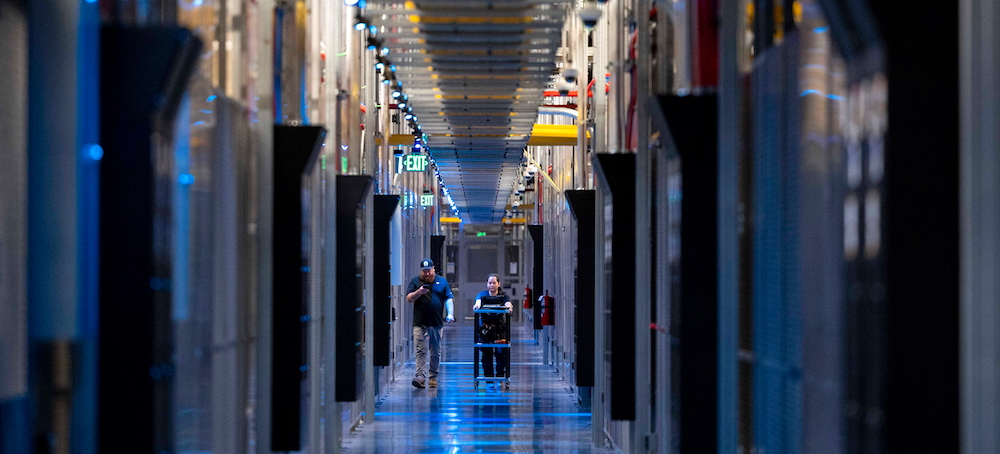 People walk through the hallways at a data center. (photo: Amanda Andrade-Rhoades/WP/Getty Images)
The most overlooked U.S. power plant isn’t a gas turbine or solar farm. It’s your house (and thousands of others), and firms are paying to use them to power data centers.
Tech companies are locked into a race to build artificial intelligence that comes down to speed and scale. AI infrastructure such as data centers, some argue, plays the role that railroads and canals did in the 19th century: The first firms to dominate will control the era’s most transformative technology. Tech giants are expected to pour about $2.7 trillion into data centers and AI infrastructure in the United States by 2030, McKinsey estimates, more than one Manhattan Project every month, in inflation‑adjusted terms.
All that new equipment needs more electricity than the grid can deliver.
Google, Meta and others have resorted to modified jet engines, diesel generators and rebooting nuclear and coal plants to power their data centers, while asking electric utilities for grid upgrades. That’s contributing to rising electricity prices, up 42 percent since 2020.
Your home offers another solution to the energy shortage. The concept is simple. When thousands of homes are coordinated together by software into what are known as distributed or virtual power plants (VPPs), they can deliver or free up a power plant’s worth of electricity for the grid by dialing down consumption from smart appliances like electric water heaters or dispatching electricity from home batteries. This approach can bring hundreds of megawatts online in months, not the years it can take to build a new power plant.
Transmission lines move electricity through space to where it’s needed. VPPs deliver power the moment it’s needed most. The grid tends to run at half capacity, because it’s built for peak demand, so storing cheap off-peak power and discharging it when demand spikes effectively creates new capacity. Home batteries can recharge later using cheap power — often wind and solar — as demand ebbs.
Last July, the largest residential test in U.S. history delivered 535 MW in California, enough to power half of San Francisco for two hours, from more than 100,000 home batteries in California. Building equivalent capacity from natural gas plants would cost twice as much, estimates the U.S. Department of Energy.
Powering AI from your backyard
All the new electricity that data centers will demand — likely 60 to 100 gigawatts by the early 2030s — could theoretically come from upgrading homes with smart appliances, heat pumps and batteries and operating them as VPPs, argues Rewiring America, a nonprofit dedicated to electrification. Residential electricity prices would drop at the same time, it calculates.
To make that scenario real, data center investments would need to invest in homeowners, not just new power plants. It’s already starting to happen.
Last month, Google announced that its new Minnesota data center will help fund thousands of small, utility-owned batteries for homes and businesses across Minnesota, a VPP that will be part of 1,900 megawatts of new clean energy capacity powering the facility.
“We’re seeing a direct line of sight between a company building a data center and investment in infrastructure in people’s homes and businesses,” said Mark Dyson of the clean energy think tank RMI, who co-authored a report on how household upgrades can power data centers. “VPPs have been waiting around for a pile of cash and a crisis, and now we have both.”
In Texas, the money is already flowing.
The need for VPP speed
Austin start-up Base Power has a deal for Texas homeowners: Let us install a home battery in your backyard, and we’ll cut your electricity rates by up to 15 percent. The company charges a monthly fee of roughly $20 and a one-time installation charge. During outages, the 50-kilowatt-hour battery, equivalent to that in a small to medium electric vehicles, can power a home for up to 48 hours.
When Base Power becomes a home’s electricity supplier, it can offer reduced rates and a battery worth more than $10,000 because it makes money by selling the battery’s power back to the grid at peak hours, says Zach Dell, its CEO and co-founder.
So far, the company has deployed about 300 megawatt hours of battery capacity to over 10,000 homes. It plans to triple installations this year, including by installing batteries into newly built homes. Power demand from data centers in Texas is forecast to exceed 40 gigawatts by 2028 — enough to power 28 million homes.
“For a utility, that’s way faster than you could ever build a gas plant,” said Dell, son of billionaire Michael Dell, founder of Dell Technologies. “A lot of utilities are seeing thousands of megawatts of demand in the form of data centers … Soon, we can do that in a quarter or two, and we can do it for 20 percent cheaper than existing technology.”
Texas, and its freewheeling deregulated electricity market, is home to much of the experimentation with VPPs. Nick Chaset, CEO of Octopus Energy U.S., which has about 25,000 customers, plans to launch in the state with a similar model in the next year or so while “actively discussing” partnerships with multiple data center developers.
Tesla has already enrolled homeowners with its Powerwall batteries into a Texas VPP of its own. SunRun, a leading residential solar and battery storage company, said its 237,000 storage customers in Texas and across the U.S. supply roughly 4 gigawatt-hours of flexible, dispatchable storage capacity. They dispatched power to the grid more than 1,300 times last year, Mary Powell, SunRun’s chief executive wrote this month, in total providing enough to power 15 million homes for one hour. The company is now pairing home batteries with more than 70 percent of its solar installations.
As electricity rates rise, most regions of the U.S. are adopting time-of-use rates and other market mechanisms that make VPPs more economical. California, Texas and parts of New England run the most established VPP programs, but a total of 35 states and the District of Columbia took steps last year to tap distributed energy sources such as homes for grid capacity.
“The market will prove out whether this works or not,” said RMI’s Dyson.
Where can I plug in?
More opportunities are on the way.
Politicians, spooked by angry ratepayers, are demanding data center developers pay their own way. This month, top AI executives from Google, Meta, Microsoft and OpenAI filed into the White House to sign a voluntary “ratepayer protection pledge” promising to absorb energy costs tied to their data centers rather than passing them on to ratepayers. (The Washington Post has a content partnership with OpenAI.)
In the first six weeks of 2026, states filed more than 300 bills related to data centers. New York’s Homegrown Energy Act, if passed, would require massive data center developers to offset their electricity demand by funding household electrification and efficiency measures like heat pumps, rooftop solar and battery storage. Illinois’ POWER Act would require large data center developers to secure clean energy and pay for the grid infrastructure to meet their demand, explicitly encouraging renewables paired with storage.
But you don’t need to wait for politicians. Most states let you plug in today.