Battleground Republicans Are Starting to Worry About the Senate
Erin Doherty, Lisa Kashinsky Politico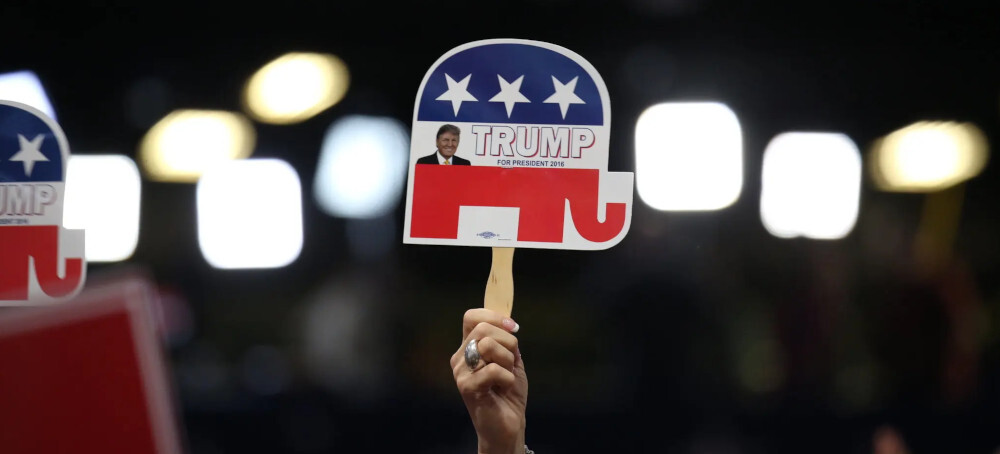 The Republican Party has found itself in an awkward bind because of President Trump’s decision to move the location of his convention speech. (photo: Damon Winter/The New York Times)
Democrats still face serious challenges to flipping the chamber. But Republicans are no longer dismissing the threat as quickly as they once did.
Democrats still face steep odds in their bid to flip the chamber, but interviews with nearly two dozen GOP operatives, party chairs and strategists across the country’s battlegrounds found a persistent concern that the longer the Iran war drags on and the economy sputters, the more it could complicate their path to keeping their majority in November.
“Momentum has shifted to Democrats,” said Michigan-based GOP strategist Jason Roe.
“Republicans have the best candidates that they’ve had in a long time but are facing serious headwinds,” said New Hampshire GOP strategist Mike Dennehy.
“I wouldn’t say I feel warm and fuzzy about things right now,” said a Georgia Republican operative, granted anonymity to speak about party strategy, like others in this story.
The Senate wasn’t initially expected to be a concern for Republicans.
Even as typical midterm dynamics often dog the party in power, this year’s map strongly favored Republicans. Democrats need to hold onto all their seats — including defending Sen. Jon Ossoff in Georgia and an open seat in Michigan, states Trump won in 2024 — while flipping four Republican-held ones.
But Republicans across key Senate battlegrounds said that Democrats have fielded strong candidates, and a tough national environment — fueled by voter anxiety over rising costs and the ongoing Iran war — has made their path much more difficult than it once appeared.
Roe, an occasional Trump critic, warned of high gas prices as a result of the ongoing conflict in Iran angering Americans. Dennehy says things can turn around if “Trump shifts dramatically to improve his standing with voters.” The Georgia operative called a prolonged war “the exact opposite of what Senate Republicans need right now.”
“They do still have an uphill battle,” Roe said of the Democrats’ hopes for a majority, “but when you look at what the map looks like today and what we thought it would look like a few months ago, it’s very different.”
The Iran war and affordability
Republicans aren’t in full panic mode yet. Most don’t expect the war to stretch much longer and say there is plenty of time for financial pressures to ease before November — and for voters to start feeling economic relief.
“If combat operations are over in the summer, there’s plenty of time for the dislocation of gasoline prices, which I think is really the primary concern here. I think that will return to normal,” said a second Georgia-based GOP operative.
Uneasy Republicans breathed a sigh of relief after Iran’s announcement Friday that it was reopening the Strait of Hormuz for the remainder of a ceasefire between Israel and Lebanon, sending oil prices plummeting. But on Saturday, Iran’s military said it closed the strait again and that it will stay that way unless the U.S. lifts its blockade of Iranian ports, underscoring the fragile state of talks.
Negotiations to end the war remain tenuous, and economic experts warn that high gas prices are baked in for at least several more months as the global economy reels from the conflict. Republicans are also eager for Trump to refocus on the administration’s wins rather than the ongoing conflict or other possible distractions.
One Iowa-based strategist gave the White House’s midterms strategy a “C” rating so far, reflecting a frustration among some Republicans with the White House.
“They say the right things strategically, and then they don’t execute them where you want them to be better,” the strategist said.
The White House said Trump is focused both on Americans’ economic concerns and resolving the ongoing conflict in Iran. “While the U.S. Military and the President’s diplomatic team continue to make progress towards securing a deal with Iran and resolving temporary disruptions in energy markets, the rest of the Administration have never lost focus on implementing the President’s affordability and growth agenda on the home front,” spokesperson Kush Desai said in a statement.
“Once short-term disruptions from Operation Epic Fury are fully behind us,” he said, “Americans can count on more economic progress in store thanks to this Administration.”
Candidate recruitment and messy primaries have shifted the map
Republicans were seeing some cracks in their best-case-scenario map even before the war began.
Party operatives were originally bullish about holding North Carolina and Ohio and flipping Georgia. Then, Sen. Thom Tillis (R-N.C.) announced his retirement, leaving an open seat in a key battleground state. Republicans nominated former RNC Chair Michael Whatley, and Democrats countered with former Gov. Roy Cooper, who has wide name recognition and strong fundraising chops.
“This is a pretty close state, and it’s a close race,” said a GOP operative in the state. “But with the national environment looking as tough as it is right now for Republicans, and you already have an established governor like Roy Cooper, that’s why I think he’s got the advantage.”
Democrats scored another recruiting win in former Ohio Sen. Sherrod Brown, another prolific fundraiser. Early public polling shows the three-term former senator running neck and neck with GOP Sen. Jon Husted, who was appointed to fill the vacancy left by JD Vance’s ascension to the vice presidency and suffers from lower name recognition than is typical for an incumbent.
“I think we’re back in 2018 where the headwinds were against Republicans,” said former Ohio Republican Rep. Jim Renacci, who unsuccessfully challenged Brown that year. “I mean, I ran against Sherrod Brown in 2018 and the national electorate was about a D plus 6 to 8. I think we’re getting about that same place in Ohio.”
In Georgia, a messy three-way GOP primary has Republicans increasingly uneasy about their prospects against Democratic Sen. Jon Ossoff, who has amassed a massive war chest.
“Republicans really need to unify behind one candidate to beat Jon Ossoff,” Iowa-based GOP strategist Morgan Bonwell said. “I don’t think they can continue, or afford to continue, beating each other up.”
The National Republican Senatorial Committee said the Democrats in North Carolina, Ohio and Georgia are “wolves in sheep’s clothing who will obediently carry water for Democrats’ increasingly radical agenda.” The NRSC also attacked Democratic candidates’ records on crime, immigration and the economy.
As some states become more competitive, Republicans are growing more focused on flipping Michigan. They argue former GOP Rep. Mike Rogers, who narrowly lost to Sen. Elissa Slotkin in 2024, is running a stronger campaign this time and will benefit from the three-way car crash of a primary on the Democratic side.
But Republicans who’ve watched Democrats overperform in a series of special elections are also starting to sweat about turnout — even in states they’re more confident in winning. Several state and local GOP party chairs told POLITICO the party has to stay laser-focused on keeping Trump voters engaged without the president on the ballot.
“What we have to focus on here in Michigan — and I’m sure all the chairs are doing this across the nation — is really putting a strategy in place to turn out the Republican vote,” said Michigan Republican Party Chair Jim Runestad. “That will be the deciding factor.”