Atrocities Against Civilians in Sudan Require World’s Attention, UN Says
Nick Cumming-Bruce The New York Times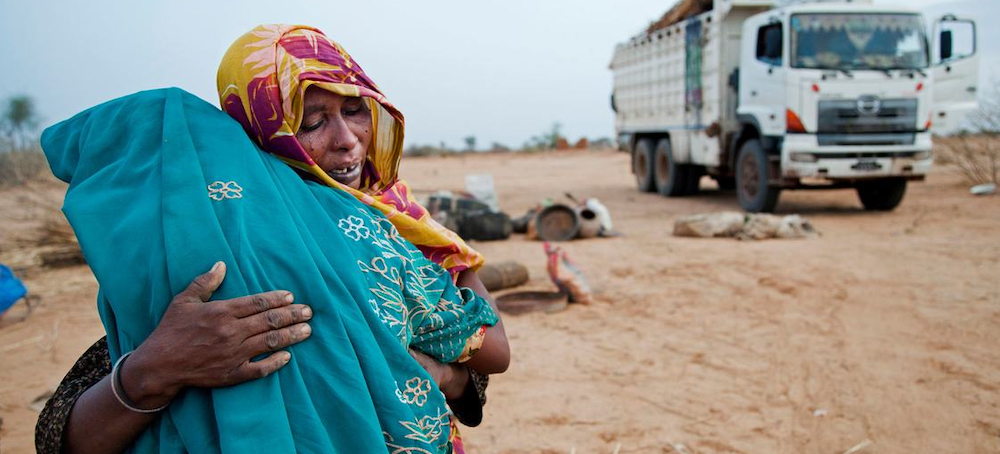 People continue to be displaced by conflict in Sudan. (photo: Albert González Farran/UN)
The United Nations’ top human rights body ordered an inquiry into mass killings and sexual violence during the country’s worsening civil war.
The warnings came during a special session of the United Nations Human Rights Council in Geneva that ordered an investigation into mass killings and sexual violence in El Fasher, a city in Sudan’s western Darfur region that fell last month to a paramilitary group battling Sudan’s military.
The group, known as the Rapid Support Forces, or R.S.F., overran El Fasher last month after an 18-month siege and heavy bombardment that killed many civilians and reduced the population to starvation.
“They were foreseen and preventable, but they were not prevented,” Volker Türk, the U.N. human rights chief, said of the atrocities. “There has been too much pretense and performance and too little action.”
The session of the Human Rights Council, which is the United Nations’ top human rights body, coincided with reports of escalating hostilities in Kordofan, a region of Sudan where R.S.F. forces, after consolidating their hold on Darfur, now appear focused on taking the offensive against the Sudanese military in the center of the country.
“All the signs are there,” Mr. Türk told the council. “Bombardments, blockades, people forced from their homes, a despicable disregard for civilian lives.”
On Friday, the council mandated a U.N. fact-finding mission that is already working on the crisis in Sudan to identify those responsible for the atrocities that occurred when the R.S.F. took over El Fasher.
The decision was part of a resolution that condemned widespread, ethnically motivated killings, rape, torture and large-scale atrocities during the conflict, including the reported massacre by the R.S.F. of 460 people sheltering in a maternity hospital.
“Much of El Fasher is now a crime scene,” Mona Rishmawi, a member of the U.N. fact-finding mission, told the council, which heard from experts who cited testimony from survivors of the conflict. Ms. Rishmawi also said the mission was investigating similar tactics in Kordofan, “where civilians are encircled, aid is blocked, and starvation is beginning to emerge — risking another El Fasher.”
The council adopted the resolution on Friday without a vote, despite objections from Sudan on key parts of it.
Hassan Hamid Hassan, the Sudanese ambassador to the U.N. office in Geneva, welcomed condemnation of the R.S.F. But he previously opposed the creation of the fact-finding mission, which is investigating abuses by all parties to the conflict — including Sudan’s military, the Sudanese Armed Forces.
The resolution adopted on Friday urged an immediate cease-fire and access for humanitarian aid to tackle what is now the world’s worst humanitarian crisis, after over two years of civil war that have displaced 14 million people and left close to 400,000 facing famine, according to the U.N.
The resolution also condemned “all forms of external interference that fuels the conflict,” but human rights advocacy groups criticized the lack of any explicit reference to the United Arab Emirates, which has been accused of funneling weapons to the R.S.F.
“It was a missed opportunity to call them out,” said Hilary Power, a director for Human Rights Watch in Geneva.
The U.A.E. is a member of the so-called Quad group of countries, led by the United States, that is attempting to mediate in the war. It has dismissed allegations that it is supporting the R.S.F., despite intelligence and diplomatic assessments that it has sent weapons, drones and other forms of aid to the paramilitary group.
Jamal al Musharakh, the Emirati ambassador at the council in Geneva, said on Friday that the U.A.E. backed the creation of a civilian government in Sudan that was not led by either warring party. The international community should hold those responsible for atrocities to account “without exception,” he said.
Last week, the R.S.F. said it had agreed to a truce but there was no indication whether Sudan’s military would, as well. Sudanese military leaders previously said they would agree to a truce only if the R.S.F. laid down its arms.
Mr. Türk, the U.N. human rights chief, called for the U.N. Security Council to refer the crisis in Sudan to the International Criminal Court.
“All those involved in this conflict should know: We are watching you, and justice will prevail,” he said.
But Ms. Power, of Human Rights Watch, warned in a statement that the fact-finding mission was struggling with an acute shortage of funds and a lack of staff. It will be able to carry out its investigations only if U.N. member states sent more resources its way, she said.