At Iranian School Devastated by Airstrike, Grieving Families Say They Will Never Forget
Reza Sayah and Kasra Kamaei PBS News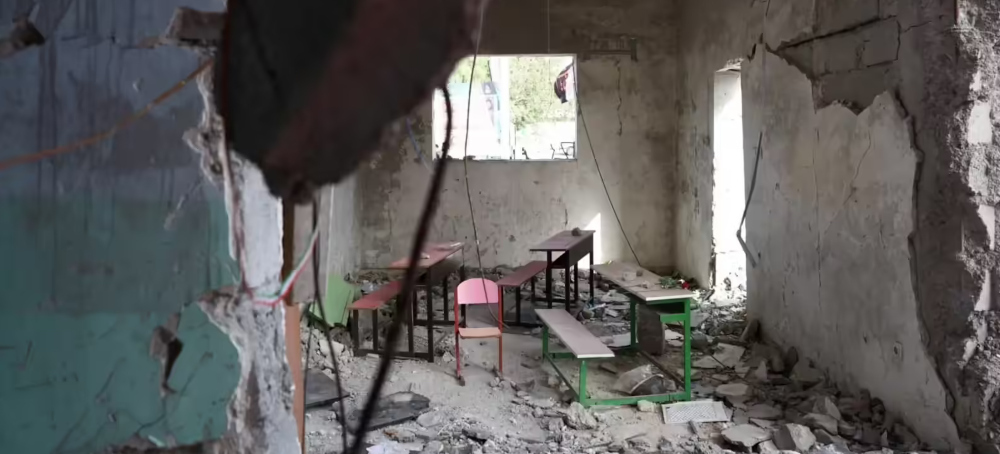 More than 150 people were killed when airstrikes hit the school in Minab, most of them children. And there is little dispute that the missiles were American-made. (photo: Reuters)
Read the Full Transcript
Notice: Transcripts are machine and human generated and lightly edited for accuracy. They may contain errors.
Geoff Bennett: The U.S. and Israel's air war with Iran has killed thousands since it started nearly three months ago. But few attacks have left a deeper mark than the strike on a school in Southern Iran on the war's opening day.
More than 150 people were killed when airstrikes hit the school in Minab, most of them children. And there is little dispute that the missiles were American-made.
Special correspondent Reza Sayah is the first American television journalist to report from the site, and he sent us this report.
Reza Sayah: Every night for more than 12 weeks, Asma Mogheirnin says she sits, prays and grieves in front of what's left of Shajarah Tayyebeh Elementary School.
Asma Mogheirnin, Minab, Iran, Resident (through interpreter): The sounds of children are still here for me. I can still hear them in my mind. Ever since this happened, my heart has been broken.
Reza Sayah: For Asma and the people of Minab, the grief and pain of what happened here still feels fresh, the elementary school believed to be hit by a U.S. Tomahawk missile strike on February 28, the day U.S. and Israeli forces attacked and started war with Iran.
Fazel Alinejead says he was working just a mile away when he heard the booming sounds of missiles hitting Minab.
Fazel Alinejead, Minab, Iran, Resident (through interpreter): It was the first explosion, second, third, fourth explosion. My nephew and I took out our phones and started filming.
Reza Sayah: This is what he shot. Fazel says he didn't know what was hit. He just raced towards the smoke until he arrived at the school.
Fazel Alinejead (through interpreter): The school building had collapsed. There was smoke coming from the windows. For a moment, I asked myself, maybe this is a dream. You're dreaming. Please, let this be a dream.
I looked on the ground, body parts, small body parts, hands, fingers, heads.
Reza Sayah: This is a satellite image of the two-story elementary school prior to the strike. Authorities here say two missiles fired minutes apart flattened half the building, burying children inside.
Fazel Alinejead (through interpreter): All I did was dig like a madman. My hands and fingernails were bleeding. All I did was dig, just in case -- I'm sorry -- just in case we find someone alive.
Reza Sayah: The Pentagon says what happened here is still under investigation, and the school was inside an active military base.
Jafar Karimi, Minab, Iran, Resident (through interpreter): It's not. That's a lie.
Reza Sayah: Jafar Karimi lives near the school. He and other residents say the area used to be a military facility, but that was more than a decade ago. The walled area that houses the school has a pharmacy, a cafe, and a cultural center, but no obvious signs of military facilities.
Jafar Karimi (through interpreter): The conclusion is clear. It's a school. America lies. Netanyahu lies. Their Arab allies lie.
Reza Sayah: Authorities here say among the 168 victims of this airstrike, 120 were students between the ages of 6 and 11. We don't have time to give you all of their names, but we're going to introduce you to some.
This young man is Sepehr Karimi. This young lady, proudly holding up her school certificate, is Motahareh Ahmadzadeh. This young lady is Attareh Zarei. This young lady is Khadijeh Darvishi. This little man, Mohammad Taha Jaffari. This young man with the big eyes, Hami Sadeghi. This young man is Mohammad Sadegh Gholami.
This young man is Ali Hafizi. This little man with a big smile is Amirhossein Jaffari. And here's another young lady proudly holding up her school certificate, Hannaneh Mehdi-Khah.
These are some of the adult victims, mostly teachers and some parents. Authorities say they recovered remains of every victim, except one, Makan Nasiri. But they're not giving up. Every night, volunteers carefully sift through crushed concrete, debris, and shred pages of notebooks, hoping to find Macan, even parts of him, for a proper burial.
This is another one of Minab's heartbreaking nightly rituals. This is the local cemetery here in the city of Minab. And this is where all the victims of the school bombing are buried. Every day at sunset, families of victims come to mourn their loved ones. They sit and pray. They light candles. They celebrate birthdays of loved ones no longer here.
This touch is how Abbas Mirani tells his son Arsha he misses him. But he's also honored that in his view, Arsha is a martyr.
Abbas Mirani (through interpreter): We had to sacrifice this blood for our country, for our people to understand no American soldier, no European or Western country will ever bring us peace and security. We knew this from the beginning, but when our children were martyred, our people woke up, our nation woke up.
Reza Sayah: Eleven-year-old Reyhandeh Mehdi Khah was at the school when the missile hit.
Reyhandeh Mehdi Khah (through interpreter): When they hit the school, the entire building shook from side to side. The windows shattered. Everything was shaking.
Reza Sayah: It was only by chance Reyhandeh was in this section of the building, the section that didn't collapse.
Reyhandeh Mehdi Khah (through interpreter): This part of my face was cut open in full of blood. The kids saw there was an opening we could go through, and I followed them. We were on the second floor. We climbed down over the debris until we got to the schoolyard.
Reza Sayah: Hours later, Reyhandeh learned that she had lost her little sister, a first grader at the school.
Reyhandeh says she has hate in her heart for what happened to her sister, but not for the American people.
Reyhandeh Mehdi Khah (through interpreter): It's just the government that's cruel and dirty. Most people in America are good. They know this is not right.
Reza Sayah: What's right, many here say, is to defend the honor of the children of Shajarah Tayyebeh Elementary School and continue the fight against the United States, the country they blame for what they call a crime they will never forget or forgive.
For the "PBS News Hour," I'm Reza Sayah in Minab, Iran.