As US Forces Close in on Venezuela, Lawmakers Warn of ‘Expanding’ Operation
Susannah George, Dan Lamothe and Amy B Wang The Washington Post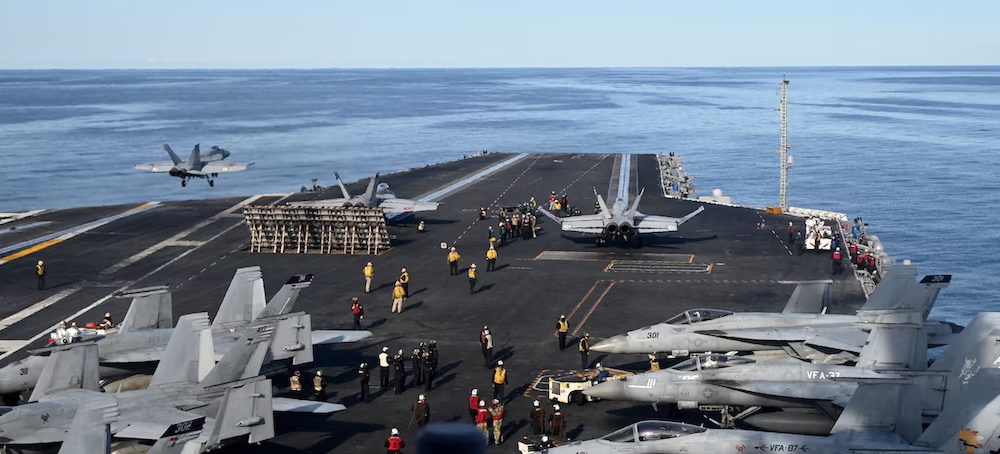 An F-18E fighter jet takes off from the aircraft carrier USS Gerald R. Ford in the North Sea last month. (photo: Jonathan Klein/AFP/Getty Images)
The Trump administration has sent warships, fighter jets and surveillance aircraft to the region as it wages what it says is armed conflict against narcoterrorists.
The aircraft carrier USS Gerald R. Ford and its associated warships are heading to the region, the Pentagon said Friday, a significant expansion of the U.S. presence.
The United States already has warships, an expeditionary Marines unit, drones, fighter planes and surveillance aircraft in the Caribbean and eastern Pacific. And on Sunday, the USS Gravely, a guided missile destroyer, docked in Port-of-Spain, the capital of Trinidad and Tobago, for joint exercises with the island nation’s military forces.
U.S. forces have blown up at least 10 boats in the region since the start of September, killing at least 43 people. The administration has accused the people of smuggling deadly drugs into the United States but has declined to provide evidence, drawing scrutiny from some lawmakers in Congress.
“So far, they have alleged that these people are drug dealers. No one’s said their name, no one’s said what evidence, no one’s said whether they’re armed, and we’ve had no evidence presented,” Sen. Rand Paul (R-Kentucky) said on “Fox News Sunday.”
Several of the strikes have been on vessels along a route used to ship marijuana and cocaine to Europe and West Africa. But, Paul said, drug smuggling and related crimes have “typically been something we do through law enforcement,” not the military. “So at this point, I would call them extrajudicial killings.”
The administration now appears to be expanding the campaign. After launching several strikes off South America’s Caribbean coast, U.S. forces Tuesday attacked vessels off South America’s Pacific coast. “The land is next,” President Donald Trump said Wednesday.
“They’ll be coming in by land a little bit more because they’re not coming in by boat anymore,” he told reporters. “And we will hit them very hard when they come in by land. And they haven’t experienced that yet. But now we’re totally prepared to do that.”
Trump has accused Venezuelan President Nicolás Maduro and the Tren de Aragua gang of trafficking drugs to the United States.
He has authorized the CIA to conduct missions inside Venezuela.
The administration informed Congress this month that the United States is fighting a war against “narcoterrorism.” Officials have tried to justify the use of force by designating drug smuggling cartels in Latin America terrorist organizations.
“I think President Trump’s made a decision that Maduro, the leader of Venezuela, is an indicted drug trafficker, that it’s time for him to go, that Venezuela and Colombia have been safe havens for narcoterrorists for too long,” Sen. Lindsey Graham (R-South Carolina) said Sunday on CBS’s “Face the Nation.”
He said the president told him on Saturday that he “plans to brief members of Congress when he gets back from Asia about future potential military operations against Venezuela and Colombia. So there will be a congressional briefing about a potential expanding from the sea to the land.”
This is what we know about the U.S. assets in the region and what they’re being used for.
Carrier Strike Group 12
The USS Gerald R. Ford and its associated warships have multiple offensive and defensive capabilities, including surveillance capacity that could be critical to an expanding operation.
The Ford is the world’s largest aircraft carrier. It typically carries dozens of fighter jets, helicopters and more than 4,000 sailors.
During recent stops in Europe, the Ford was accompanied by the destroyers USS Mahan, USS Winston S. Churchill and USS Bainbridge, but it wasn’t clear if those vessels would travel with it to the Caribbean.
Iwo Jima amphibious ready group
The Navy and Marine Corps have deployed a task force off the coast of Venezuela. A forward presence for Naval operations, it’s staffed by more than 4,500 sailors and Marines. The group includes guided missiles destroyers, an attack submarine, a Special Operations ship and reconnaissance aircraft.
Special Operations
The Pentagon has also deployed the MV Ocean Trader, a civilian ship converted into a floating base for Special Operations. The ship can serve as both barracks and command center for Special Operations forces in the area.
The 160th Special Operations Aviation Regiment, an elite helicopter unit that supports the world’s most dangerous missions, is also deployed in the area. “Little Bird” helicopters typically used by this unit were identified operating less than 90 miles from the coast of Venezuela this month by a Washington Post visual analysis.
A U.S. official told The Post the helicopters were engaged in training exercises that could serve as preparation for expanded conflict, including the possibility of missions inside Venezuela.
Troops
There were an estimated 10,000 U.S. sailors and Marines in the Caribbean, based on the ships announced or acknowledged by the Pentagon. The figure doesn’t include personnel in Puerto Rico, which probably make the total significantly higher.
Additional aircraft, including MQ-9 reaper drones and F-35 fighter jets, have been spotted at U.S. bases in Puerto Rico, according to images and reporting published by Reuters.