As the West Goes After Russia’s Oil Fleet, Moscow Fears for Its War Funding
Catherine Belton The Washington Post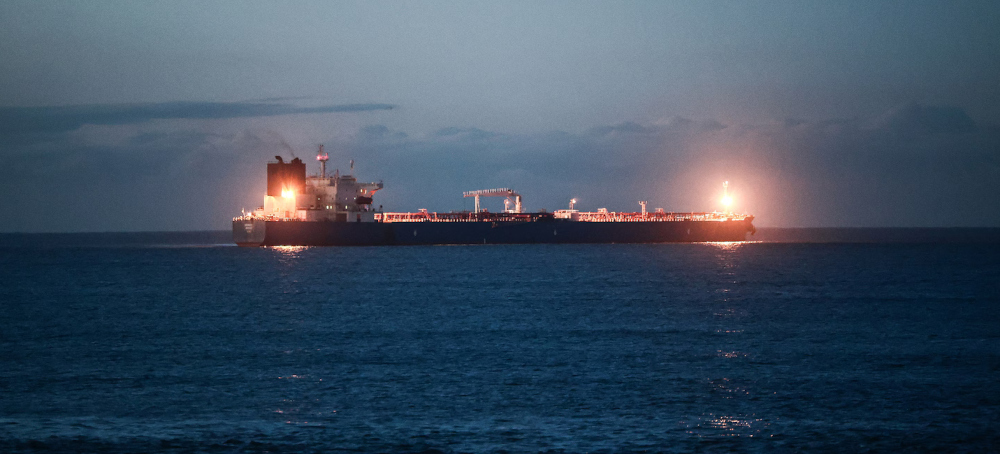 The oil tanker Grinch, suspected of belonging to Russia’s shadow fleet, near Marseille on Jan. 25, surveilled by the French navy. (photo: hibaud Moritz/Getty)
New European measures to crack down on Russia’s shadow fleet could severely hurt its economy at a time when it is looking increasingly vulnerable.
The European Union is considering imposing an outright maritime ban on services needed to ship Russian oil, such as insurance and transportation, as part of a new sanctions package marking four years of Russia’s war.
The ban would significantly ratchet up the sanctions imposed on Russian oil, replacing the current oil price cap system, and comes as 14 European nations including Britain, France and Germany warned last week they could intercept the shadowy fleet of tankers Russia created to help it evade sanctions operating in breach of international maritime law.
Russian oil revenue plummeted by 50 percent in January compared with the same month the previous year after tough new sanctions imposed by the U.S. Treasury on Russian oil majors Rosneft and Lukoil in October. The penalties forced Moscow to accept ever-steeper discounts of more than $20 per barrel for its oil. Combined with India’s apparent agreement to halt Russian oil purchases in favor of increased imports from the United States and potentially Venezuela, the measures threaten to further strain the resources Moscow needs to fuel its war machine, risking crisis as nonpayments grow across the economy.
Inspired by the seizure last month by U.S. forces of the Marinera tanker after a weeks-long pursuit despite a Russian submarine escort, the French navy briefly captured another suspected Russian shadow fleet tanker, the Grinch, which had been traveling from the Russian Arctic port of Murmansk across the Mediterranean carrying 730,000 barrels of oil under the flag of Comoros.
French President Emmanuel Macron said the vessel was subject to international sanctions and suspected of flying a false flag.
After Russia launched its full-scale invasion of Ukraine in February 2022, the Kremlin used intermediaries to buy up aging tankers and created what became known as the shadow fleet, to lessen its dependency on Western shipping services and reduce sanctions risks. Instead of being insured through Western companies, these tankers often receive insurance from Russia, backed by the country’s central bank, and sail under the flags of less stringent jurisdictions such as Sierra Leone and Cameroon, to conceal the origin of the oil.
If enforced, the proposed measures could impact nearly a half of Russia’s oil exports, or about 3.5 million barrels per day, which head through European waters via the Baltic and Black seas, with crude shipments mostly bound for refineries in India, China and Turkey.
It’s not yet clear if the proposed E.U. maritime services ban, which requires a unanimous vote by member states, will be passed. But with the risk on the shadow vessels increasing from interceptions as well as attacks by Ukrainian drones, the costs are rising for shipments through Europe.
“Russian oil exports are highly sensitive to disruptions in shipping. It is an Achilles’ heel,” said Janis Kluge, an economist at Germany’s Institute for International and Security Affairs. “If I were in Russia’s shoes, I would be very worried about the developments both with regards to a stricter policy against the shadow fleet and the Ukrainian drone attacks against tankers. Because both create significant risks. It is critical for Russia to have these shipping lanes open for its oil, or it will really run into big trouble.”
A Russian academic close to senior Moscow diplomats said any European ban on maritime services for Russian oil and any further interceptions of shadow fleet tankers were “serious threats for Russia.”
“This is a threat not just for the economy, but also it’s a political question about whether Russia can allow such actions without losing its political reputation,” the academic said.
Even without the further risk to oil exports, Russian finance officials have been writing with increasing urgency to President Vladimir Putin to warn of a potential crisis by the summer, according to a person in contact with these officials and who spoke on the condition of anonymity because of the sensitivity of the subject.
The officials have warned falling revenue means the budget deficit is only set to grow without further tax hikes while pressure is mounting on the Russian banking system due to high interest rates and a corporate borrowing spree to fund the war.
One Moscow business executive said the crisis could hit in “three or four months” as signs appear that real inflation is spiraling far beyond the officially declared 6 percent despite interest rates being held at a high 16 percent. Signs of growing strain in the economy are the biggest numbers of closures of restaurants in Moscow since the pandemic and the forced layoffs of thousands of workers as costs grow, the executive said, also on the condition of anonymity.
But there is little sign that Putin is set to change his calculus and step back from the Kremlin’s maximalist war demands. Last week, Foreign Minister Sergei Lavrov dismissed the Western security guarantees Ukraine says it needs for any deal, calling instead for an end to the regime in Kyiv.
“We have no understanding about when the war will end,” the business executive added.
The growing economic pressures are nevertheless weighing on Moscow as it seeks to keep the Trump administration on its side during negotiations to end the war. “If Trump comes to the conclusion that Russia is sabotaging the negotiation process then it’s possible there could be new sanctions including on the energy sector, and this is a serious challenge for Russia,” the Russian academic said.
If anything, Russia is only growing more vulnerable to economic pressure, said Craig Kennedy, a former vice president at Bank of America Merrill Lynch now at Harvard University.
“Oil revenue are sliding, credit is overextended. And Moscow knows things are only likely to get worse in 2026,” he said.
Not all of Russia’s oil is under sanction, and Western companies can ship this oil as long as it is sold under the price cap first imposed by the European Union in December 2022. The E.U. had hesitated over imposing a full ban over fears it could cause a counterproductive oil price spike.
But when the U.S. sanctioned Russia’s two biggest oil majors, Rosneft and Lukoil, in October last year, it sharply increased the share of Russia’s total oil output under U.S. sanctions to 80 percent. Moscow became even more reliant on its shadow fleet to transport its oil through the Baltic and Black seas to refineries in India, Turkey and China.
“The amount of unsanctioned oil now produced in Russia is a lot lower,” Kennedy said. “If shipping compliance gets tightened, it could put even more pressure on Russian export revenue.”
Ukraine has also been stepping up its own efforts to target the shadow fleet, further increasing the risks and costs of shipping Russian oil. Since late November its forces have attacked at least nine Russia-linked tankers, deploying naval and aerial drones, as well as mines.
European officials will likely still face a game of cat and mouse in targeting the illicit Russian oil. Already since the U.S. imposed sanctions on Rosneft and Lukoil, two mysterious new intermediary companies — Redwood Global Supply FZE LLC and Alghaf Marine DMCC — emerged out of nowhere to become major exporters of Russian oil, according to data from Kpler, a global commodities intelligence firm, compiled by the Kyiv School of Economics.
Redwood sold 757,000 barrels per day in December, and Alghaf sold 174,000 barrels per day after trading zero amounts of oil previously, according to the data. “What we observed is that volumes traded by these new companies skyrocketed,” said Borys Dodonov, head of the Center for Energy and Climate Studies at the Kyiv School of Economics.
European governments also argue that many of the Russian shadow fleet vessels flying flags of convenience from nations such as Cameroon and Sierra Leone are not compliant with international maritime safety standards, while those that sail under more than one flag during a voyage — as the Marinera did — can be treated as “stateless” under international maritime law allowing them to be boarded and searched.
Amid the crackdown, Russia could be forced to register more of its shadow fleet under Russian flags, making them easier targets for sanctions, analysts said, especially if they are de-registered by other flag states.
Any such move however could also increase the possibility of conflict over attempts to board Russian-flagged vessels with Moscow seeking to intimidate Europe out of taking any action. Russia’s Maritime Board, overseen by hawkish former Security Council chief Nikolai Patrushev, warned late last month that measures would be taken to protect Russian shipping interests against actions by “unfriendly states.”
“It’s a question of whether these actions will be taken by the Europeans by themselves without the participation of the U.S.,” the Russian academic said. “Then there could be some measures in response like protection by a military convoy.”