As ICE Arrests Surged, Trump Administration Sought to Cut Bodycam Program
Maria Sacchetti The Washington Post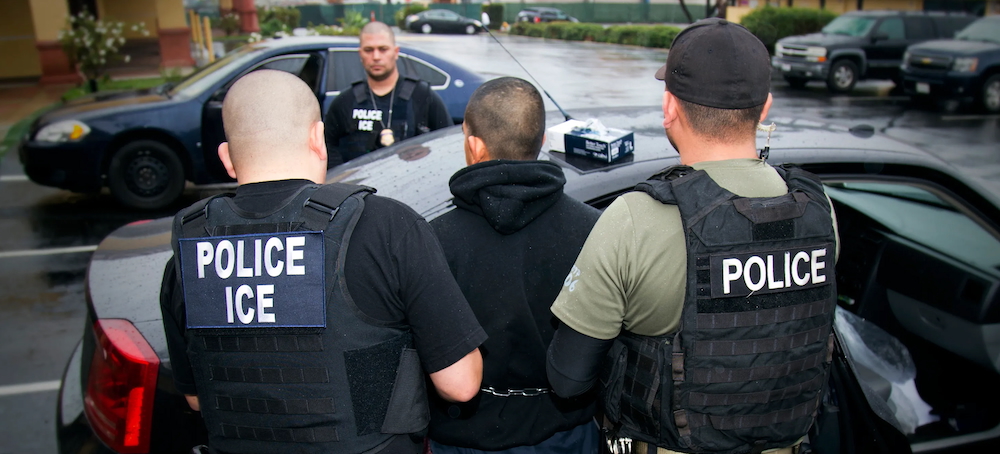 Immigration and Customs Enforcement agents make an arrest. (photo: Charles Reed/ICE/AP)
ALSO SEE: ICE Agent Charged With Misdemeanor Following Scuffle With an Activist
A string of violent incidents has added fresh urgency to calls for more body-worn cameras. But DHS proposed reducing spending on them in its initial budget proposal.
In its initial budget proposal, the Department of Homeland Security said it planned to slash the body camera program’s 22-person staff to three employees and reduce spending on the initiative from about $20.5 million to $5.5 million. Officials instead proposed “sustaining” the cameras ICE had last year to devote more resources to “frontline operations.”
A string of violent incidents involving federal immigration officers — including the fatal shooting of Minneapolis resident Renée Good in her SUV this month — has added fresh urgency to calls from congressional Democrats and some Republicans for more body-worn cameras. In several use-of-force incidents, witnesses and Homeland Security officials have given wildly differing accounts of the confrontations. Yet the government has voluntarily released little officer-worn footage.
To address these concerns, House appropriators this week said they would allocate about $20 million for cameras for DHS, which oversees ICE and its sibling agency, Customs and Border Protection, and require the agency to report back on its progress in 30 days. But the House plan stops short of requiring officers to wear cameras, and some congressional aides and analysts said this week that the extra money is meaningless if the cameras are not mandatory.
Rep. Rosa DeLauro of Connecticut, the top Democrat on the House Appropriations Committee, said Republicans would not agree on requiring agents to wear the cameras. “Body cameras only enhance transparency and accountability which is required to build public trust — which ICE has totally lost under the leadership of [Homeland Security] Secretary Kristi Noem and Stephen Miller,” DeLauro said in a statement.
Top Republicans on the committee did not respond to questions about that assertion. But a Trump administration official confirmed Friday that the White House opposed mandating body-cameras as one of “many unserious poison pill demands” from Democrats in the budget bill. The official, in an unsigned email from the Office of Management and Budget, did not explain the administration’s reasoning.
The latest figures, which were compiled in June, showed that ICE had 4,400 cameras, though its workforce has since swelled to 22,000, while CBP had 13,400 cameras for a workforce of at least 45,000 armed officers, according to the House Homeland Security Committee. It is unclear how many of those cameras are in use.
Homeland Security officials have said they have been working to expand officers’ access to body cameras. But the agency did not ensure that every ICE officer had a camera last year after receiving a massive infusion of cash, and it has not responded to multiple questions from The Washington Post and lawmakers about why so many officers and agents don’t have them.
According to a 2024 DHS report, ICE’s cameras were supposed to have been fully operational by September after years of testing. Congressional Republicans nearly tripled ICE’s annual budget for the previous fiscal year, but Trump officials did not appear to prioritize cameras.
ICE officer Jonathan Ross and other officers at the scene of Good’s killing did not appear to be wearing body cameras and DHS has not released any corresponding footage. DHS has not explained why Ross and his colleagues weren’t equipped with cameras, but Ross testified last month that he and other ICE officers in his five-state region were not allowed to wear body cameras because their field office did not have a written policy for it.
Ross was filming Good with his cellphone shortly before shooting her, raising additional questions about why he was handling a phone and a gun at the same time.
“They’ve gotten so much money, they have more than enough money to do the [camera] program,” Claire Trickler-McNulty, a Biden administration ICE official, said. “It seems more like a policy and operational choice not to use body-worn cameras.”
Homeland Security spokeswoman Tricia McLaughlin told CNN this month that the agency “of course” allowed officers to wear cameras and said the agency was working on expanding the program. McLaughlin told The Post the same thing in September, and officials have not provided data on how many officers and agents are equipped with cameras.
President Joe Biden ordered federal law enforcement to wear body cameras and make other reforms in a 2022 executive order. Trump rescinded that directive after starting his second term.
Nevertheless, a month after Trump began his second term, then-acting ICE director Caleb Vitello issued a directive that said cameras can build trust and transparency and wrote that officers should activate them “as soon as practicable at the beginning of an enforcement activity.” Vitello was soon demoted for reasons that were never disclosed, and did not respond to requests for comment.
Since Trump took office, ICE has released only one body-camera video, of a confrontation outside a New Jersey detention center. CBP has issued three videos, all of shootings on the southern border.
Body-worn cameras were broadly accessible to law enforcement as far back as 2016, when Justice Department figures show that roughly half of police agencies had them. Usage spread after a Minneapolis police officer killed George Floyd in 2020, igniting the largest anti-racism protests in U.S. history. At first, police said Floyd suffered a medical incident, but witness video — and, later, police body-camera footage — showed the officer had used excessive force. Officer Derek Chauvin was convicted of murder and manslaughter, and sentenced to 22 and a half years in prison.
At least eight states mandate that law enforcement officers use body-worn cameras: Colorado, Connecticut, Delaware, Illinois, Maryland, New Jersey, New Mexico and South Carolina, according to the National Conference of State Legislatures.
Proponents of cameras say they provide an independent accounting of law enforcement’s interactions with the public that benefit officers and residents. Footage can gather evidence of crimes, dispel false accusations, and de-escalate tensions between police and the public.
“It protects both the law enforcement officers and the people they interact with,” said Deborah Fleischaker, a former top DHS official and an acting ICE chief of staff under Biden. “If an agent did something wrong, you want to know about it so you can handle it, so you can fix it. But it’s also protective of the agents because, look, the reality is that not every claim of use of force or bad language or abuse is true.”
Noem’s apparent failure to fully implement the body camera programs for ICE and Customs and Border Protection was a major sticking point in budget negotiations in recent days as congressional Democrats demanded reforms in exchange for avoiding another government shutdown. Some filed bills to make body-worn cameras mandatory, expressing concern that immigration officers are violating civil rights and breaking the law by assaulting people, including U.S. citizens, and entering homes without a warrant.
Multiple lawmakers said they felt Democrats had not pushed hard enough for body cameras and other reforms.
“Body cameras on ICE agents are one important step towards accountability for ICE’s secret agents violently terrorizing American cities, but it is far from enough,” Rep. Dan Goldman (D-New York) said in a statement. “ICE agents must be unmasked and fully identified, prohibited from arresting immigrants following the rules by showing up for court appearances, and held fully accountable for their unconstitutional and excessively violent conduct by stripping their immunity. ICE is out of control and must be reined in.”
A week after Ross shot Good, DHS shared a video of Miller, the White House deputy chief of staff for policy, saying on Fox News last year that ICE officers enjoyed immunity from prosecution for actions they take in the course of their duties. That is broadly true, though legal experts caution that immunity is not absolute if an officer has broken the law.
Miller and the White House’s rhetoric has frightened immigrants and their advocates who worry that officers are using excessive force, and are concerned that the absence of body cameras means there is less a chance that officers will be held accountable when abuses occur.
In the rare cases in which video from immigration officers’ body-worn cameras has been made public, the footage has sometimes contradicted DHS’s initial account.
In Chicago, the Trump administration accused Marimar Martinez and Anthony Ruiz of assault and attempted murder of a federal employee with a deadly or dangerous weapon, alleging they had rammed a Border Patrol agent’s vehicle. Agents’ body-camera footage later showed that agent Charles Exum had rammed Martinez’s vehicle and then pointed his gun at her, threatened her and shot her five times.
After body-camera footage showed agents had crashed into Martinez’s vehicle, a federal judge dismissed the charges in November. Exum has not been charged.
The DHS agents and officers who do wear body cameras sometimes fail to turn them on.
Greg Geist, an assistant federal public defender in Washington state, represented a Mexican national charged with assaulting a federal officer in November. Only one member of the 10-man team of Border Patrol and ICE officers sent to arrest the man outside a county courthouse was wearing a camera, and Geist said that Border Patrol agent, Nathan Bagwell, neglected to turn it on.
“Every officer should be wearing a body worn camera. It’s the best form of evidence to show what actually happened,” Geist said in an interview. “Even then it should be looked at as this protects everybody. This protects the officers. This protects the community. It’s just common sense. … Law enforcement shouldn’t look like they’re hiding things.”
Border Patrol Agent Sean Frobe said in his written report that he and his team arrested Beltran outside after identifying themselves and displaying their badges.
But Geist said the court security camera footage offered a dramatically different account. The video, which The Post reviewed, showed agents and officers swarming Beltran on a sidewalk after he exited the courthouse, slamming him against a law enforcement vehicle, and dragging him into the middle of the street.
The 35-year-old father of two, who had lived in the United States since he was 19, was barely visible underneath a pile of officers.
“This Court will never know what the agents actually said because they made the choice not to record what happened when they went to arrest Mr. Beltran-Flores,” Geist wrote last month. “These agents have access to body worn video systems. They just chose not to use them.”
CBP did not respond to requests for comment from the agents or about the number of cameras it has deployed.
In 2023, CBP said it had piloted cameras on the Mexican and Canadian borders and officials had also planned to issue cameras to the SWAT-style Office of Field Operations Special Response Teams. ICE had tested the cameras with Homeland Security Investigations special response teams in Houston, El Paso, New York, and Newark, as well as deportation officers in Atlanta, Salt Lake City, and Indianapolis.
“Every single ICE officer agent should wear a body camera, just like local law enforcement is forced to do,” said Rep. Angie Craig (D-Minnesota), said at a public hearing over Good’s death.
But Ross, the officer who shot Good, said last month that officers do not wear cameras in Minnesota, Iowa, Nebraska, North Dakota, and South Dakota.
“Our field office does not have a body-worn camera policy; so we cannot wear them,” he said in his testimony in the criminal case against a Mexican national who was convicted of assaulting a federal officer with a dangerous or deadly weapon as he fled arrest in his car with Ross’s arm stuck in the window. “We have no way of storing the footage. There’s no policy in our area, in the St. Paul Field Office, that covers the various states. We have no policy for body cam.”
During his testimony, Ross agreed that the body cameras or dashboard-mounted cameras might offer a clearer view of his allegations against the immigrant later convicted of dragging and seriously injuring Ross with his car.
“You would agree with me that if there were dash cams that had video and sound, we would be able to see better what the stop looked like; fair to say?,” the defendant’s lawyer, Eric Newmark, asked Ross, according to the court transcript.
“Yes,” Ross said.