Appeals Court Strikes Down Trump’s Tariffs as Illegal but Leaves Them in Place, Pending Appeal
Rachel Lerman and David J. Lynch Washington Post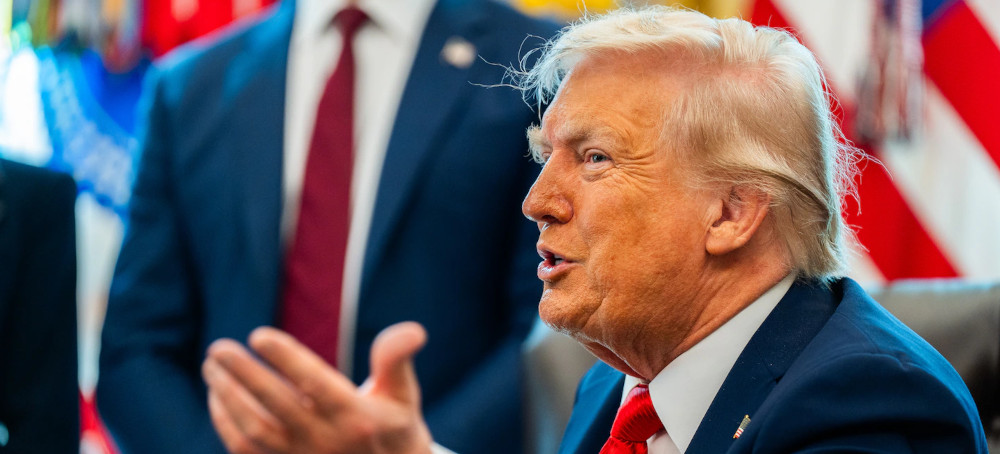 Most of President Donald Trump's tariffs were ruled illegal by a federal appeals court. (photo: Demetrius Freeman/The Washinton Post)
ALSO SEE: What Happens to Trump’s Tariffs Now That a Federal Appeals Court Has Knocked Them Down?
Trump’s cornerstone economic policy faced yet another challenge as a federal appeals court ruled he did not have the authority to impose the levies.
Trump’s tariffs will be allowed to remain in effect for now, to allow time for an appeal to the U.S. Supreme Court. U.S. Attorney General Pam Bondi tweeted Friday night that the Justice Department would appeal the decision.
The U.S. Court of Appeals for the Federal Circuit ruled 7-4 to uphold a lower court’s decision that Trump overstepped his authority in using a 1977 law, the International Emergency Economic Powers Act (IEEPA), to impose most of his tariffs. Historically, the emergency law has been used to impose economic sanctions in the case of threats against the country.
“The statute bestows significant authority on the President to undertake a number of actions in response to a declared national emergency, but none of these actions explicitly include the power to impose tariffs, duties, or the like, or the power to tax,” a group of federal judges wrote in their ruling. “ … Absent a valid delegation by Congress, the President has no authority to impose taxes.”
The decision throws the future of Trump’s foundational economic policy into uncertainty once more, only weeks after the president unveiled increased levies on more than 60 countries around the world. Those tariffs spared many countries from even higher levels first proposed by Trump in April, but still added much higher taxes than the country has imposed in recent decades.
Trump posted Friday on Truth Social criticizing the decision, writing that a “Highly Partisan Appeals Court incorrectly said that our Tariffs should be removed, but they know the United States of America will win in the end. If these Tariffs ever went away, it would be a total disaster for the Country.”
The legal challenge was brought by a group of state governments and small businesses, who argued, in part, that no such emergency exists to justify Trump using the law. The Trump administration has disputed this, arguing that the trade deficit that the United States has run every year since 1975 constitutes such an emergency.
The Liberty Justice Center, which represents the small businesses in the lawsuit, said Friday it would continue to defend the suit in the appeal to the Supreme Court.
“The President cannot lawfully impose tariffs on his own; and IEEPA does not give him unlimited unilateral tariff authority,” Jeffrey Schwab, senior counsel and director of litigation said in a statement. “This decision protects American businesses and consumers from the uncertainty and harm caused by these unlawful tariffs.”
The four judges who dissented from the majority’s ruling wrote that “IEEPA embodies an eyes-open congressional grant of broad emergency authority in this foreign-affairs realm …”
Trump has said the tariffs are a response to years of unfair trading practices by other nations that have hollowed out American manufacturing communities. The president has pledged the levies will bring a “golden age” back to the country’s manufacturing sector.
The number of U.S. manufacturing jobs has been falling since 1979, mostly because of the effects of automation. Most mainstream economists say the tariffs are unlikely to result in a significant increase in the number of American factory jobs while raising costs for U.S. factories that rely on foreign parts and for American consumers.
The U.S. economy is already starting to feel the effects of the policies, as inflation has increased in some sectors and remained flat in others, and the labor market has weakened.
During a slight reprieve from higher tariffs earlier this year, the Trump administration attempted to broker deals with countries around the world. By the time the higher tariffs took hold in August, they had reached a handful of trade deals, agreeing to impose levies on imports from the European Union, Britain, Vietnam, Japan and others.
The White House can pursue other ways to impose tariffs, including a law they used to start levies on imports of steel, aluminum and automobiles. If Trump’s use of IEEPA is ultimately struck down in court, but that will take time.
In his post on Truth Social, Trump emphasized that tariffs remain in effect while writing, “The U.S.A. will no longer tolerate enormous Trade Deficits and unfair Tariffs and Non Tariff Trade Barriers imposed by other Countries, friend or foe, that undermine our Manufacturers, Farmers, and everyone else. If allowed to stand, this Decision would literally destroy the United States of America.”
The appeals court also sent part of the case back to a lower court to reconsider whether the government should refund tariffs to all companies that already paid them, or just the parties that sued the government.