An Explosive New Ruling Forces the Supreme Court to Confront the Trump Administration’s Lies Under Oath
Dahlia Lithwick and Mark Joseph Stern Slate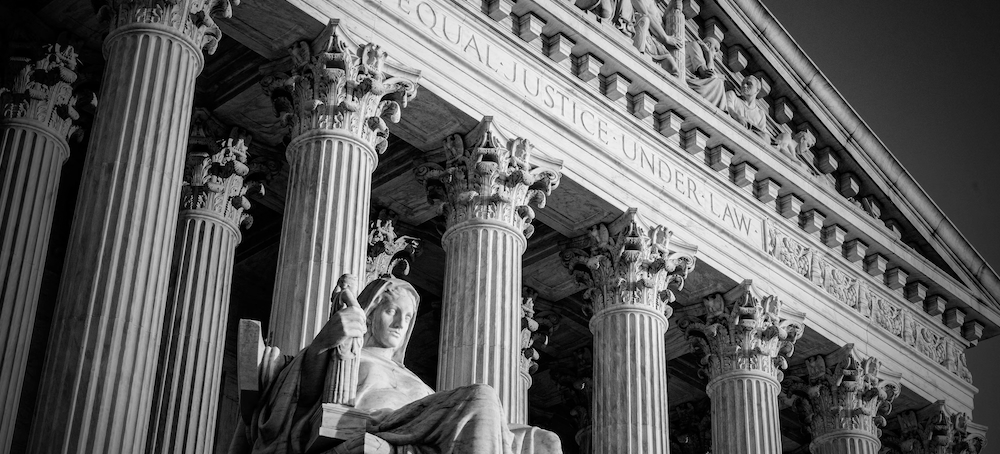 The Supreme Court Building in Washington, D.C. (photo: Mark Peterson/Redux)
Dahlia Lithwick: Can you start by reminding us what this cruel and unusual policy allows for? Because I think “third-country deportation” sounds a little benign for what it actually is.
Mark Joseph Stern: It sounds antiseptic, but it’s absolutely atrocious. This is the policy the Trump administration uses to banish immigrants to countries that are not their home countries, and to which they often have no connection whatsoever. The Trump administration does this without giving people notice of where they were being expelled, or an opportunity to object to being expelled there. That clearly violates the Convention Against Torture, which bars the government from deporting people to any country in which there is substantial reason to believe they will be tortured or killed.
The Trump administration claimed it could just ignore that law and deport noncitizens to random countries as long as it received “diplomatic assurances” that deportees would not face torture or death there. But it refused to say what those assurances were or to reveal anything about them in court. In the most notorious instance, the government dumped immigrants in South Sudan—where they had never stepped foot before, and which the U.S. government currently tells citizens not to visit due to a high risk of “crime, kidnapping, and armed conflict.” Government lawyers said it was fine, though, because they received pinky-promises from South Sudan diplomats that nobody would be tortured.
In his opinion, Judge Murphy cited an extraordinary colloquy from a hearing. He had asked Justice Department lawyer Mary Larakers: “Is your position that the Government can decide right now that someone who is in their custody is getting deported to a third country, give them no notice and no opportunity to say, ’I will be killed the moment I arrive there,’ and, as long as the Department doesn’t already know that there’s someone standing there waiting to shoot him, that that’s fine?” And Larakers responded: “In short, yes.”
That is the official position of the U.S. government. And as Judge Murphy explained in this opinion, it is outrageously unlawful for many reasons. I’ll just list two. First, the Convention Against Torture—which Congress has implemented into federal law—requires individualized determinations of risk when an immigrant says that they fear torture if deported to a certain country. That means that the immigrant must be told what country they’re going to be sent to and then get an opportunity to object. That’s what the government had been doing for decades before the second Trump administration changed the rules.
Second, Judge Murphy said this policy obviously violates due process. And that is a modest holding. He is not saying that third-country deportations are always unconstitutional. He’s not saying that immigrants always have to be believed when they say they fear torture or persecution in a certain country. All he held is that the government has to tell people where they will be expelled to, and give them a chance to raise a claim of persecution before they’re put on a plane. Anything less would deprive them of due process and nullify the Convention Against Torture.
There’s a piece of this that’s a recurring theme on this show: Judge Murphy walks through every single way that Trump administration officials violated his earlier orders trying to halt this policy. And they just don’t care.
Listeners may remember when the Trump administration defied one of Judge Murphy’s earlier preliminary injunctions, when the government loaded immigrants onto a deportation flight to South Sudan. And even though Murphy tried to halt those expulsions—and though the Trump administration initially defied his order—the Supreme Court ended up siding with the government on the shadow docket. This time around, I think Judge Murphy is trying to show the justices that this incident was not a one-off. The rot here, the outrageous flouting of court orders, goes so much deeper, to the point that the government’s position is just a stack of lies.
So, for instance, Judge Murphy laid out why it looks like Solicitor General John Sauer misled the justices during the South Sudan episode. Sauer told the Supreme Court that because of Murphy’s attempted intervention, the government had “slammed on the brakes while these aliens were literally mid-flight—thus forcing the government to detain them at a military base in Djibouti.” But an ICE official later testified that that was untrue. The plane was always scheduled to stop at Djibouti—it was not diverted there at the last minute. And in fact, it stopped over in Ireland for several hours before that, and could have stayed there or turned around. So Sauer’s claim that Murphy forced an unscheduled emergency stopover in Djibouti is just flat-out false.
Here’s another example: The government wanted to expel a Guatemalan refugee to Mexico. The refugee told an immigration judge that he had been persecuted in Guatemala, and also raped and held hostage in Mexico. So the judge held that he could not be deported to either country. The government affirmed to the judge that it would not deport him to either country. It then promptly deported the refugee to Mexico, which in turn sent him to Guatemala. When Judge Murphy asked the government about these events, it claimed it had a witness who would testify that this refugee actually stated he was not afraid of being sent to Mexico. Then hours before this supposed witness was set to testify, the government admitted that no such witness had ever existed, and it had no basis to claim that the refugee was unafraid of deportation to Mexico. The government made the entire thing up.
This is another theme we’ve talked about so much in the last year, which is the essential role that lower court judges play in telling the truth and getting the record straight. It’s easy to say that what happens in court doesn’t matter. But when a judge says, “You’re lying,” that goes on the record. It’s essential—not just for the preservation of the rule of law and democracy, but for creating a historical account of what’s happening.
Our friend Skye Perryman, head of Democracy Forward, has been hitting this point. She has said that when this full factual record is presented to the justices, it’ll be a hell of a lot more difficult for them to side with the Trump administration. When all of the facts are laid out the way that Judge Murphy did it, it sends a message to the Supreme Court: If you side with Trump again, you will not just allow for this horrible, illegal policy to take effect; you will also incentivize defiance of the judiciary. You’ll incentivize lying to the judiciary. And you will ultimately pave the way for your own ruin by unwinding the principle that the executive branch has to follow court orders. That, over anything else, is the message that I think Judge Murphy is trying to send to the Supreme Court.