Americans Have No Idea What Donald Trump Wants From Iran
The Economist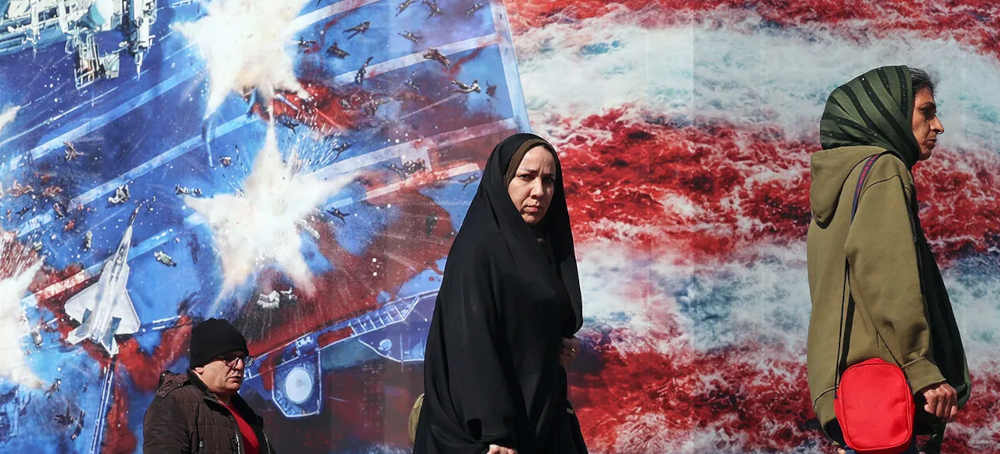 Trump's Iran policy is headed towards a war in search of an objective. (photo: EPA)
The president himself may be among them
Never mind that Ali Khamenei, the Iranian supreme leader, has said those words many times before. They were even in the preamble to the nuclear deal Iran signed in 2015—the one Mr Trump tore up three years later. The president simply wants to hear them again, and the threat of war would dissipate.
At least, that was his position on one particular February evening. On other days he has said that America should strike Iran to punish the regime for killing protesters early this year, or to compel it to get rid of its missile arsenal, or to overthrow it entirely. His ultimate goal remains a mystery. If war comes, it will be a war in search of an objective. Never before has America amassed so much firepower with so little idea of how to use it.
The most straightforward aim would be to use the threat of force to push Iran into a deal that restrains its nuclear ambitions. That has been a focus of American diplomacy for two decades. Even when Mr Trump abandoned the 2015 agreement, known as the Joint Comprehensive Plan of Action (jcpoa), he did not scorn the idea of a deal with Iran; his goal, he said, was to negotiate a better one. That objective only became more urgent in the years that followed. By last spring the Islamic republic had enriched more than 400kg of uranium to near-weapons-grade, enough to make ten bombs if refined a bit further.
Then came Mr Trump’s decision to launch strikes on three of Iran’s main nuclear facilities, the climax of the 12-day war between Israel and Iran in June. The programme was not “obliterated”, as he likes to boast. Iran still has a working nuclear reactor and decades of accumulated know-how. But key elements are defunct. Its stockpile of highly-enriched uranium is probably still buried beneath the rubble. Rafael Grossi, the head of the un’s nuclear agency, said in October that Iran no longer appeared to be enriching any uranium.
A third round of American-Iranian talks was scheduled for February 26th, after The Economist went to press. Even if the Iranians say Mr Trump’s magic words, that is the easy part: it is harder to flesh out the details of an arms-control agreement and decide how to verify Iran’s compliance. A deal does not seem imminent.
The bigger problem, though, is that it no longer seems urgent. If Iran offers to limit uranium enrichment, it is proposing to stop doing something that it is not currently able to do. That is not much of a concession. It would be hard to sell such a deal to hawks in Washington, let alone to Israel. Even some supporters of the jcpoa now believe that a nuclear-only pact would squander America’s leverage and throw a lifeline to Iran’s embattled regime.
The rest of Mr Trump’s possible goals range from insufficient to implausible. A comprehensive deal to restrict Iran’s missile arsenal and end its support for Arab militias would be a monumental achievement. But Iran refuses to discuss those issues, and Mr Trump has been advised (correctly) that the regime will not yield under fire. Trying to topple the regime is uncertain and fraught with peril, as America’s experience in Iraq made clear.
Most Americans are confused. A recent survey by The Economist and YouGov found that just 27% of Americans support a strike on Iran. Though Republicans are more supportive than the country as a whole, some of Mr Trump’s maga allies are baffled as to why the president is contemplating the sort of Middle Eastern war he once campaigned against. Members of Mr Trump’s cabinet briefed top members of Congress on February 24th. Chuck Schumer, the Senate minority leader, emerged in confusion. “If they want to do something in Iran, and who the hell knows what it is, they should make it public,” he said.
Yet a string of recent media leaks suggests that Mr Trump’s aides are focused on tactical questions. Would a limited first strike make Iran more or less amenable to concessions? How much would a war drain America’s precious supply of air-defence interceptors? These are valid questions, to be sure—but it is odd to debate how a war should be fought before deciding why.
Some of this confusion is uniquely Trumpy. The president tweets before he thinks and plays loose with the facts; neither trait is conducive to running a war. Mr Trump backed himself into a corner by warning the regime in January that he would retaliate for the killing of protesters. After his quick wins in Iran last summer and Venezuela in January, he seems enamoured of military force; he is said to be frustrated that the current standoff with Iran offers no easy options.
Steve Witkoff, his diplomatic envoy, recently said that Iran could be “a week away” from enriching uranium to weapons-grade: “That’s really dangerous,” he told Fox News. Two days later Mr Trump said Iran’s nuclear programme had been “blown to smithereens”. Needless to say, both cannot be true. If the president’s version is accurate, there is no urgent threat to justify a big military campaign. Meanwhile, if you take Mr Witkoff at his word, his boss is a liar, and there is little reason to believe a new strike on Iran’s nuclear facilities would be more decisive than the last.
To be fair, though, Mr Trump is hardly the first American leader who struggled to identify a realistic goal in Iran. George W Bush hoped that invading Iraq would diminish Iran’s influence and destabilise its regime. It did the opposite. Barack Obama thought Iran might find a way to “share the neighbourhood” with America’s Arab allies, an idea that mostly angered said allies. Presidents have wanted to change Iran’s behaviour for almost half a century; none have worked out how to do so.