Ali Larijani: Kant’s Disciple of Death
Bobby Ghosh Substack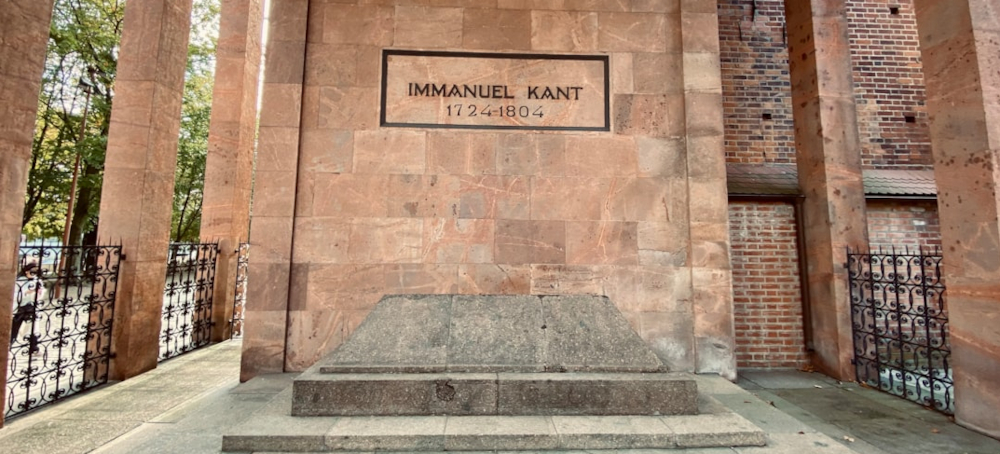 The grave of philosopher Immanuel Kant. (photo: Alexandr Chernyaev/Unsplash)
ALSO SEE: Ghoshworld, Bobby Ghosh on Substack
The Iran regime’s designated “moderate” was also the man who ordered the crackdown that killed tens of thousands.
It was also, largely, a chimera.
Larijani was many other things: a member of an influential family in the leadership of the Islamic Republic, a veteran of the Revolutionary Guards, a decade-long propagandist-in-chief on state television, a parliamentary speaker, a nuclear negotiator, and — in the final months of his life — the de facto leader of a regime at war with Israel and the US.
What he was not is a philosopher in the way that description is meant to imply: a man shaped by reason, open to dissent, committed to the dignity of persons.
There is a persistent Western habit of treating intellectual credentials as evidence of liberal sympathies. The same might be said of the Islamic Republic’s founder, Ayatollah Ruhollah Khomeini, who wrote verse and was described in certain credulous corners of Western media as a mystic poet. The poetry was real enough, but it told you almost nothing about the man’s politics.
It may seem entirely logical to assume that a man who has read Kant must, somewhere in his soul, be receptive to the Enlightenment values that the German sage espoused. But this is a category error. And Larijani was its most elegant refutation.
The Kant connection deserves to be examined on its own terms, because it is not fraudulent — it is something more interesting. Larijani’s three books on Kant explored epistemological questions: the foundations of mathematical knowledge, the relationship between metaphysics and science, the role of intuition in cognition. These are not trivial subjects.
But as the Egyptian political writer Mahmoud Hadhoud has observed, the intellectual tradition within which Larijani worked was that of Hikmat al-Muta’aliyah — Transcendent Philosophy, the distinctly Shia framework rooted in the synthesis of Mulla Sadra. Larijani’s philosophical project, Hadhoud notes, was “an attempt to reinterpret Kant in a way that preserves the legitimacy of religious knowledge within a modern epistemological framework.” Larijani was not bringing a Kantian worldview into Iran. He was conscripting Kant into a pre-existing theocratic worldview, using the tools of Western epistemology to reinforce, rather than challenge, the metaphysical foundations of the Islamic Republic.
In short, he used Kant the way the regime in Tehran uses everything: as a legitimizing instrument.
Larijani’s actual record is not ambiguous. After fighting in the Iran-Iraq War as a Revolutionary Guards officer, he spent a decade running the Islamic Republic of Iran Broadcasting, the state television network. During that tenure, he used the platform to wage systematic war on the reformist agenda of President Mohammad Khatami — so aggressively that Khatami eventually barred him from Cabinet meetings.
More revealing still was his enthusiastic defense of a 1996 television program called Hoviyat — “Identity” — which aired coerced confessions by writers, intellectuals, poets, and dissidents. The program did not merely accuse them of disloyalty. It systematically branded them as foreign agents, Zionist tools, enemies of Islam. One dissident, the writer Faraj Sarkohi, was kidnapped by security forces, tortured into recording false confessions, and eventually released abroad.
Larijani’s response to criticism of the show was to accuse the targets of receiving money from foreign embassies. When the political winds shifted years later, he tried to distance himself from Hoviyat, claiming it had been the work of subordinates. Sarkohi called that claim what it was: a clear lie.
This, too, is a pattern the Islamic Republic has perfected: the tactical disavowal. Act, then deny. Benefit, then retreat. The philosopher was not above it.
Why, then, did so many serious analysts keep reaching for the “moderate” label? The answer lies partly in how the Islamic Republic has been structured — and how it has learned to manage Western perception.
Larijani was not a cleric. He wore a suit, not a turban. He spoke at international forums. He led nuclear negotiations with European diplomats and helped secure parliamentary passage of the 2015 JCPOA. He occasionally criticized hardline positions in a way that sounded, to Western ears, like independent thought. The International Crisis Group’s Ali Vaez summed him up as “a true insider, a canny operator, familiar with how the system operates.” That is a description of a skilled political survivor, not a reformer. But the two are easily confused at a distance.
The Islamic Republic has long understood that it needs legible interlocutors — people who can be read by Western counterparts as negotiating partners. Larijani was supremely useful in this role. He leaned into it when it served him, at the nuclear table or in back-channel diplomacy through Oman. He discarded it the moment the system required something else.
That moment came, with terrible clarity, in January of this year.
When mass protests erupted across Iran — across more than 200 cities, the largest uprising since the revolution itself — Larijani did not reach for the categorical imperative. He reached for the security apparatus. According to the New York Times, he was in charge of crushing the protests with lethal force. Reports from IranWire described him as the “mastermind” of the crackdown, coordinating between Revolutionary Guards commanders, intelligence services, and the clerical establishment.
By some accounts, he modeled the operation on China’s response to Tiananmen Square in 1989 — viewing that massacre not as a historical atrocity but as a workable template. The US sanctioned him in mid-January for his role in what rights groups estimated to be tens of thousands of deaths.
Larijani justified the mass murder by labeling the protests as the work of an “urban quasi-terrorist group.”
Consider that phrase. From a man who wrote three books on a philosopher whose entire moral edifice rested on the inviolable worth of every individual person. Kant argued that human beings must never be treated merely as means to an end. Larijani’s crackdown was nothing but the use of human beings as means — as obstacles to be cleared, as examples to be made, as a problem to be solved.
The Kant scholar, then, was a construct. Not entirely false — the books exist, the degree is real — but constructed for a particular audience, useful for a particular purpose. He was the Islamic Republic’s best answer to Western wishful thinking: an educated, suit-wearing, chess-playing pragmatist onto whom outside observers could project their hopes for a reasonable Iran.
The truly remarkable thing is how long it worked. Even after Hoviyat. Even after the 2009 post-election crackdown, to which his name was connected. Even after being disqualified from presidential elections twice, apparently because he had become inconvenient to hardliners rather than because he had grown too moderate. Right up until January 2026, some analysts were still insisting that the man who ordered the massacre might be someone Washington could do business with.
There is a lesson here that outlasts Larijani. The Islamic Republic does not produce moderates in any liberal sense of the word. It produces, occasionally, pragmatists — people who understand that a deal is sometimes more useful than a confrontation. When those people make deals, it is in service of the system, not in defiance of it. Their flexibility is tactical; their loyalty to the theocratic project is absolute.
Larijani embodied this type with rare completeness. He was educated enough to seem accessible, disciplined enough to serve the regime across four decades, and ruthless enough to do what the regime required when the moment came. In one oft‑cited jab at Khatami‑era diplomacy, he called the nuclear bargain “trading pearls for bonbons” — a sneer that telegraphed his view that Iran had given away too much — and then, years later, used the nuclear deal that came out of that diplomacy to burnish his own pragmatist credentials. The man knew how to play every side of the board.
What Immanuel Kant would have made of his most famous Iranian reader is not hard to imagine. The German sage held that a person’s moral worth is determined not by their credentials, but by their actions — and specifically by whether those actions could be universalized as a principle of conduct for all humanity.
No sane person would wish the January crackdown on the whole human race.
The so-called Kantian knew what he was doing. That is the most damning thing of all.