Alaska Trawlers Caught 10 Killer Whales This Year, and Nine of Them Died
Bjorn Dihle Outdoor Life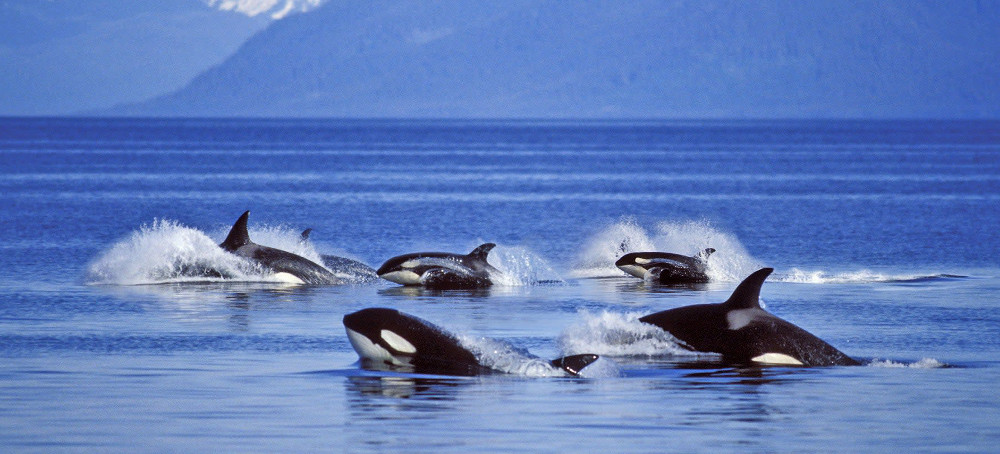 Killer whales surface in Alaska. (photo: AFP)
NOAA Fisheries is “analyzing collected data to determine the cause of injury or death and determine which stocks these whales belong to through a review of genetic information,” the agency said in a press release.
Killer whales are protected under the Marine Mammal Protection Act, which requires boat operators to report injuries or death. Each Bering Sea trawler carries two NOAA Fisheries Observers aboard to document bycatch, but when trawlers drag nets in other places off Alaska’s coast they lack 100 percent observer coverage.
Trawler Troubles in Alaska
A large number of Alaska’s trawlers are homeported in Seattle. They fish for pollock and other fish, which get turned into products like fish sticks and Filet-O-Fish sandwiches.
In the early 1990s, a trawler on its way up from Seattle dropped a net to do a practice drag. That one drag caught the entire Southeast Alaska rockfish quota, leading to massive outcry and eventually leading to trawling being banned off Southeast Alaska.
In other places in Alaska, trawling is both happening and being labeled sustainable by Marine Stewardship Council, despite the fact that it has been documented to destroy coral and other important habitat essential for the ocean ecosystem.
Over the past decade, trawlers in the Bering Sea and Gulf of Alaska have bycaught more than a billion pounds of marine life. That bycatch includes king and chum salmon, crab, halibut, and other species. Much of the bycatch is thrown overboard dead. Trawlers are allowed to catch an unlimited number of chum salmon.
Meanwhile, king and chum salmon runs in Western Alaska have collapsed in recent years. Salmon is the lifeblood of dozens of Alaska Native villages along the Yukon and Kuskokwim Rivers, and subsistence fishery closures have enormous impacts. While climate change plays a role in the declines, many Alaskans see a clear link to trawl bycatch.
Critics also point to the fact that observers can only document bycatch that makes its way to the surface—and the massive, loaded nets of some trawlers have been documented as dragging the bottom up to 100 percent of the time, potentially pulverizing habitat, crabs, and other bottom-dwelling species.
“If what they are doing underwater with trawl nets was happening on land where the public could see it, it would be shut down tomorrow,” said David Bayes, owner of Homer-based DeepStrike Sportfishing.
Higher Than Normal Killer Whale Bycatch
Groundfish Forum, a Seattle-based association that operates 19 trawlers responsible for “a number” of the whale deaths, said that the level of killer whale trawl bycatch documented in 2023 is unusual. Groundfish Forum’s captains noticed an “increase in the number of killer whales present near our vessels, where they appear to be feeding in front of the nets while fishing.” The majority of dead whales were found inside nets.
“We are committed to working with NOAA and fishery managers to find solutions,” their statement continued.
Hannah Myers, a University of Fairbanks marine biology student who spent a week aboard a groundfish trawler studying killer whale interactions with the vessel, told the Anchorage Daily News she’s concerned by what’s going on deeper in the ocean. It is likely that killer whales are feeding on fish from the net’s entrance, or using the dragging net as a fishing aid, she said. The whales may be following trawlers in part because their normal prey is depleted.
Orcas in Alaska Are Stealing Fish Right From the Lines - and the New Behavior Seems to Be Killing Them
Marianne Guenot, Business Insider
They've been known to pluck fish off from commercial fishing gear for decades. But recently, they've been spotted lingering by the boats more often, appearing to "be feeding in front of the nets while fishing," the group said.
The Groundfish Forum, a Seattle-based trawl group that represents members operating 19 boats in the area, gave the warning in a statement shared by the Anchorage Daily News.
"This new behavior" has never been documented and has marine scientists stumped, the Groundfish Forum said in the statement, dated September 21.
The news came as more orcas have been getting tangled up in trawling gear in the area, leading to nine deaths in Alaska in 2023 so far, the US federal fisheries agency said on September 21.
That's a marked spike, up from seven orca deaths or serious injuries in the six years leading up to 2020, per the Groundfish Forum statement.
Orcas are copycats, learning from each other
Killer whales are known to be able to pick up behaviors from their peers.
Like any other dolphin (yes, they are a type of dolphin), they are intensely social. That means new behaviors can spread like wildfire through a population.
This can be because it gives them a hunting advantage — two orcas off the coast of South Africa, for instance, learned together how to selectively suck out the livers of great white sharks.
But it could also be a fad spreading simply because the killer whales find the behavior entertaining. That's likely why, for a spat in the 80s, orcas were seen wearing dead fish on their heads like hats, for no obvious benefit.
Another recent example made headlines when a pod of orcas on the other side of the world seemed to be purposefully targeting and sinking sailboats.
Scientists still aren't sure what motivated the behavior, but they think it may have been a form of play that spread through the killer whales, to the detriment of sailors venturing near the Iberian coast.
Observers from the National Oceanic and Atmospheric Administration (NOAA) are now investigating what exactly has caused the recent spike in killer whales' deaths near Alaska.
Thankfully, resident fish-eating killer whales in Alaska are not endangered. NOAA estimates there are in excess of 1,920 living near Alaska.
But all killer whales are protected under the Marine Mammal Protection Act, which means any death or injury needs to be reported, per NOAA.