Across Israel, Jews and Arabs Join Forces to Help War Victims and Prevent Riots
Netta Ahituv and Nadin Abou Laban Haaretz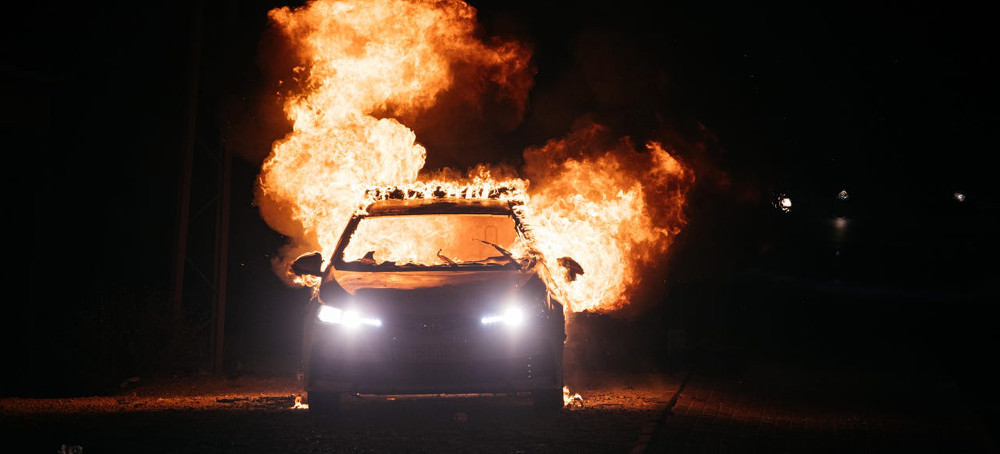 A police car that was torched during the IDF’s operation in the Gaza Strip, in May 2021. “We cannot prevent violence alone, only together. (photo: Avishag Shaar-Yashuv)
In Haifa and Jaffa, joint Jewish and Arab patrols seek to prevent violence on both sides. In the south, Bedouin residents risk their lives to search for victims of Hamas terror. In the shadow of war, Arab-Jewish solidarity initiatives emerge
“On Sunday, the second day of the war, we saw that there was enormous chaos and realized we must do something,” said Sleman Shlebe, a Bedouin resident of the northern Negev, who in a short time recruited some 600 volunteers, mostly from the Azazmeh tribe, who arrived with their ATVs and created emergency teams to search for missing Israelis.
“We had heard about people missing from both the Arab and Jewish communities, and knew that thanks to our exceptional familiarity with the south we could help,” he said. “We divided ourselves up in the cars so that there would be people responsible for different things: gathering information, rescuing and administering first aid.”
Within a short while, one of the teams confirmed that a person listed as missing up until that point had been killed. Following this tragic discovery the phone numbers of the members of the teams began to be distributed widely and the requests for assistance didn’t stop flowing in.
“In no time,” said 48-year-old Shlebe in a phone interview conducted while he was in the field, “we received dozens of phone calls and messages from parents begging us to help them find out what had happened to their children, and from people who asked us to come rescue them from their homes or the fields. We tried to respond to everyone and to help anyone who made contact.”
All this was happening despite the fact that he and his people had no weapons – and armed Hamas terrorists were still roaming the area. “It’s true that some of those among us worked in security, but who was going to give a weapon to Bedouin?”
Shlebe continued: “One of the phone calls was from an Arabic speaker who said he had been shot. He asked that we come to rescue him in a field abutting the Gaza Strip. When we got there, we realized that it was a terrorist who was trying to kill us all. Fortunately, we got out alive. Our best weapon is God.”
The fact that such a vital rescue apparatus had been created literally overnight came to the attention of the established security forces in the area. At a certain point they dispatched police officers and guards from the regional council to provide an armed escort for the Bedouin squads. “They realized that our knowledge was important, and we used it to help save Arabs and Jews from danger,” Shlebe said, adding that together with the other forces, the Bedouin volunteers searched for, defended and helped to save hundreds of people in dozens of locations over the next few days.
“We stood outside army bases to evacuate people to the hospital. Together with armed teams, we entered Jewish communities where there were terrorists. We collected the survivors from the party [the Supernova rave, near Kibbutz Re’im] who were hiding outside for hours. We tried to help everyone we could, but unfortunately it was too late for a large number of them.
Shlebe lives in Bir Hadaj, an agricultural Bedouin village that was officially recognized by the state in 2003. But most of the volunteers joining the search and rescue effort live in non-recognized villages in the desert, along Highway 40, where no air-raid sirens can be heard and there are no bomb shelters. Some of their villages don’t even have proper schools.
“Many of us feel that the state has abandoned us, but we haven’t abandoned it,” said Shlebe, expressing the hope that his 11 children would receive a good education and be safe, and that the homes in his and other unrecognized villages would not be left without water and electricity in the coming days.
Shlebe’s impressive and brave team was formed ad hoc in the midst of war. However, a dozen Bir Hadaj residents operate a community-wide group of volunteers that provides emergency rescue and medical services as a matter of routine. Naturally, all 12 contributed to the war effort this past week. It was thus difficult to catch Ahmed Abu Habak, the head of that group, referred to as the Local Emergency Team, which works in coordination with the Israel Defense Forces, the police, firefighters and other emergency services.
On Saturday, Abu Habak and his people managed to transfer a shooting victim to Soroka Medical Center in Be’er Sheva after the ambulance carrying the man had been stopped because the roads were blocked. On Sunday, he himself was trapped for a time by terrorist fire. On Monday, he waited for soldiers to arrive and handed an unarmed terrorist over to them.
“We found his footprints leading toward the Tze’elim army base,” Abu Habak told Haaretz. “We tracked him down and then captured him and waited for the army.”
All 12 of the Bir Hadaj volunteers have undergone first-aid training with the Ihud Hatzala or Magen David Adom emergency rescue services. Abu Habak took special courses for first responders offered by the Home Front Command and the National Fire and Rescue Academy.
On Sunday, a family from the Bedouin town of Shaqib al-Salam, aka Segev Shalom, called and asked for help after terrorists had infiltrated their community. The Local Emergency Team alerted “its connections” in the IDF and rushed in as quickly as possible, he said. When they arrived, soldiers there were in the midst of a shoot-out with four terrorists; under fire, Abu Habak and his people were able to rescue the family.
Here, too, despite the fact that the team is involved in an ongoing way in extremely dangerous activities, they are not permitted to carry weapons and thus often operate in tandem with officers from the Segev Shalom police station. This joint activity, sometimes in times of dire emergency, has created friendly relations between them. In addition to the harrowing scenes Abu Habak witnessed this week, he lost two close friends in the police force. One was Chief Superintendent Itzhak Bazuka-Shvili, commander of the Segev Shalom police station. The other was Shalom Tzaban, captain of the Kiryat Gat firefighters’ station. Both were killed battling Hamas militants in Sderot.
The desire to volunteer and help seemed to be quite strong this week among the Bedouin in southern Israel. After Arnold Nataev, a local correspondent for the Maariv daily paper, published an article Sunday headlined “Enlist us: Bedouin residents in the south ask to join the fighting,” he was deluged with dozens of messages from Bedouin saying they were prepared to volunteer for any mission in the aftermath of the bloody events unfolding in the area.
“I am prepared to volunteer for the Israel Defense Forces at this difficult time,” read one text message. “I am also prepared to do so as a fighter. I would do anything for my country. Israel is in our hearts.” A resident of the Bedouin city of Rahat wrote Nataev that members of some 30 local families wanted to volunteer and had even called the police to ask how, but no one answered.
For her part, veteran lecturer and social activist Amal Abo Alkom, who among other things serves as director of the Bedouin Women for Themselves NGO in Segev Shalom, also refused to stand by and do nothing after the war erupted. She launched a command center to assist local Bedouin and Jews in distress. “I haven’t slept since Saturday,” she said later in the week, after she and other women from her organization had begun to run between towns, distributing basic goods, medication and toys for children. They typically ask residents what they need and also try to provide a listening ear for those experiencing acute personal and collective trauma.
“Some friends, psychologists around the country, both Arabs and Jews, have offered to help and to speak, for example, to members of the Alkra’an family and others who have lost their dear ones, but it won’t work if the internet here is weak,” Abo Alkom said. “These people need in-person assistance. They need social workers who will come here, but for the moment everyone is afraid to travel. I understand the fear, so I show up instead.”
The extended Alkra’an family has lost four children – two brothers, Malek, 15, and Jawad, 14, and two cousins, Amin Akal, 11, and Mahmoud Diab, 12. They were killed Saturday when a rocket launched in Gaza hit the shack where they were staying at the time. There was no bomb shelter in the vicinity. Abo Alkom visited the family, which she is related to, the following day, and heard about the great trauma they had suffered. The father told visitors how he had searched for his children between the rubble, finding body parts and desperately trying to figure out what had happened to whom. “Many others from my community are missing or are wounded,” Abo Alkom added. “Moreover, many of my Jewish friends were taken hostage, injured or killed. The pain is total and incomprehensible.”
Between mosque and synagogue
On Saturday evening, a message was sent to members of a host of activist WhatsApp groups about the establishment of a joint Arab-Jewish civil guard in Tel Aviv-Jaffa. Its goal: to protect local residents, regardless of religion or ethnic background, should clashes erupt among them. Within hours, some 1,000 people joined the guard’s new WhatsApp group. Nearly 500 listened in during a video conference that evening – Jews and Arabs, all ready to make sure the events of May 2021, when inter-communal riots broke out in Jaffa and other “mixed” cities during a round of fighting between Israel and Palestinians in Gaza, wouldn’t be repeated. The keynote speaker was attorney Amir Badran, a city councilor who is running for mayor on behalf of the We Are The City party.
“I am a Jaffa native, raising four children here,” he said at the beginning of the conference. “It’s important for me that they and all of us will have peace in our city, and that we will be able to live here together. If we cannot live together, we will be more vulnerable. These are difficult days, and they will continue to be difficult, but we still have hope.”
The chairman of the Ajami and Jabaliya neighborhood council in Jaffa, Ramzi Abi Taleb, concurred with Badran. “In the seven years I have been active in this capacity, we have experienced many crises,” he said, “and during every conflict we Arabs and Jews have joined forces to help out – and we have prevailed.”
Members of the new patrol group, which is unarmed, are tasked with trying to keep the streets calm as the war evolves. One way they are helping ease tensions under such circumstances is by documenting incidents by video; they also express their solidarity with local residents. The new guards are planning to deploy if there is a potentially explosive situation, such as during prayers at a mosque, church or synagogue.
“This civil guard is the antidote for all the hate we see around us. It is important,” one activist said during the video conference. A few hours later, the participants were asked to specify what they can do to help: collect equipment to be donated to either soldiers or residents in the south whose homes have been destroyed, man shifts on the hotline for residents, do actual patrolling in the streets, contribute to solidarity activities on social media, etc.
Badran stressed that in the last few days he has spoken with representatives of local Arab neighborhoods, the Islamic Council of Jaffa, the League for the Jaffa Arabs, the Orthodox Church Association, local sheikhs and imams, and various Jewish and Arab activists. They are all “devastated by what is happening and are committed, on one hand, to preventing violence, incitement or harassment by Arabs vis-à-vis Jews or by Jews vis-à-vis Arabs,” he said. “Everyone is committed to asking their communities to show restraint, on one hand, and, on the other, are demanding that the municipality and the police ensure our personal safety, our children’s safety and the safety of our places of worship.”
The Arab-Jewish group in Jaffa could take a page from the book of a similar partnership, between the communities of Carmel and Fureidis, south of Haifa. Arabs and Jews there joined an initiative, called Neighbors at Peace, “with the understanding that we cannot prevent violence alone, only together,” according to Boaz Peled, one of the founders. The group holds frequent events, conferences and outings in an effort to foment honest and open dialogue between the locales. Their WhatsApp group, which has 300 active members, also constitutes an excellent platform for helping and protecting residents in fraught and potentially violent times like these. “If, for example, a violent [Jewish] gang approaches a garage in Or Akiva where Arabs work, someone will inform our group and we will get there as quickly as possible to try to calm down people’s nerves,” Peled said. “In 2021, we saw that in places where Jews and Arabs were trying to stop the violence together, the damage was less severe.”
Haifa and Taibeh, too
The public bomb shelter in the Khalisa neighborhood in lower Haifa is dark and filthy.
“It looks like no one has stepped in here since the Second Lebanon War in 2006,” observed Orwa on Monday afternoon, climbing up some 100 steps leading from the shelter up to a nearby playground, to fill up two large buckets of water that he will use to wash down the dusty space.
Orwa belongs to a group of some 600 Haifa residents, Arabs and Jews alike, who, since war broke out in the south on Saturday have been cleaning Haifa’s shelters together. They have all joined a WhatsApp group that provides regular updates on the situation in the shelters – which of them are clean, which need professional repairs, which are locked. New people are constantly joining the group out of a desire to do something for the common good, even sometimes tough manual labor.
Orwa proudly displays a digital map of all the city’s shelters and their status. “Almost all were cleaned within a few days thanks to Arabs and Jews, all Haifa people,” he said. “This partnership is our hope.”
The Shelter Cleaning Initiative, as it’s called, was launched by Palestinian activist Sally Abed, one of the founders of Rov Ha’ir (Most of the City), a Jewish-Arab social movement that is running for the municipal council. Last Saturday evening, she wrote in a series of tweets that went viral: “We’re aching. All of us. Some of my very close friends, partners, activists. anti-occupation and social justice activists who I see as real allies to our Palestinian cause are kidnapped, killed, or have lost someone... It seems like we are not allowed to hurt for both. You hurt as a palestinian? No place for you here. Let’s remember that it’s the most important thing we can do at this moment. To allow ourselves to hurt for both, to grief for all. Towards a place where we can also build for all.”
Abed decided to harness the collective mourning and anxiety: “I’m drained,” she admitted. “What’s going on is challenging everything that I thought, it shakes things up in the deepest personal and political way. We [already] had a big organization of Arabs and Jews in Haifa, and it was clear to us that we could ‘convert’ it into activity at this moment. We decided what would be the biggest act of solidarity that we could undertake that would not involve political dialogue, because it’s not the time for talk, but for deeds. And then we grasped that there are tons of shelters in Haifa that are not fit for use, and that we could go, Jews and Arabs together, to clean them up and make them usable. On Saturday, we started with a group of 40 activists and it grew to 600 within 24 hours. We cleaned up more than 50 public and private shelters, from Kiryat Haim to Wadi Salib.”
Not only in Jaffa and Haifa are Arabs and Jews working shoulder to shoulder, but also in the Arab city of Taibeh, in the central part of the country. MK Ahmad Tibi (Hadash-Ta’al) has been operating a type of helpline there to assist civilians, both Jews and Arabs. His team includes Arab and Jewish volunteers and is trying to address a flood of requests.
“A Jewish mother whose daughter is missing said she reached out to several Knesset members and told me I’ve been the first to respond,” Tibi said in a phone conversation this week. Another person who was missing for several days after the massacre Saturday at the party in Kibbutz Re’im was Awad Darawsha, a Palestinian-Israeli paramedic from the village of Iksal in northern Israel. Tibi has been in close contact with the family and dispatched his parliamentary aide to pay them a visit. On Thursday, the family learned that Awad was killed.
“There is trauma and chaos coming from every direction,” added Tibi, who, along with other leaders of the Arab community is also trying to help Arab-Israeli students studying in the West Bank to get permits to return to their families in Israel proper. “There are thousands of them,” he said, noting that he has also gotten requests from beleaguered residents of the Gaza Strip “where hundreds have been killed and continue to be killed.”
Tibi said that while he and many others have been trying to “lower the flames” and has called on the Arab public to keep calm and not get dragged into arguments and certainly not violence – there are those looking to place blame for the escalating situation on that community.
For example, Channel 12 journalist Amit Segal tweeted early in the week that Tibi and fellow MK Ayman Odeh weren’t fast enough in his view to condemn the massacres perpetrated by Hamas. To which Tibi tweeted back: “Amit, this is what’s most pressing for you to tweet about during these tough hours? A witch hunt? Since this morning I’ve been on the phone talking to families of missing people (Arabs and Jews), helping students come home, and making efforts to prevent friction and incitement in the mixed cities – incitement that is disseminated on social media.”
Following Segal’s tweet, and a text in a similar vein posted by journalist Attila Somfalvi, Tibi has been flooded by death threats. “It happens during every war, I’m already used to it, but this time the threats are more explicit and urgent. I feel like they have become more daring because of this government. The need to protect our public is clear – people are looking for a scapegoat and we’re an easy target.
“But this case is so cut and dry that it has just one ‘address’ of whom to blame: the Kahanist government of Smotrich, Ben-Gvir, Sukkot and Netanyahu. Only a diplomatic solution, without a siege or an occupation, will bring hope and a different future. And also without collective punishment and most importantly without harming civilians, both here and there. Because the number of civilians being killed on both sides is unfathomable.”