A War by Any Other Name
Bobby Ghosh Substack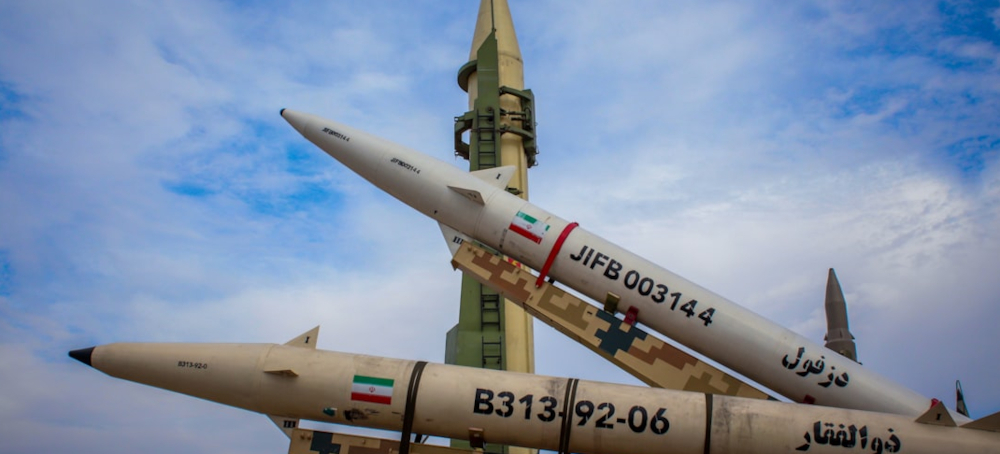 President Trump has plenty of other names for the war on Iran. (photo: Moslem Daneshzadeh/Unsplash)
ALSO SEE: Ghoshworld, Bobby Ghosh on Substack
… and President Trump has plenty of other names for it.
On Monday, Iran fired a barrage of ballistic and cruise missiles at the United Arab Emirates’ Fujairah Port. On Tuesday, Trump suspended his much-promoted Project Freedom naval escort operation in the Strait of Hormuz, citing “the fact that Great Progress has been made toward a Complete and Final Agreement with Representatives of Iran.”
That very night, the French container ship San Antonio, run by the shipping group CMA CGM, was struck by an Iranian projectile while transiting the Strait. The ship was damaged, several crew members were injured.
On Thursday, three US Navy guided-missile destroyers — the Truxtun, the Mason, and the Rafael Peralta — came under attack by Iranian missiles, drones, and small boats as they transited the Strait of Hormuz. American aircraft responded by striking Iranian military facilities at Bandar Abbas, Qeshm and the Bandar Kargan naval checkpoint in Minab. It was the most direct exchange of fire between the two countries since the Pakistan-mediated ceasefire of April 8.
This, the President tried to assure the country, was “just a love tap.”
Speaking to ABC News from a visit to the Lincoln Memorial Reflecting Pool repair site, Trump elaborated: “They trifled with us today. We blew them away. They trifled. I call that a trifle.” The ceasefire, he insisted, is still in effect.
It is, of course, nothing of the sort. American aircraft are bombing Iranian ports. American naval forces are firing on Iranian boats and tankers. Iran is firing on US warships and on the Gulf states.
But for Trump to acknowledge that the truce has collapsed would force a choice he plainly does not want to make: resume the war he started in February, or admit it has not ended on the terms he announced. So he has reached for a third option, which is to redefine the meanings of words. This week’s kinetic actions were a “trifle” and “a love tap.” The war itself, on different days and in different moods, has been an “operation,” an “excursion,” a “journey,” a “detour”.
The literary calisthenics soft-pedal the seriousness of the situation in the Persian Gulf. They are an exercise in political misdirection, to lull Americans into thinking things aren’t so bad, and to save the president from having to order the full resumption of hostilities even as polls reveal the majority of his countrymen already disapprove of his conduct of the conflict.
They also serve a specific constitutional purpose. In March, Trump explained his avoidance of plain speaking to reporters: he doesn’t like the word war “because you’re supposed to get approval.” The 1973 War Powers Resolution requires a president to end hostilities not authorized by Congress within sixty days. The president’s solution, as the sixty-day mark approached last week, was a letter to Speaker Mike Johnson and Senate leader Chuck Grassley declaring that “the hostilities that began on February 28, 2026 have terminated.”
Eight days later, American aircraft were striking Bandar Abbas.
Wars run on two clocks. There is an operational clock — what military units are doing, what targets are being struck, what production lines are being repaired. And there is a political clock — what the public believes is happening, what occupies the front pages, what the president can or cannot say without consequence. When the country is paying attention to a conflict, the clocks roughly synchronize. In this war, they seem to have come apart, and that suits Trump just fine.
The operational clock is running at the speed dictated by events. American destroyers fired on Iranian boats, American aircraft hit Iranian military facilities. The naval blockade Trump imposed in April still holds dozens of Iranian-bound tankers. The strait, through which a fifth of the world’s oil passes, has not been reopened despite the president’s repeated demand that it be — the Iranian attacks on US warships is, in Tehran’s framing, retaliation for the American blockade that has held it shut. Hezbollah, on Iran’s behalf, continues to engage Israeli forces in southern Lebanon, where a separate ceasefire has been violated repeatedly since it was declared. Iran is rebuilding its missile and drone production in underground facilities the strikes did not destroy.
The political clock is running at a different speed, never more so than this past week. The biggest American news story today was the April jobs report — 115,000 added despite the war. The president spent his Thursday at the Reflecting Pool. His secretary of state, rather than rallying allies and reassuring the wider world, meet with the Pope.
The decoupling of clocks is not accidental. The president’s preferred vocabulary — love tap, excursion, journey, detour — is calibrated to make a war feel small enough not to require looking at. But we must keep looking.
I have repeatedly argued since the opening of hostilities on February 28 that Trump’s decision to join Israel’s strikes on Iran was reckless and foolish. The intelligence did not support the urgency claimed. The negotiations Tehran was conducting at the moment of the attack — through Omani mediators, on terms the Omani foreign minister had described as flexible — were destroyed by the strikes themselves. The Supreme Leader was killed, his son was installed in his place, and the Iranian regime that emerged from the rubble is harder, more isolated, and less interested in compromise than the one Trump bombed. I see no reason to revise my opinion of the war.
But the war exists, and Trump made it exist. Opponents of a war started by executive caprice have a particular obligation to keep watching it, and drawing attention to it — because inattention is what allows an act of executive caprice to be managed by further executive whim, indefinitely, without the constraint that public engagement provides. Every week the political clock is out of sync with the operational clock is a week Trump runs the war on his own terms.
What re-synchronizing the clocks requires is attention. And attention — media coverage that treats Hormuz strikes as a front-page story rather than a footnote — will eventually produce the other things it requires, such as a War Powers Resolution vote on the blockade; honest, non-oscillating intelligence assessments; an administration that has to use the word war in public, and accept the constitutional consequences of having started one.
This “excursion” should not have started. But Trump started it. Now the country owes itself the discipline of watching what is being done in its name — no matter what the president wants to name it.