A New Supreme Court Leak Shows John Roberts at His Worst
Dahlia Lithwick and Mark Joseph Stern Slate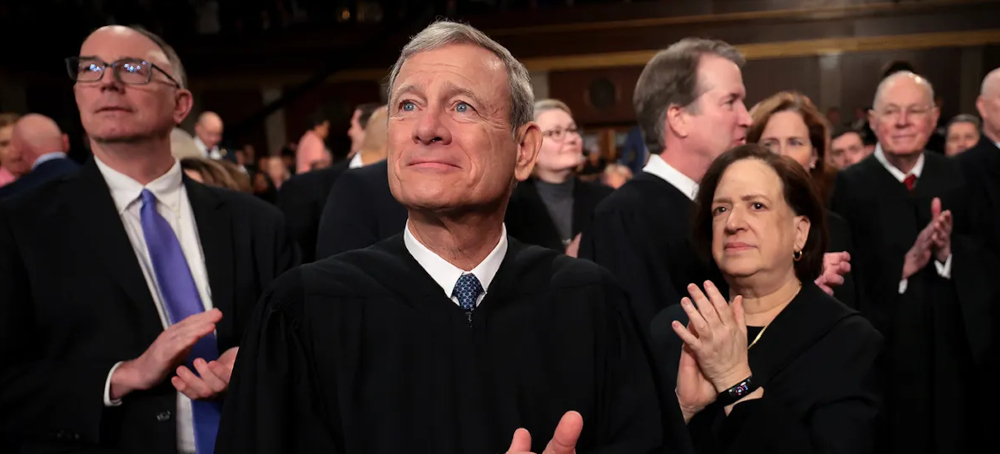 Supreme Court Justice John Roberts. (photo: Getty)
While the court’s conservatives have railed at the term “shadow docket” for years, insisting that the words imply secrecy and bad motives to a benign emergency procedure that operates according to neutral legal principles, the new reporting reveals exactly why the Republican-appointed justices don’t want to shine public or academic light on this practice: If this leak is any indication, the public would be aghast to see the brazenly political, spin-soaked flimflam that goes into deciding these critical cases.
The Times’ latest exposé, by Jodi Kantor and Adam Liptak, documents the previously opaque internal court debate that led up to the Supreme Court’s unprecedented obstruction of President Obama’s Clean Power Plan in 2016. That they did so in a cryptic one-paragraph ruling was, in Kagan’s words at the time, “unprecedented.” This event, though, became the precedent for all that followed. The EPA rule at issue would have required states to gradually shift energy generation toward green technology in a bid to fight climate change. Industry groups and red states swiftly challenged its legality, but the U.S. Court of Appeals for the District of Columbia Circuit declined to block the new plan on an emergency basis, and rapidly calendared the case for oral argument.
The plaintiffs then filed a Hail Mary request with the Supreme Court to intervene before the D.C. Circuit even heard the merits of the case. At the time, SCOTUS had never before frozen an executive branch policy while an appeals court was still reviewing it (and had already refused to grant a stay). Besides, the plaintiffs had plenty of time to fight the EPA: The states were not required to comply with the new rule until two years later in 2018, as Justice Stephen Breyer pointed out, while the fossil fuel companies did not have to take action for six more years.
And yet the conservative justices issued the stay anyway, without a word of justification, kicking off a new era of aggressive and often unexplained SCOTUS intervention in lower court proceedings that has become the disturbing norm a decade later. Until Saturday, we had to guess how and why the Supreme Court decided to shatter precedent and strangle the Clean Power Plan in its cradle. The newly leaked memos from Roberts and Breyer—along with those by Justices Samuel Alito, Elena Kagan, Anthony Kennedy, and Sonia Sotomayor—show how the court came to claim this new “emergency” power for itself. Perhaps most shockingly, this correspondence reveals that it was the chief justice who pressed hardest for a swift and sweeping decision, and that his reasoning had far more to do with presidential politics and personal grievance than any majestic legal logic. More than anything, the new reporting puts the lie to the hollow claims of the chief justice sitting astride a mythical 3–3–3 court where his measured centrism guides the nation through partisan times. It is now manifestly clear that Roberts is himself a top partisan operator, especially under the cover of secrecy and internal norms of collegiality and confidentiality.
Vladeck has already laid out Roberts’ errors and contortions of the law: Among other things, he invoked the wrong standard for relief, greasing the skids for premature action; he also fixated on the Clean Power Plan’s supposed “harm” to the red-state plaintiffs and the fossil fuel industry, while ignoring the harms to the government, the public, and the planet if the plan were blocked. But what stands out just as much is the cynical basis for the chief justice’s haste in leaping in before the matter could be conclusively resolved by a court below. To that end, he cited two media interviews with Obama administration officials to explain why the court had to act immediately. In one, an EPA official said new mercury restrictions had proved successful even though the Supreme Court struck them down because most power plants had complied even before SCOTUS’ decision. In another, the EPA administrator said her agency was “baking” the Clean Power Plan “into the system” and that it would be “solid no matter what Congress” later did.
Roberts quoted this second interview with evident irritation. “I am of the mind,” he wrote, “that a rule designed to transform a substantial swath of the nation’s economy should be tested by this Court before it is presented as a fait accompli. But it seems that the EPA is sufficiently confident of this rule’s immediate implications that not even the combined efforts of Congress and the President could reverse its effects.”
This gibe is especially rich in light of how frequently in recent years Roberts has voted to let the Trump administration implement a policy with immense, irreversible national consequences before his court has approved it on the merits. Even at the time, though, his attitude prioritized political considerations over legal ones. As Breyer and Kagan pointed out, any “harm” to red states and the fossil fuel industry was speculative and years away. The plaintiffs had not even established that shifting power generation toward technologies that inflict less damage on humans and the planet qualified as “harm” here. The chief justice’s biggest concern appeared to be that the Obama administration would be able to promote green energy before his court had a chance to stop it. And that he could not tolerate.
The most charitable read of Roberts’ intemperate intervention (and Alito’s memo supports the same conclusion) is that the Obama administration, by way of comments, was somehow disrespecting the high court. In his musings, Alito asserted that if the court failed to stop the Obama regulations in its tracks, it would make a “nullity” of the court’s authority and “institutional legitimacy.” Roberts similarly warned his colleagues that “the comments of the E.P.A. administrator herself indicate that without immediate action from this court, this rule will become functionally irreversible.” The offense, in this telling, wasn’t so much personal as institutional: Obama’s EPA was allegedly short-circuiting the court’s much-prized supremacy, and needed to be put in its place.
And yet even if this dispute was over lofty principles of judicial supremacy and institutional regard, the court’s later conduct gave the game away. In the decade since this decision came down, it has mainly gone to the mat when Democratic presidents are in office, and has shown scant institutional self-respect when President Donald Trump trammels the judiciary’s authority. (Just last year, the conservative supermajority rewarded the administration for actively defying a lower court order blocking irreversible deportations without due process, showing zero concern about rendering judicial review a “nullity.”) That asymmetry shows how hollow the chief’s claims of “institutional legitimacy” ring. These truncated, unsigned shadow docket orders have morphed from a one-off against Obama’s EPA to a predictable thumb on the scale for unlawful Trump actions, making it abundantly clear that the conservative majority is only protective of its institutional prerogatives when an Obama or a Biden is enacting a rule with which they ideologically disagree.
That EPA ruling in 2016, with its profoundly flawed analysis of what constitutes “emergency” and “harm,” presaged the current Wild West abuse of the shadow docket to rubber-stamp policies and practices that seem dubiously meritorious, with adverse effects on millions of people waved away. And these memos lay bare the extent to which the work product underpinning these decisions is often half-hearted and vibes-based; animated more by grievance and hurt feelings than neutral legal rules. The dispiriting, inevitable conclusion to be drawn from these leaked documents is that the court’s conservative wing is not simply abusing an “emergency” or “interim” docket to achieve desired outcomes. Rather, it has invented a mechanism to conceal petty political vendettas and reckless, speculative reasoning from a public that has become rightly suspicious that this is how the court behaves behind closed doors.