It’s Beginning to Smell a Lot Like Stagflation
Paul Krugman Paul Krugman's Substack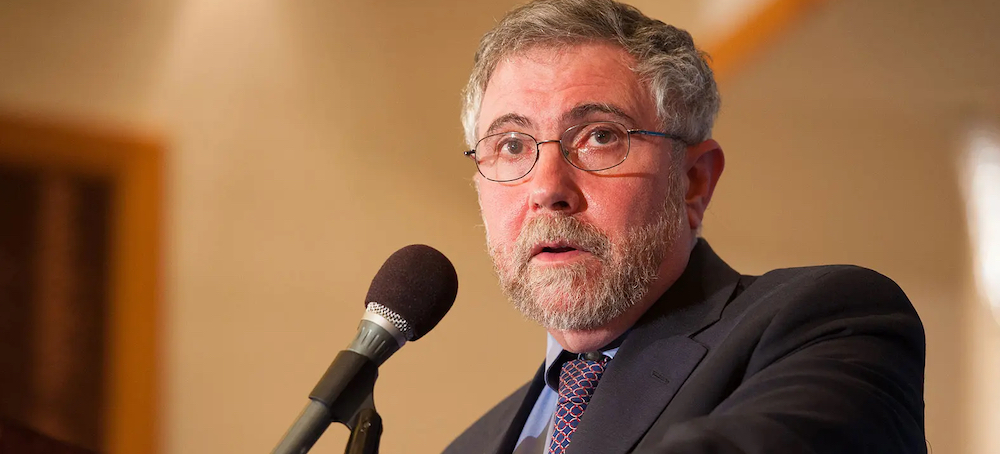 Paul Krugman. (photo: Commonwealth Club)
And it's all about Trumponomics
At this point, however, the data really are looking increasingly stagflationary. And I thought it might be useful to talk about why the lights on the economic dashboard are flashing yellow or red.
The starting point for any discussion is the fact that Trump is pursuing really extreme policies on both trade and immigration. He has completely reversed 90 years of gradual trade liberalization, bringing us right back to Smoot-Hawley tariff rates (and imports as a percentage of GDP are three times what they were in 1930, so these tariffs matter a lot more):
On immigration, ICE has just gotten going on mass arrests and deportations, but the number of foreign-born workers in the United States is already shrinking after years of rapid growth:
These sudden policy reversals will clearly lead to higher inflation over the next year or so. Whether they’ll lead to more persistent inflation is less clear, but I think that will have to wait for another post.
There is almost complete consensus among economists that tariffs are inflationary. As far as I can tell, the only dissenters are economists who work, directly or de facto, for the Trump administration. After all, a tariff is basically a selective sales tax imposed on goods produced abroad. Is there any scenario under which tariffs wouldn’t raise consumer prices?
The only way tariffs could fail to be inflationary is if foreign producers were to slash their selling prices in an attempt to retain their market share. There may be some foreign companies doing this, but for the most part it just isn’t happening. To keep consumer prices from rising in the face of a 15-point rise in average tariff rates, which is more or less what Trump has done, foreign companies would have to cut their dollar prices by more than 13 percent. In fact, import prices excluding tariffs have risen under Trump:
The war on immigrants is also inflationary, because it is choking off production in industries that rely heavily on foreign-born workers. Stories are proliferating of crops left to construction projects hobbled by ICE raids and a climate of fear, and more.
So is inflation happening? So far there have only been hints of tariff-driven inflation in official data. What seems to have happened so far is that U.S. companies rushed to import and stockpile foreign products before the Trump tariffs went into full effect, and are still to a large extent selling out of those stocks. Also, many companies were reluctant to raise prices, alienating customers, as long as there was a chance that Trump would make deals that brought tariffs significantly down again.
That, however, isn’t happening. It’s true that many of Trump’s tariffs are clearly illegal, and the courts could force him to reverse them. But I wouldn’t get my hopes up. And if the tariffs are here to stay, we can expect them to be passed on to buyers.
We can already see this happening in private surveys of purchasing managers, which have historically been good predictors of official inflation. The latest report on services from the Institute of Supply Management was quite grim on both inflation and jobs. Torsten Slok of Apollo has a chart showing the historical relationship between the ISM and inflation rates 3 months later, which suggests a nasty shock — inflation of 4 percent or more — just around the corner:
Will we see clear evidence of the inflationary impact of Trumponomics in next week’s consumer price report? Will Trump engage in another round of tirades about rigged statistics just a few days from now?
Honestly, I don’t know. But we can be highly confident that, thanks to Trump’s policies, winter inflation is coming. What about stagnation?
Contrary to what many people believe, tariffs don’t necessarily lead to high unemployment. America had a high average tariff even before Smoot-Hawley — 15.8 percent in 1929 — but the unemployment rate in 1929 was under 3 percent.
The reason many economists believe that Trump’s tariffs will raise unemployment isn’t so much their level as the uncertainty they create. How can you expect businesses to make long-term investments when they don’t know whether they’ll be facing 10 percent or 35 percent tariffs a year or two from now?
You might argue that tariff uncertainty will abate now that Trump has made “deals” with some of our major trading partners. But these aren’t formal, signed trade agreements. And Trump’s claims about what other countries have agreed to — like his insistence that Europe has promised him a $600 billion slush fund and “I can do anything I want with it” — are contradicted by the countries themselves. So tariff uncertainty remains high. And the uncertainty created by mass arrests and deportations, which is equally likely to hurt business, is just getting started.
In fact, you can argue that the only thing holding back a really big economic slowdown has been the boom in data centers and other AI-related investments.
And even with the AI boom, the U.S. economy has clearly been slowing. Quarterly growth rates have been erratic, mainly because of wild swings in imports, which surged early this year as companies tried to front-run the tariffs then plunged as tariffs came into effect. But if you smooth out the craziness by looking at half years rather than quarters, you see a clear slowdown under Trump:
I’ve already mentioned the Institute for Supply Management survey, which usually provides an early read on what’s happening to the economy. The latest survey, in addition to suggesting rising inflation, points to a further slowdown in growth:
The past relationship between the Services PMI® and the overall economy indicates that the Services PMI® for July (50.1percent) corresponds to a 0.5-percentage point increase in real gross domestic product (GDP) on an annualized basis.
This is getting down to what Goldman Sachs calls “stall speed” — “a pace below which the labor market weakens in a self-reinforcing fashion.”
Last week Trump fired the head of the Bureau of Labor Statistics over a weak jobs report, which he insisted was “rigged” and politically motivated. But those new numbers just brought the BLS into line with multiple other indicators suggesting a weakening economy.
It’s worth remembering that the last two years of the Biden administration were marked by “Immaculate disinflation,” with inflation falling while the economy maintained solid growth.
But now inflation is coming, while stagnation seems to have arrived. So stagflation it is.
MUSICAL CODA
A stagflation era (1978) song — but cheerful.