UN’s COP31 Climate Conference Fizzles Out as Global Policy Divides Deepen
Bob Berwyn Inside Climate News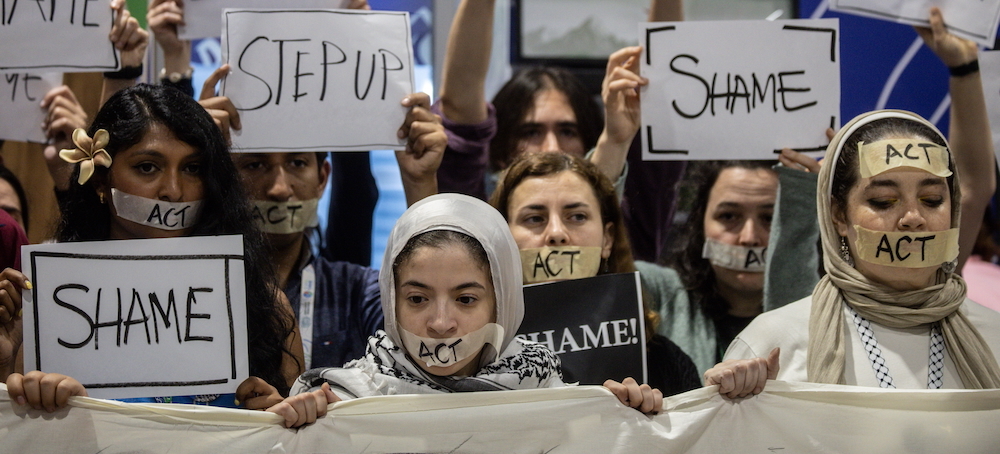 People protest outside ahead of the closing plenary session on the final day of the COP31 climate conference on November 20, 2026, in Antalya, Turkey. (photo: Chris McGrath/Getty Images)
Countries could not find consensus on climate finance, fossil fuels and carbon capture.
As cleaning crews cleared away the debris left by more than 100,000 participants, Murat Kurum, president of the Conference of the Parties and Turkey’s minister of environment, urbanization and climate change, tried to tie together disparate parts of a draft climate deal with a shiny ribbon of multilateralism.
Many countries were not buying it.
For the first time since 2009, the conference ended without consensus on a cover decision, the concluding statement that typically signals global solidarity on how to confront the worsening climate crisis. Countries did adopt several decisions, including a program to help workers and communities transition away from fossil fuels, and a plan to assess progress on climate adaptation.
The failure to agree on an overarching conference statement reflected deep divisions over whether the agreement should mention fossil fuels and carbon capture, as well as how much climate financing developed countries should provide to developing nations hit by costly climate disasters.
The European Union, as well as several Latin American countries and Pacific Island states, said they would not accept the proposed text from the conference leaders.
Cover decisions at the annual conferences usually focus on new steps or
language that could reinforce international efforts to slow global
warming. A central aim at this meeting was to set quantifiable but
voluntary global goals for the widespread electrification of economies,
and to increase funding from developed countries to help developing
countries adapt to climate impacts.
In 2022, the U.N. conference in Egypt agreed to establish a loss and damage fund to help vulnerable countries pay for irreversible climate impacts. A year later in Dubai, delegates from more than 190 countries agreed, for the first time, that a “just and orderly” transition away from fossil fuels in energy systems is needed to slow global warming.
Since then, international collaboration on climate issues has declined amid increased conflict, rising oil and gas prices and economic insecurity. The talks in Turkey ran two days beyond the scheduled end without reaching broad agreement on potential next steps, an outcome that won’t kill the global effort but is widely viewed as a serious setback.
But compromise for the sake of consensus is not enough, said Kathy Jetn̄il-Kijiner, a climate envoy for the Marshall Islands Ministry of the Environment.
“We will not be forced to accept false solutions,” she said. “We will not compromise our future to benefit fossil fuel interests.” As written, she added, the Antalya Pact undermines her country’s security and threatens its future.
“People are dying, seas are rising and ecosystems are collapsing,” Jetn̄il-Kijiner said. “Are we so divorced from reality that we take backward steps, even as overshoot threatens to overtake us? To accept this deal would be a betrayal to the Marshallese people.”
It’s not the first time Pacific Island nations threatened by rising seas have objected to the outcome at one of the United Nations’ annual conferences. During the 2023 U.N. talks in Dubai, a final text was adopted even though a delegation representing 39 small island developing states objected because they were still outside the plenary meeting, trying to coordinate their position.
But in Antalya, the divide ran much deeper. The economically powerful and politically influential European Union, representing 28 member countries, also rejected the proposed agreement.
Ireland’s climate, energy and environment minister, Darragh O’Brien, said the European countries formally objected to the cover decision because it fell short of what the global climate crisis demands.
“We will not endorse a decision that does not even mention fossil fuels, the key driver of climate change, and not accept a COP that greenwashes fossil fuels,” said O’Brien, speaking on behalf of the EU during Ireland’s rotating presidency.
Egypt and Brazil, hosts of the U.N. climate talks in 2023 and 2025, also criticized the text proposed by COP31 president Kurum of Turkey and Chris Bowen of Australia, president of the conference negotiations.
Liliam Beatris Chagas de Moura, director for climate at Brazil’s Ministry of Foreign Affairs, said she was disappointed that this year’s conference did not sustain the momentum from last year’s talks in her country.
Mohammad Ayoub, a climate negotiator with the Saudi Arabian energy ministry, said the 22-member League of Arab States supported the proposed Antalya Pact. He criticized developed countries for using up most of the global carbon budget, the amount of fossil fuels that can be burned without overheating the planet, and then asking developing countries to give up the very energy sources that fueled their own growth.
Ayoub condemned some countries’ opposition to including references to carbon dioxide removal and carbon capture and storage in the pact, calling their resistance to those technologies unscientific.
Carbon capture and storage are not close to being deployed fast enough “to keep 1.5 degrees within reach,” he said, referring to the long-term goal of limiting the average global temperature increase established by the 2015 Paris climate agreement.
“We believe that climate change requires all solutions on the table, and
that countries select from these solutions depending on their national
circumstances.”
U.N. Secretary-General António Guterres said he was “deeply disappointed” that the talks ended without consensus on an overarching agreement.
“But this setback does not change the facts,” he said. “Fossil fuels are driving the climate crisis. We can’t put out the fire while pouring fuel on it.”