Step 1 for Democrats: Kill the Filibuster
Dan Pfeiffer The New York Times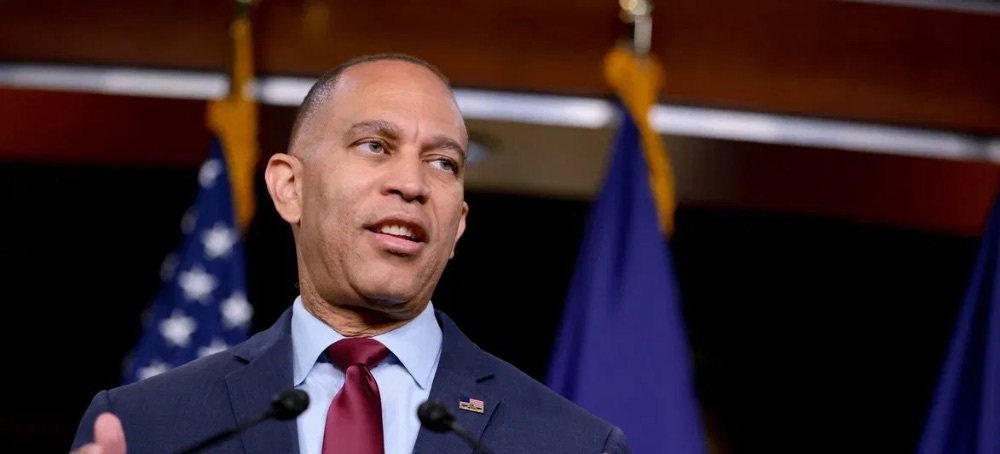 Incoming U.S. House Speaker Hakeem Jeffries. (photo: Anna Moneymaker/AP)
We should be very clear, however: The midterms were not a permanent realignment. The voters who swung to Democrats this election are trying us on to see if we can do better than the Republicans they voted for two years ago.
The problem is that President Trump is still in office. He has already signaled that he hasn’t moderated, promoting his fanatical aide Stephen Miller to White House chief of staff. In the House, Republicans have chosen Representative Jim Jordan, a Trump acolyte, as the new minority leader. They will undoubtedly see it in their political interest to deny Democrats legislative wins.
In the Senate, Democrats retook the majority, but they won’t have enough votes to overcome Republican filibusters. Voters want change, and under the current rules, Democrats do not have the power to deliver it. And if we can’t deliver tangible results, we had better make sure voters know that we tried like hell and that Republicans are to blame for the lack of progress.
To do this, Democrats will have to reimagine both how we govern and how we communicate. Step 1 is audacious but straightforward: Abolish the filibuster. Don’t wait for 2029, on the assumption that the next president will be a Democrat. Do it now.
One thing I learned during my years working on Capitol Hill and in the White House: Most Americans don’t care about legislation that is doomed to fail.
Politics is a battle for attention. It’s difficult to get people to pay attention to bills that make it through the House, where a simple majority is all that’s required for passage, but then die a quiet death in the Senate after failing to garner the 60 votes needed for cloture — Senate-speak for overcoming a filibuster, ending debate and moving a bill to a decisive up-or-down vote.
Winning the battle for attention is especially important when it comes to the swing voters who decided many of this year’s elections. Once the ballots are counted, they often don’t pay close attention to politics until it’s time to vote again. Unlike hard-core Democrats or Republicans who stay dialed in, swing voters often don’t keep track of every legislative twist and turn — or give out A’s for effort. If good bills don’t become law, there’s a good chance that they will blame the party in control of Congress; never mind that the votes to break a filibuster weren’t there.
In 2024, male voters, young voters, Latino voters and voters without college degrees all swung toward Republicans. In 2026, they swung toward Democrats. If we have two more years of legislative gridlock and make no progress on affordability, these voters could, very easily, abandon Democrats again.
Every election since 2016 has been a change election: To register their dissatisfaction with the status quo, many Americans vote for change, then don’t get the change they want, and then vote for change again. It’s one of the reasons we went from Barack Obama to Mr. Trump to Joe Biden and back to Mr. Trump, and why the House and Senate each changed control three times in that period.
Abolishing the filibuster would change this dynamic. With Democrats taking control of Congress and only a simple majority needed in both houses for bills to pass, instead of dying in the Senate, bills would now go to Mr. Trump’s desk, where he would either sign them or veto them.
If he vetoes popular bills, those vetoes will get a lot of attention, putting the onus on Republican intransigence, not Democratic failure.
Imagine Democrats passing the first increase to the federal minimum wage in nearly two decades on a party-line vote. The president would have to choose between signing it into law and taking the blame for killing it.
The last time Democrats seriously debated filibuster reform was in 2021, when we had control of the House, the Senate and the presidency and were trying to pass major election reform. At the time, Democrats were only two votes short of the 50 votes needed to change the rules. (As the president of the Senate, Vice President Kamala Harris would have supplied the tie-breaking vote.) In January 2022, 48 Democrats voted to eliminate the filibuster for voting rights legislation, with Senators Joe Manchin and Kyrsten Sinema voting with the Republicans.
Mr. Manchin and Ms. Sinema are no longer in office. When the next Congress begins on Jan. 3, the Democratic caucus will have 56 senators. That means Democrats could lose five votes and still get to the 51 needed to change the filibuster rules.
Several of the incoming senators, including James Talarico, Abdul El-Sayed and Juliana Stratton, have said they want to either end or amend the filibuster. Others haven’t taken a public position.
The math isn’t easy. Senator John Fetterman, a Democrat, and Senator Angus King, an independent who caucuses with the Democrats, have both opposed changes to the filibuster. Undoubtedly, other senators will be wary of a fight over Senate procedure at the start of a new Congress.
Mustering the votes to do away with the filibuster will take persuasion, and there will be risk. One day, very likely, Republicans will again control the White House and both chambers of Congress. With the filibuster gone, they would need only 51 votes to enact the laws they want: Imagine the damage they could have done over the past two years if the Senate had been able to pass bills like the SAVE America Act — voter suppression legislation Mr. Trump desperately lobbied for.
But Democrats shouldn’t shy away just because there is risk. The next time Republicans are in charge, they might decide to eliminate the filibuster, and it would be gone anyway.
In the short term, the risk is relatively limited for Democrats. We will now have an overwhelming majority in the House. And the 2028 map — reflecting the Senate terms that expire two years from now — is friendly enough that the odds of Democrats losing the Senate in 2028 are relatively low.
Additionally, eliminating the filibuster would make it easier for Democrats to maintain our new, bigger tent. If Senate passage required only 51 votes, red-state Democrats could be more strategic about how they spend their political capital without blocking legislation.
Finally, the filibuster is bad in principle. It’s an antidemocratic relic, abused during the Jim Crow era, that makes it almost impossible to get much of consequence done. Frequently, the only way to pass significant legislation is through the convoluted budget reconciliation process.
Starting the new Congress with debate about Senate rules will ruffle some feathers.
But consider the alternative: Two years of bills going nowhere in the Senate, followed by a 2028 campaign in which Democrats ask voters to trust us again, even if we gave them almost nothing to show for that trust.
Just last year, Mr. Trump was urging Republicans to get rid of the filibuster. We should take him up on it. Then put up every bill that makes health care more affordable, lowers other costs and bans congressional stock trading, and make him sign his name to every no.