Zohran Mamdani: ‘If You Aren’t Willing to Fight, You Will Never Win’
Jack Crosbie Rolling Stone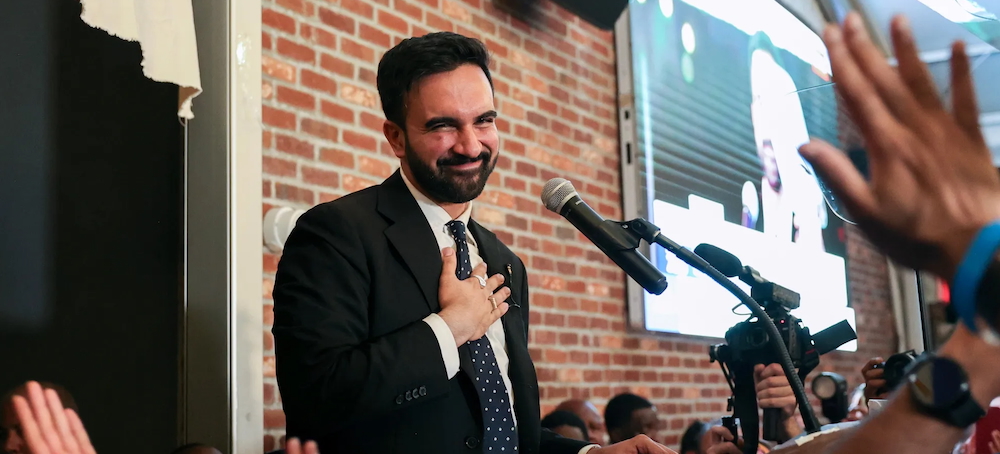 Mayor Zohran Mamdani addresses a crowd of people. (photo: Bloomberg)
The New York City mayor talks about the future of the Democratic Party, what he’s learned over his first six months in office, dealing with President Trump, Taylor Swift’s wedding, and more
“What got you into Chelsea — you love Clearlake Capital?” he asks me before the cameras have even started rolling in the historic foyer of Gracie Mansion for the Rolling Stone Interview. He is roasting the fact that my team is owned by a massive American private-equity firm that spent $1.5 billion on new players only to finish in 10th place in the English Premier League this season. The mayor supports Arsenal, a rival London team who finished first. He is equally disgusted with my support for England in the World Cup. “Brother, whyyyy?” he says, grimacing.
I knew these opinions would be contentious, and yet, I was not prepared for the verbal violence they would bring. I make noises of protest, jabbing at Arsenal’s longtime sponsorship by the dastardly Dubai-owned Emirates Airlines, blaming my allegiances on an English father. None of it works. The dimples on Mamdani’s cheeks are pointed at me like a double-barreled shotgun. He is grinning, grinning.
This process repeats multiple times over the course of our interview, whenever sports come up. I begin to understand what former Gov. Andrew Cuomo must have felt like on that debate stage last June, being skewered by a cheerful democratic socialist in a slim-cut suit. If Zohran Mamdani wants your head, his blade is ever sharp.
Since his decisive win over Cuomo in November of last year, Mamdani’s name has been on everyone’s lips. To the right, he is the bogeyman of their greatest fears, a brown man who believes in the radical redistribution of wealth and who they fear will institute Sharia law across the city. To the left, Mamdani is a sunny-dispositioned savior of New York’s perennial dysfunction and the catalyst for change in a national political system that has long been ruled by do-nothing centrist Democrats and an increasingly bloodthirsty far right. In the first six months of his administration, he hasn’t really behaved like either side’s caricature of him. Instead, he’s governed: cutting deals with the state government, City Council, and the powerful forces of New York’s political ecosystem. And in New York’s June primaries, he laid his political capital on the line by endorsing a slate of radical candidates for national and state office, knocking off several incumbents and making it clear that he was ready to spill blood within his own party.
Mamdani, then, is a rare force in modern Democratic politics. The charm is genuine, but it’s also a tool. The ideals are sincere, but they’re also a challenge. His staff, as far as I can tell, love him, but there’s no question of the power he now holds. On the campaign trail, he was “Z” — a state senator not so far removed from his days canvassing for other candidates. In victory, however, there are no more nicknames. They call him “Mayor.” Like it or not, everyone else has to do the same.
You’re coming off of a huge primary Election Day, where you
backed several democratic socialist candidates with limited experience
in public office. That was, by some measures, a big risk with your
political capital, and you came away with a clean sweep. Take me into
that Tuesday night. How did it compare to the night a year ago when you
won your own primary?
It was an incredible evening. To see what it meant to so many
different parts of our city, to travel [to each of their events], to see
that no matter what neighborhood or borough you called home, New Yorkers
were hungry for change. It was incredible.
Did you have any moments of déjà vu?
So many of the people who were at the heart of our campaign
poured themselves into these races. It speaks to the fact that for so many
of us, it was never about one office — it was about one movement for
working people. I mean, Darializa [Avila Chevalier, who successfully
primaried House Hispanic Caucus leader Adriano Espaillat], for example,
she was a field lead on our [mayoral] campaign. As I was walking through
her district, we met one of her field leads who told me that they were a
canvasser trained by Darializa more than a year ago. That is what we are
looking to build — a movement that, wherever it finds a fight for working
people, it is there on the front lines.
Darializa is a former activist, and she was criticized during her
campaign for past social media posts praising communist ideology,
calling for the police to be abolished, and at one point tweeting “Fuck
Kamala Harris.” For many people, she seems to be another bogeyman for
what socialism will bring. What did you say to her about handling that
backlash?
I told her first that this only happens when there’s a chance
that you win. And this is a reflection of the desperation that some are
feeling in the face of what would be a new chapter in our city’s politics.
For the vast majority of those who will be voting and who live in that
district, this is not what they are concerned about. The people of New
York’s [13th Congressional District] want to know that they have a
representative that is willing to fight for them in the face of living in
the most expensive city in the United States of America. It’s one of the
poorest congressional districts across the country. So much of what we
saw, the fearmongering, the blatant racism, it was an attempt to distract
from the fact that Darializa would deliver on exactly that vision for
those same working people.
You said the backbone of your movement has been people moving
from field leads and activists to actually running for office. What
advice do you give those who are thinking about making that transition?
What I would say is that to run for something … at the heart of
it has to be “Why are you doing this?” If the answer is “For working
people,” then you will find that there are far more people who are ready
to stand alongside you in that fight.
The issue of income inequality, the absence of affordability in people’s lives, it’s not unique to New York City. It is something that Americans are feeling across the country. They’re tired of a politics that has effectively been bankrupt, whether it’s politically bankrupt, morally bankrupt, or economic. And they’re looking for something that actually speaks to their needs.
This election cycle was the most political hardball we’ve seen
you play. Several of the endorsements you made came against the wishes
of the centrist block of the Democratic Party. Why did you think that
this was the right time to take those shots?
I made a promise a little more than a year ago to New Yorkers
that I would use every tool at my disposal to deliver on an affordability
agenda. When you are fighting for those who have been left behind, there
will always be risk. It will always be easier to let that fight go.
I often think about the words that Tim Walz said about political capital. To paraphrase them: What is the use of having it if you’re not using it to help working people? That’s what came back to me in that moment. The consistency, the clarity, the conviction that characterized all three of these [congressional] races compelled me to make that decision.
That national battle between centrist and leftist Democrats has
really come to center stage. Former DNC chair Jamie Harrison tweeted on
election night: “I say this with no ill will or animosity. If you hate
the Democratic Party, then please don’t run for our nomination.” He
didn’t mention you or any of these candidates by name, but it seems like
a pretty pointed critique. How do you respond to that?
Usually, if someone says, “This is not of any ill will or animosity,” what
they’re about to say is characterized by ill will and animosity. But look,
the question that I come back to is “What is the Democratic Party if not
its voters?” If you look at what Democrats are voting for in New York 13,
in New York 7, in New York 10, and you say that that is not representative
of the party — it may not be representative of what has effectively become
our party, which is something that’s run by well-paid consultants and
big-money interests. But it is representative of what Democrats themselves
want to see. It’s representative of the fact that in this country there is
just one majority and that’s the working class.
Of course there’s a difference between campaign promises and
what you can actually deliver. What has been a lot harder for you to
achieve since coming into office than you thought it would be on the
campaign trail?
It’s often framed that campaigning is easy and governing is hard.
In campaigning, however, you are asking people to believe in something
despite their own experiences. What I appreciate about governing is that
it comes with an opportunity to deliver.
Over the past six months, we’ve taken what was previously an intellectual question — “What does it look like to run a city with democratic socialism?” — and delivered on it. We have paved over 165,000 potholes. We have returned tens of millions of dollars to tenants who were taken advantage of by their landlords. We have put our city on a path to universal childcare, saving parents more than $20,000 a year. We’ve done all of this while delivering the lowest recorded number of murders and shootings in New York City history, and with a commitment to put our city on a path to the most ambitious affordable-housing agenda that we’ve seen in generations.
Right. But I’ve seen you get criticism even from some of your
supporters more on the left as you’ve had to moderate some of these
proposals and promises. Are there ever moments where you feel like you
have to compromise in areas you didn’t want to?
The job is difficult at its core. You are looking to deliver for eight and
a half million people, many of whom have experienced politics as an act of
disappointment with various stages. My North Star is thinking about those
that have been priced out of this city. What I’ve found is there’s a lot
more that’s possible to do than what we’ve been told in the past.
I am never going to say that this work is easy or it’s straightforward. It’s incredibly difficult. However, there is a way to deliver on what you ran on. It will take time. But what we’ve shown is that even in six months, you can put the city on a different path.
A lot of the ideas that you ran on would not have been so
shocking to the political establishment in FDR’s era. Why do you think
that those things are seen as political impossibilities now?
For a long time, those kinds of ideas — what the Democratic Party can
stand for, what it can fight for — could only be found in a history book.
Think about the distillation of this vision into the four freedoms [FDR’s
principles, taken from his State of the Union Address in 1941, that all
Americans should live with the freedom of speech, freedom of worship,
freedom from want, and freedom from fear]. If offered today, [the four
freedoms] would be heard as a radical vision of this country, when in fact
it’s very much grounded in why so many [Americans] are proud to be
Democrats — why I’m proud to be a Democrat. It speaks to a recent history
of our party becoming more a reflection of a consultant class and of
special interests than a reflection of what working people need.
“Hope is a responsibility. If you share that with others, it is also a duty to deliver on it.”
You say you’re proud to be a Democrat. Do you think that your
movement can ever coexist with the centrist faction of the Democratic
Party, or is this really an existential battle for where the party’s
going to go?
I think we all belong to the big tent that is the Democratic
Party. The question in front of us is “Where do we want to go, and what do
we want this party to be?” The Republicans have this seemingly limitless
ambition for what it is that they want to accomplish, whereas we seem to
be constructing an ever-lowering ceiling of possibility. In 2028, we have
an opportunity to move beyond the current federal administration. That
begs the question “To what?” I think that it is time to not only have a
vision, but to deliver on that vision.
What we’re showing here in New York City is that it is possible to put working people back at the heart of our politics and then also deliver for them at the same time. Too often, New Yorkers have been asked to choose between their quality of life and the quality of the city’s ambition. It’s time to show that in fact both of these things can be fulfilled at once.
What does a national Democratic Party look like to you,
ideally?
It looks like a party that is asking itself the question of “What are
working people struggling with?” and then answering that question with
what they can do to make life easier. I believe that our politics has to
go beyond an intellectual exercise and has to be something that is
material. If we cannot describe our politics and how it helps people
afford their rent, their groceries, their childcare, then it seems like a
hobby that some people can afford to have.
A sentiment I’ve seen online a lot in reaction to your first
six months in office is some version of “Turns out you can just do
things.” What’s one accomplishment you’re proud of that wasn’t a stated
campaign promise?
On the first day of our administration after inauguration, I went to meet
with a number of tenants who live in a building that is controlled by a
real estate organization, where they have filed complaint after complaint
after complaint. I went into one of the tenant’s homes and she showed me
her bathroom, and it was just rust falling off the pipe, falling off the
ceiling. I asked her how long she’d been living with this and then she
turned around and she pointed to her son, and she said, “Longer than he’s
been alive.” He was more than 20 years old.
We made the decision to file a lawsuit on behalf of those tenants. Just by virtue of filing that lawsuit, we got the next owner to agree to remedy all of the violations at that building and other buildings owned by that same real estate organization. That, to me, shows the worth of fighting because if you aren’t willing to fight, you will never be able to win.
But you need to enact those things systemically as well. As you
know better than I do, NYCHA — the New York City Housing Authority,
NYC’s public-housing agency — is one of the most complaint-written
landlords in the city.
Sometimes the systemic nature of an issue has been used to justify why you
cannot do anything in the short term. We have heard many who have come
forward and said, “NYCHA has $80 billion in capital needs. It’s a federal
responsibility. We need the federal government to act.” All true. We also
know that whether or not it’s a Democratic administration or a Republican
administration, NYCHA has had those capital needs. If we are going to wait
for D.C. before we take action, we are effectively leaving hundreds of
thousands of public-housing residents on the hook for the amount of years
that it will take for D.C. to finally remember those same tenants. We are
going to put forward the resources that go beyond what the city has done
before — we nearly doubled our city’s capital commitment to NYCHA.
Part of the reason that you face questions like this is because
you’ve become the face of a movement in American politics. But when you
become the face of something, you start becoming liable for everything
that someone wants to pin on you. I’ve seen everything from the Charlie
Kirk assassination to FIFA’s overturn of American player Folarin
Balogun’s red card in the World Cup put on you. How do you decide which
of those critiques you feel like you have a responsibility to respond
to?
If they affect working New Yorkers. There’s a difference between
the discourse and what people in this city are concerned about.
You’re good at this.
Thank you.
Everyone who has seen you, met you, interviewed you says the
same thing — that you are a talented politician. Sometimes it’s not said
as a compliment. What does being a good politician mean to you?
I think it means delivering. For a long time, being a good politician has
meant debating. [My administration] wants it to be material. If you knock
on a New Yorker’s door right now and you ask them what they’re worried
about, they’ll define it in terms of cost.
What do you judge yourself by? What are you privately worried
that you’re not going to be able to deliver on?
I often go back to why so many New Yorkers knocked on doors for
our campaign. What brought them out to do that? That hope is a
responsibility. If you share that with others, it’s also a duty to deliver
on it.
“I feel like an uncle who opens up the closet and it’s just the same outfit again and again. Shout-out to the suits.”
For me, when we talk about 2,000 seats of free childcare for two-year-olds this year, 12,000 seats next year, a seat for every single two-year-old by the end of four years, I always want to make clear that that is not my achievement. It’s the achievement of everyone who walked up those six-floor walk-ups and knocked on door after door after door and told people that there was a world we could win where childcare didn’t have to be $20,000. I want to measure our administration in whether we delivered for both the person who was knocking and the one whose door was getting knocked on.
I’m curious about your upbringing, which was about as
classically New York as you can get for someone who came here at the age
of seven. How did that cultural upbringing shape your view of the world
and your politics? Your musical references are everywhere, for instance.
Some of my earliest memories are in New York City. I used to love
going to Tower Records. I think it was on 66th and Broadway. And they
would have just floors of just incredible numbers of CDs. I loved the
Offspring at the time.
Classic. Classic of the era.
The first album I was given was the clean version of Jay-Z’s The
Blueprint. They used to sell bootleg CDs right outside of Tower
Records, and that’s where I bought Eiffel 65’s seminal classic. A lot of
people only know them for “Blue (Da Ba Dee).” “Too Much of Heaven,” great
song.
What are you listening to now?
Right now, I’ve been listening to a lot of Radio & Weasel, who are a
duo from Uganda who were running the charts for a long, long time. I’ve
also been listening to a Pakistani rapper named Shamoon Ismail, who I’ve
listened to for a few years. If I’m feeling reflective, throw on some
Kacey Musgraves.
New album was great.
I’m still listening to Golden Hour.
It’s always funny hearing those cultural references coming from
a guy who has made it a thing to pathologically wear a suit. Tell me
about that style choice.
I feel like an uncle who opens up the closet and it’s just the
same outfit again and again and again. I mean, shout-out to the suits.
One of my pet peeves with politicians, and no offense, is the
T-shirt over the collared shirt.
Oof. I do that sometimes.
I know, I know. I’ve seen you do it, and it’s not a personal
attack.
I’m taking it like one.
And of course we know you love sports. What was your entry
point to sports?
I have to credit my uncle. He introduced me to Arsenal in the
late Nineties, early 2000s. I was born in Uganda, in East Africa. Arsenal,
I would argue, is the most supported team in Uganda. A lot of that has to
do with the history of African talent on the team: Kanu, Lauren … Kolo
Toure, Emmanuel Eboue, Alex Song … I’ll even name him even though I’m
forever hurt by [him] — Emmanuel Adebayor.
My first World Cup memory is probably around ’98 as well — just falling in love with Zizou [France’s French-Algerian captain Zinedine Zidane]. I mean, what a player. The first time my dad ever let me be late for school was when France was playing Senegal [in the 2002 World Cup]. His love of academia had no chance against Pan-Africanism. We stayed home, watched Papa Bouba Diop score on Fabien Barthez. That’s one of my early memories.
How do you use that knowledge of sports to connect with people?
I think there are a lot of people for whom sports are effectively their
first language. When you speak to someone for whom English is clearly a
second or third or fourth language, you’re in some ways speaking to a
shadow of them. You’re missing the entirety of who this person is. And
when you talk to someone about sports, whether it’s soccer or basketball,
whatever else it may be, it’s as if the fullness of them is finally in
view.
All right, the sports stuff was supposed to come at the end.
We’ve got to talk about Trump. Your meeting with Trump at the White
House was one of the most striking parts of the very beginning of your
tenure as mayor. What’s your relationship now?
The relationship is as it was. It’s built around New York City. For all of
the many disagreements that the president and I have, we have one thing in
common, which is a love of this place.
Do you feel like you have to appeal to Trump’s ego a little bit
in those interactions to keep his sights off the city? I think the fear
has been that what happened with ICE and the National Guard in places
like Minneapolis or Los Angeles is going to come to New York City.
I think I need to continue to be honest with the president, and
that honesty is in places of disagreement. I’ve spoken to him directly
about how I think of ICE as a cruel agency that does nothing to serve the
interest of public safety. I’ve spoken about how I think it should be
abolished.
“It is hard to prepare for death threats. I’ve come to accept it as part of the work that I do.”
What do you think about him constantly saying how handsome you
are?
Thank you?
We’ll take it, I guess. His second term has come down harder on
other cities, but New York hasn’t escaped the ripple effects of what
Trump has done.
The cruelty of ICE is not an intellectual concern to our city.
There are New Yorkers who’ve had their families split apart by this
agency. I get texts on a regular basis from both people that I know and
those that I’ve never spoken to before, asking me for help.
Whether we’re speaking about health care or we’re speaking about SNAP, federal policy is making it harder for people to afford to live in the city. And we’re trying to do everything we can to fight back against the effect of those cuts. And yet, there is a limit to what a city can do in the face of federal policy that is looking to decimate these programs. It’s going to have a real impact on an untold number of New Yorkers across the five boroughs.
The other national issue that has become increasingly relevant
for every politician in this country is Israel and Gaza. Why do you
think that it’s important for New York’s mayor to have a clearly defined
position on that subject?
My politics is one that has no exception. When I’m speaking about
the importance of dignity and international law and human rights, I speak
about that with an application to everyone. For a long time, what we’ve
seen is a willingness to exempt Palestinians from those ideals. The more
willing you are to cut anyone out of a conviction, the more likely you are
to lose that conviction altogether.
Where did you develop those convictions?
From a young age, if I could see a contradiction between that
which we said we believed and that which we were willing to do, it was
something that I just couldn’t let go. The more you’re in politics, the
more you’re told this is just simply how it is. And to me, I just never
think that’s a good enough answer.
I bring it up because it’s really one of the most divisive
issues of our time, and it’s also one that has brought you some of the
most intense criticism — in your personal life, too. Your wife, the
artist Rama Duwaji, has also been criticized over her views on Israel
and Gaza. How have you two adjusted to that?
It is hard to prepare for death threats. It is hard to prepare
for getting a phone call from a district attorney telling you that someone
from another state is going to be charged for what they have said and
hoped to do about you. When you are willing to speak up for all people,
there are consequences that come from it. It’s obviously at a different
scale now that I sit in front of you as the mayor. But even when I was an
assembly member and I would speak about how it’s unacceptable that we’re
sending billions of dollars to kill innocent Palestinians, I would receive
voicemails that threatened many of the same things.
I’ve come to accept it as part of the work that I do. What will always be very difficult to accept is what it means for the people that I love. You hear politicians speak about it, and it initially reads as if it’s a cliché. When you start to live it, you fully understand the weight of what this work does to those that you love and those around you. It transforms everyone’s life.
As we’re speaking on July 6, I want to address the elephant in
the room: Taylor Swift’s wedding, which happened two days ago. How long
did you know that she was planning a big event in the city?
We had some indication that there would be a permit application
coming in, but it wasn’t until right before the wedding that that permit
was actually submitted.
So she was last minute.
In terms of what the city had to respond to, that application
came in just before the wedding. But our responsibility is also to plan
for any eventuality and to make sure that we’re ready to respond to it.
You get any feedback from the various agencies involved?
Generally, I think the city services acquitted themselves very
well.
There you go. So that’s the—
I thought you were asking me how the attendees — whether they had a good
time. I was like, “I have no idea.”
Well, I was going to ask if you were invited.
No.
Yeah, too bad. Her loss.
[Laughs.] No. I’m fine.