Why the U.S. Military Has Never Threatened Civilian Governance
Loren Voss Lawfare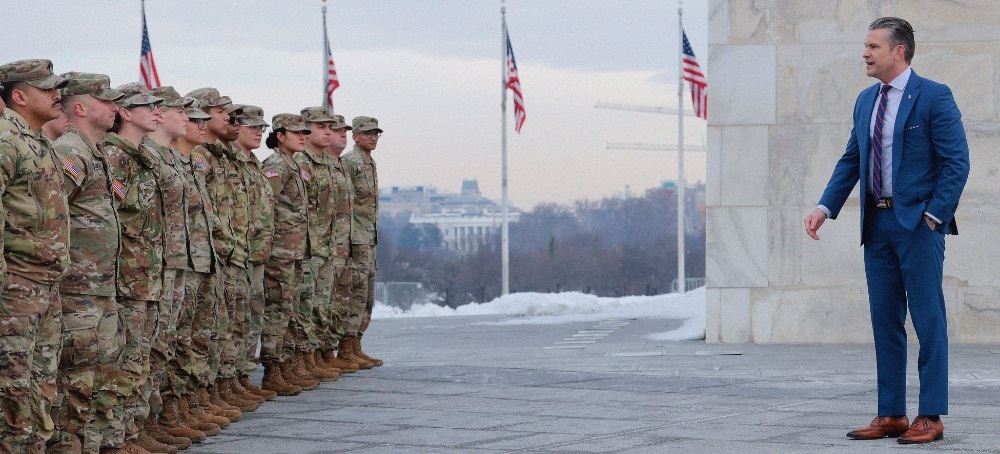 Defense Secretary Pete Hegseth with members of US Army. (photo: Chip Somodevilla/Getty)
A review of “The State and the Soldier: A History of Civil-Military Relations in the United States” (Polity, 2025).
Kori Schake’s “The State and the Soldier” provides a framework for understanding and evaluating the current contested state of civil-military affairs in the United States. In Schake’s view, American civil-military relations has three central tenets: Members of the military owe their loyalty to the Constitution; they are subordinate not only to the president as commander in chief and but also to Congress; and they can only faithfully carry out civilian orders or resign. Her new book’s central thesis is that an evaluation of healthy civil-military relations can be distilled into two tests: (a) Can the president fire military leaders with impunity? and (b) Will the military carry out policies they don’t agree with?
Schake argues that despite the founders’ fears about the risks associated with a standing army, the U.S. military has never posed a threat to civilian governance. Throughout the book, she uses historical examples to explain how the military professionalism that so worried the founding generation has instead become a bulwark of American democracy. Her history effectively demonstrates the importance of military professionalism but also raises the question: What obligations do civilian leaders have to ensure the military does not pose a threat to democracy?
Schake starts with the origin story of civil-military relations in the United States during George Washington’s tenure as commander in chief of the American colonies’ revolutionary army. Her account of Washington’s is considerably more interesting and accurate than the sentimental story of the reluctant but near-perfect politician who led America at its founding. She argues that his “every act was imbued with politics, and the consciousness of their consequence caused that great man to weigh those acts in light of strengthening the nascent republic.” He wore his uniform in sessions of the Continental Congress; made his last act as a general a political appeal—a public letter to state governments outlining what he thought was needed next; and used his veteran status for political ends. Yet his enduring legacy, established while in uniform, was the foundational subordination of the military to elected civilian leaders.
Schake then regales readers with stories of “bad examples” of military officers’ acting on political considerations, many of which seem nearly unbelievable today. In 1804, the senior-most officer of the Army, James Wilkinson, joined a conspiracy to overthrow the U.S. government and establish a new country, led by former Vice President Aaron Burr. Wilkinson revealed the effort to the president, but only after he believed the effort would fail. Schake recounts a confrontation between Gen. Ulysses S. Grant and President Andrew Johnson in 1866 in which Johnson, afraid that Grant would side with Congress in any executive-legislative fight, ordered Grant to the Mexican border to undertake some negotiations. Allegedly, Grant privately stated that he would disobey the order because it was a political order to get rid of him. Johnson posed the issue to the attorney general at a cabinet meeting. Grant argued that he had a responsibility to carry out the commander in chief’s military orders, but the president did not have the authority to order him in areas beyond the military sphere. Although this was Grant’s most direct refusal to submit to civilian control, Grant frequently circumvented the president’s directives in areas directly within the military realm.
Schake recounts how Civil War generals Grant, Zachary Taylor, George McClellan, and Winfield Scott all campaigned for the presidency while on active duty. Indeed, Taylor and Grant both won the presidency but did not resign their commissions until months later, Grant not until the day he took the presidential oath of office. Scott, by contrast, won his party’s nomination only once but campaigned for the presidency three times while serving as commanding general of the army, and kept the role after losing.
But in gauging the significance of these examples, it is important to keep in mind two caveats. First, civil-military norms in that era were different from those today; thus there did not appear to be any general outcry about these generals’ electoral efforts (not that a lack of criticism makes it good unto itself). Second, the meaning of active duty at the time was also different from today—McClellan had specifically relinquished command of the Army of the Potomac almost two years prior and had no military assignment while running for office.
Schake concludes that these bad examples are actually few and far between throughout the country’s 250-year history, and, more importantly, they did not become precedents later military actors built upon. Her historical narratives lead to the somewhat surprising realization that the lack of a threat to civilian control of the military appears to be largely due to the military’s professionalism rather than to the enforcement of civil-military norms by civilian leadership, which frequently let bad behavior by senior military officers go unpunished.
Strong professional ethics is one reason the military is frequently touted as the “most trusted public institution” (although it’s worth noting that the military’s reputation in this regard sits near a multi-decade low). However, Schake raises the concern that the popularity of the military, and particularly of certain military leaders, may then pose risks to civilian control. She offers numerous examples in which military insubordination or creative reinterpretation of orders should have resulted in the court-martialing or firing of senior military leaders, but presidents decided not to pursue such actions for fear of political repercussions. President Monroe, for example, authorized Maj. Gen. Andrew Jackson to defend against Seminole raids. Jackson instead engaged Spanish forces and occupied Pensacola, arguably with the intention of conquering Florida. Jackson’s popularity stemming from previous battlefield successes constrained the president’s ability to rein in Jackson’s insubordination. Monroe gave control of Florida back to Spain but did not offer a real rebuke of Jackson’s actions.
In most of these “bad examples,” the military officers knew what civilian leadership intended and determined they knew better. Schake seems to believe the largest concern is this kind of praetorianism, in which military leaders believe they possess better judgment about the true public interest than their civilian superiors. The term is derived from a class of soldiers during the Roman Republic who became so powerful they were able to determine political outcomes.
Schake also tells a story of military officers who did not stand up to civilian leadership but were then criticized for their silence (or at least their public silence). H.R. McMaster’s “Dereliction of Duty” is well-known in military circles as a compelling account of mistaken Vietnam War policy decisions by civilian leaders that went largely unchallenged by the chiefs of staff. In Schake’s view, McMaster’s book implies that the military leadership of the time should have been more public in expressing their disagreement with the president and the secretary of defense. Schake disagrees, arguing that the president and secretary of defense allowed the joint chiefs to make their case during the policy formation stage, but ultimately rejected their advice because it was inconsistent with the administration’s domestic priorities. All of this, in her view, was consistent with the president’s prerogative as the country’s elected civilian leader.
Schacke is certainly right that civilian leaders must have the final say, even when their judgments prove to be mistaken. But McMaster’s thesis runs deeper than Schacke suggests. Misrepresenting the costs of the war (and various other deceptions by President Lyndon Johnson, well covered in the literature) was more than just “crafting a political strategy” in conflict with military advice; it involved misleading Congress and the American people when they had little or no access to independent sources of reliable information. Is this a misuse of the military by a civilian leader that would harm civil-military relations? It doesn’t appear to fail Schake’s two-part test, which is a somewhat unsatisfying answer.
The book also covers a range of more recent civil-military controversies, including military leaders sharing their policy views publicly. In 2021, Maj. Gen. Patrick Donahoe responded to Tucker Carlson’s insulting of women’s service by providing a photo of him reenlisting a woman and saying Carlson was wrong. Schake argues that civilian Defense Department leadership should have spoken up instead because it was a divisive political issue. The Department of Army Inspector General investigated Donahoe and found that he had failed to display Army values for this post (and other messages). While insults are clearly unprofessional, it is less clear where the line is between what constitutes a “divisive political issue” and what is a matter for professional military expertise. Twitter disagreements with political TV personalities are not the right medium for such messages, but is defending the combat capabilities of members of the force, when backed up with facts, not a matter for professional military expertise?
Another example Schake offers is Gen. Mark Milley’s defense of critical race theory (CRT) appearing on military reading lists during a 2021 congressional hearing. If you remove CRT, would it not seem that the education of military members falls within the realm of military expertise? If being a “political issue” results in a topic’s being removed from the category of topics that fit within military expertise, the space in which military members can give their expertise will shrink as more and more aspects of life, and therefore military service, become politicized. An alternative answer might be not that they cannot give their views on topics within their military expertise but, rather, that they must be more circumspect about the venues in which they do so and the words they choose.
The book ends with a series of recommendations based on lessons learned, and they fall on the military side of the equation to implement—adopt George Marshall’s rule that politicians have a right to be wrong; be clear about the issue of professional expertise and respectfully decline to give views on anything outside of it; enforce military rules, even against top performers; when the law conflicts with the commander in chief, choose the law; reinforce the difference between the military and veterans; military leaders may appeal to Congress to advance their policy preferences as a means of “legalized insubordination”; and trust is what makes civil-military relations work best.
These recommendations might help our system pass Schake’s two-part test, but one might wonder if it might still fail the broader goal those tests are meant to achieve. At the beginning of the book, Schake makes two claims about the strength of civil-military relations in the United States. One is that there has never been an organized attempt by the U.S. military to overthrow the U.S. government. The other is that the military has never posed a threat to democracy. While the two are used somewhat interchangeably, the latter is considerably broader than the former. Her two-part test arguably measures whether the military threatens civilian control, but not whether the military might be used by civilian leaders to threaten democracy.
We should care that the military, as an institution, has never posed a threat to democracy. And we should want to understand why that is so and thus keep future threats minimal. The book ends with a teaser on this point—“the American system of civil-military relations will falter if we continue to rely on the military alone to prevent civil-military relations from becoming dangerously unbalanced.” Schake’s two-part test places the obligation fairly heavily on the military rather than on the civilian side of civil-military relations.
The more important question today appears to be: What are the obligations of the civilian leadership to the military which they control? Schake acknowledges that a problem could arise from an “unprincipled principal,” per the language of military ethics scholar Pauline Shanks Kaurin. In the introduction, Schake speculates about a situation in which Congress either cedes more of its constitutional authority to the president for partisan purposes, or governors advance partisan policies by offering National Guard units to other states or the federal government.
In another setting, Schake argued that “[t]here is virtually no one in the American military qualified to ascertain what lawful orders are democracy-corroding” and that the appropriate response to democracy-corroding orders is to make them unlawful. The critical takeaway Schake wants everyone to have is that, in these situations, as tempting as it is to turn to a professional force to fix a problem, military members are not the guardians of American democracy against the civilian officials whom Americans elect, directly or indirectly. Once the military, as an institution, takes on this role, it sets the United States on the same historical path other countries have followed, in which militaries threaten freedom rather than protect it.
Her reliance on the law to fully address the problem, however, is overly optimistic. The legal frameworks governing the use of the military, particularly domestically, are a confusing patchwork, and, in some cases, the exact boundaries are uncertain. Schake writes about the law in a straightforward manner, but the law is considerably less determinate than her presentation suggests. Unsettled debates about the constitutional and statutory powers of Congress and the president give rise to a greater future risk that the military will pose a threat to democracy, possibly through an unprincipled principal, than the book recognizes.
Schake writes that the Posse Comitatus Act prohibits the use of the military for law enforcement purposes “unless authorized by Congress, requested by a state legislature, or the president proclaiming the country is under invasion or there exists an insurrection requiring force to put down.” To be clear, the exact language of the act allows exceptions only by express authorization in the Constitution or an act of Congress. The law is less expansive yet more complex than she treats it. For example, the executive branch has also claimed a “military purpose” carve-out for roughly 50 years, providing that any action undertaken primarily to further a Department of Defense or foreign affairs function falls outside the scope of the Posse Comitatus Act. Courts have supported this military purpose doctrine in specific circumstances. And finally, in the sphere of the military and national security, Congress and the courts frequently accord significant deference to the president so that threats to the nation can be addressed quickly and fully.
We are seeing the law’s complexity come to the forefront in the nation’s capital. Washington, D.C., just passed the one-year mark of a National Guard deployment for a “crime emergency”/“beautification” effort, with 23 states, D.C., and two territories sending troops. The D.C. National Guard is operating under the command of the president (though this authority has been delegated to the Secretary of the Army), and troops from other states receive their operational orders from the D.C. National Guard. The result is a federal force (according to the government’s own legal argument), albeit not the Army, Navy, Marines, Air Force, or Space Force, and therefore not subject to the limitations of the Posse Comitatus Act. Schake, reacting to the Los Angeles domestic deployment last year but still relevant today, correctly observes that the “Trump administration is test-driving a novel legal theory that you can circumvent the restrictions on domestic law enforcement by the American military.”
Reliance on military professionalism and the law is necessary but not sufficient for healthy civil-military relations. If the goal is truly not just that the military not become a threat to civilian control, but that it not be a threat to democracy more generally, then healthy civil-military relations should also be about appropriate norms on the civilian side of the equation and proper use of the military by civilian leaders.
When discussing the firing of several military leaders within the first month of President Trump’s second term, Schake emphasizes the necessity of the military accepting even unfair civilian decisions, because that is the test of subordination to civilian supremacy. But in cases when such firings are partisan in nature—that is, firing military officers not for lack of competency but for lack of political alignment—this would seem to encourage more partisan acts by military members in the future. If the real reason behind a large number of firings of senior officers was partisan, a president would have violated civil-military norms on the civilian side of the equation. Today, politicians from both parties find it to their short-term advantage to politicize the military in various ways, including by using it as a validator of their opinions. If political leaders continue to flout these norms regularly, it would be unreasonable to expect military professionalism to sustain norms that the civilian side systematically undermines.
Schake’s historical examples do give some insight into the appropriate norms for the civilian side. She describes the dangerous precedent set by Lincoln’s suspension of habeas corpus and continued military enforcement of the suspension, even after the chief justice of the United States (riding circuit in Maryland) determined that only Congress, not the president, had the authority to suspend it. Lincoln persisted for two years after the decision, even though Congress had not legislated on the issue and provided the president the power to suspend habeas corpus for the duration of the war. So, for an almost two-year period, Schake concludes, the military chose to “obey the commander in chief rather than the law.”
The specifics of this example make it more complicated, but the conclusion even more important. Lincoln described suspension of the writ of habeas corpus in his message to Congress as permitting federal officials “to arrest and detain, without resort to the ordinary processes and forms of law.” Because availability of habeas was considered such a fundamental right, the Constitution allows only Congress to suspend it and only in very limited circumstances, namely, rebellion or invasion. In Congress’s 1861 special session and later sessions, most of the congressional debate was focused not on whether the president’s suspension was right or wrong (the congressional records from the time seem to indicate most thought it was right, even if views were split on the legality) but, rather, on the appropriate language to approve it after the fact and how to regulate its future suspension.
Congress did support the war effort in various other ways, such as through increased funding and recruitment, and on Aug. 6, 1861, legalized all previous acts of the president “respecting the army and navy” and “militia or volunteers from the States” since his inauguration on March 4. But Congress as a body stayed silent on the issue of habeas corpus suspension until 1863. Senior military leaders had to be aware, at least in general, that the issue had been discussed in Congress. Still, their correspondence and actions indicate that the generals paid little attention to the debate over which political branch had the final say. The nuance here, from a civil-military perspective, is that the senior military leaders did not claim emergency powers for themselves and instead ensured they had clear orders from their commander in chief. Under Schake’s two-part test for healthy civil-military relations, the situation would appear to pass while failing to serve the test’s underlying purpose: gauging whether the military poses a threat to democracy.
Another striking example in the book ends with the military leader siding with Congress. President Andrew Johnson suspended Secretary of War Edwin Stanton in 1867, and Grant, then commanding general of the Army, begrudgingly became secretary of war ad interim. Under the law at the time, the Tenure of Office Act, the Senate voted not to concur with Stanton’s suspension, which effectively reinstated him. Grant could potentially have been subject to criminal penalties for continuing in the role. Johnson offered to pay the fine and serve the prison sentence if Grant were convicted. Nonetheless, Grant complied with the Senate’s decision. This chain of events, including Johnson’s subsequent removal of Stanton, led to Johnson’s impeachment, but not conviction.
The interesting angle addressed indirectly through these two preceding examples and the other stories Schake tells is the interplay between the two political branches of government, both of which exercise authority over the military. It is perhaps clearest what a military leader should do when one of the two civilian branches with control over the military is breaking the law, while the other is asking the military to follow the law. Real life, however, is seldom so clear-cut.
Schake writes that “[s]erving military members have a constitutional responsibility to provide Congress their military judgments.” Although no explicit constitutional provision imposes such a responsibility, her argument makes one critical point that much of the civil-military conversation today misses: Civilian control of the military is not just presidential; it is congressional as well. Congress needs access to military information and professional military judgments from senior military leaders to exercise its Article I responsibilities.
According to notes from a 1966 White House meeting, President Lyndon Johnson did not want Congress to have accurate figures or plans related to Vietnam. Yet, while the joint chiefs and other military leaders were not willing to go public with their different views on how to prosecute the war (which is a good thing, as Schake explains), they did give their honest military opinions in congressional hearings when asked to testify. A Senate subcommittee held closed hearings in 1967 and found a “sharp difference of opinion between the civilian authority and the top-level military witnesses.” While recognizing civilian control of the military as one of the “great bulwarks” of the U.S. system of government, the subcommittee report concluded that greater weight should be given to recommendations for military actions from high-ranking military experts. This example underscores a broader point—military professionalism can protect civilian control without requiring military deference to one civilian branch at the expense of the other.
Schake convincingly demonstrates the critical role of military professionalism in protecting civil-military relations throughout American history. Bad examples exist, presidents tolerated their behavior, ambiguous legal authorities create unclear restraints, and political actors have sought to use the military to their partisan benefit. But the negative has not become precedent, and Schake’s history shows the extraordinary importance of our military’s ingrained professionalism.
If the ultimate goal is to keep the military from posing a threat to democracy, though, military professionalism alone cannot sustain healthy civil-military relations. A corresponding civilian professionalism is necessary as well. Military leaders are constrained by norms even when they believe the decisions of civilian leaders are wrong. Civilian leaders must likewise be constrained by norms governing how they exercise their authority over the military.