Why Most Politicians Are Not Calling for Data Center Bans Despite Voters’ Anger
Liz Goodwin and Riley Beggin Washington Post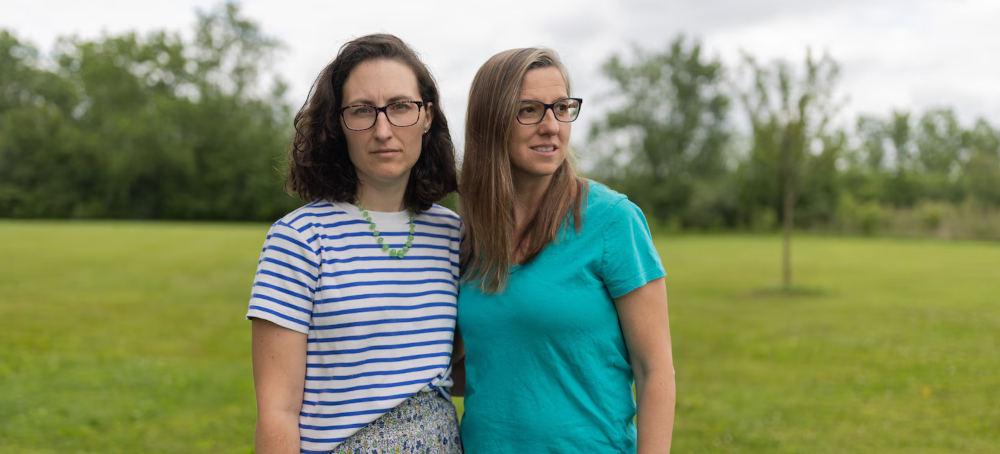 Annette Singh, left, and Annie Cannelongo in a park in their Hilliard, Ohio, neighborhood that is next to a data center. (photo: Maddie McGarvey/The Washington Post)
Many Americans are furious about the energy-guzzling behemoths that drive artificial intelligence, but politicians in both parties are cautious about backing all-out prohibition.
The full-time moms say their fury over the massive computer-filled warehouses has consumed them ever since Amazon Web Services broke ground on a data center site that stretches from the lush playground their kids use close to the elementary school that Singh’s child attends. Singh can no longer see deer peeking out from the trees and farmland that used to abut the park, and Cannelongo, her friend, laments that she can now hear the roaring highway from her house.
Their opposition to data centers has led Singh to collect signatures at her book club and in her suburban neighborhood for a longshot ballot initiative to ban them statewide. This campaign is hardly a one-off. Voters across the nation are concerned that the centers are driving up electricity prices and polluting the air. More than 70 percent of Americans oppose building the centers in their local area, according to a recent Gallup survey.
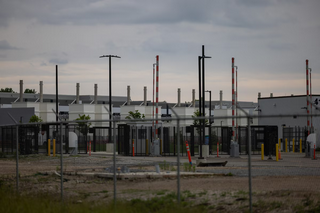
The Amazon Web Services data center in Hilliard.
(Maddie McGarvey/For The Washington Post)
“It affects me personally,” said Cannelongo, 46, a former teacher. (Jeff Bezos, executive chairman of Amazon, owns The Washington Post.)
The political energy is slowly beginning to catch up to voter anger. Lawmakers in both parties who have touted the centers as economic boons in their states are backpedaling.
Gov. Mike DeWine (R-Ohio) paused new tax breaks for the centers last month after an independent report estimated that they had cost the state more than $1 billion in lost revenue last year. And Republicans and Democrats running for office say they want AI companies to offset their electricity usage to tame skyrocketing power bills.
But few politicians are embracing grassroots demands for a pause or ban on data center construction, which some on the left see as a missed opportunity for Democrats to distinguish themselves ahead of a midterm election that they hope will hinge on cost-of-living concerns.
Democrats are divided because some trade unions support the centers, which create construction jobs, and because the powerful industry behind them has poured millions into attacking political opponents. Republicans have largely supported the centers, spurred by President Donald Trump’s enthusiastic backing, and have only recently been raising concerns as they hear from their enraged base.
The data centers’ footprint encompasses states that are midterm battlegrounds and will be crucial to determining which party controls the House and the Senate next year. Ohio is home to more than 200 data centers, the sixth-most of any state, according to data compiled by the industry group Data Center Map. Georgia, Virginia and Texas host even more of the centers.
A handful of progressive leaders, including Sen. Bernie Sanders (I-Vermont) and Rep. Alexandria Ocasio-Cortez (D-New York), have pushed legislation to temporarily ban data center construction. Local lawmakers in more than 10 states also introduced bills this year to pause construction. Last week, residents of Monterey Park, California approved the nation’s first permanent ban on data centers, with more than 86 percent of voters supporting the prohibition.
But even Sanders-endorsed candidates in competitive races, including Abdul El-Sayed in Michigan and Graham Platner in Maine, have not taken up that mantle.
“What I don’t want to do is inadvertently exit the playing field... and then cede the policymaking space to folks who don’t want to impose any limitations,” El-Sayed told The Washington Post.
On Monday, Sanders called for the creation of a sovereign wealth fund seeded with a 50 percent tax on AI companies’ stock, so that Americans would own a piece of the industry. Sanders, in an interview, touted the policy.
“But I think it’s good politics, as well,” he said. “You are tapping into the concerns that the American people have, and you win elections when you do that.”
Democratic candidates are largely calling for smaller-scale policy interventions, with many saying the centers should pay for their electricity usage and stop obscuring details of their development from the communities in which they are built.
“We need to make sure if [data centers] are going to come here and benefit, you need to bring your own energy, you need to not make all of us pay for it,” Amy Acton, the Democrat running for Ohio governor, said in a recent roundtable.
Former senator Sherrod Brown, a Democrat mounting a comeback bid in Ohio, said he was unaware of the push to get a data center ban on the ballot in the state. “With data centers, we make sure the investors pay for electricity. Not the people who live in Zanesville or Coshocton or in Cambridge,” he said.

Former senator Sherrod Brown said investors should pay for the electricity consumed by data centers.
(Samantha Madar/Columbus Dispatch/USA Today Network/Reuters Connect)
The issue animated a May debate among the Democratic candidates running for Michigan’s open Senate seat, with El-Sayed calling artificial intelligence a “tsunami” coming toward Americans that merits regulations of the same stringency as those governing public utilities. State Sen. Mallory McMorrow touted her plan to tax the industry to pay for job training, and Rep. Haley Stevens, the most centrist Democrat in the race, said she supported building the centers so long as they pay for their own resources. “I’m eager to see Michigan lead on the moonshots of the 21st century,” she said.
Many Republican candidates previously followed the lead of Trump, who signed an executive order last summer to speed data center construction. But in recent months, more are beginning to respond to grassroots anger.
The Republican candidates for governor and Senate in Ohio, Vivek Ramaswamy and Sen. Jon Husted, have a history of backing the centers. But both have recently expressed concern about the centers’ electricity usage and said they should offset it. “The goal is to support America’s growing technology infrastructure while helping ensure reliable, affordable energy for local residents,” Husted said in a statement. The senator joined Trump for a roundtable with technology companies in March to celebrate their leaders signing a pledge to offset their electricity costs. Former congressman Mike Rogers, the Republican Senate candidate in Michigan, says data centers need to pay for their energy.
“We’re going to have to grapple with it,” said Alex Triantafilou, chair of the Ohio Republican Party, pointing to an uptick in community-level anger on the right.
To the activists pushing for sweeping change, the response has not been swift or substantive enough.
“The big corporations that have money are donating to both sides, so it’s hard for anyone to oppose them,” said Cannelongo, who has not organized for the moratorium but supports other efforts.

Cannelongo backs efforts to regulate data centers.
(Maddie McGarvey/For The Washington Post)
AI companies have poured tens of millions of dollars into the midterms, backing pro-AI candidates and working to defeat those who seek to regulate the industry. Many unions, which have considerable leverage in the Democratic Party, also support data centers, which experts say create thousands of short-term construction jobs but fewer permanent ones.
“These are creating good union jobs, both in the construction, but also in the keeping them secure and maintaining them,” said Tim Burga, president of the Ohio AFL-CIO.
In Ohio, 71 percent of voters said in a recent poll that they support a temporary ban on data centers. Majorities said data centers have a bad effect on the environment, energy prices and the quality of life of people who live near them.
In a statement, an Amazon spokesman said the company is committed to delivering “meaningful local benefits“ to communities and has invested $70 billion in Ohio since 2016.
“There are folks that believe that if the Democratic Party would become a party of no data centers that a Democratic Party could … run the table,” said Chris Gibbs, chair of the Ohio Democratic Party’s rural caucus.
Gibbs said that would be shortsighted, however, and that the better path is to help communities strike better deals with tech companies so they benefit more financially from the centers’ presence.
“Just to be the party of ‘no’ all the time I don’t think is good for the Democratic Party’s future,” Gibbs said.

The playground that is next to the data center.
(Maddie McGarvey/For The Washington Post)
For Singh and Cannelongo, the slow-moving debate has been hard to watch.
“This area is so great,” Singh, 36, a political independent, said of the peaceful Columbus suburb. “I feel like this taints it a little bit. Like puts a black spot on it.”
“I’m frustrated,” she added. “I want better politicians.”