Why Making Anthony Fauci the Enemy Will Harm US Public Health for Years
Melody Schreiber Guardian UK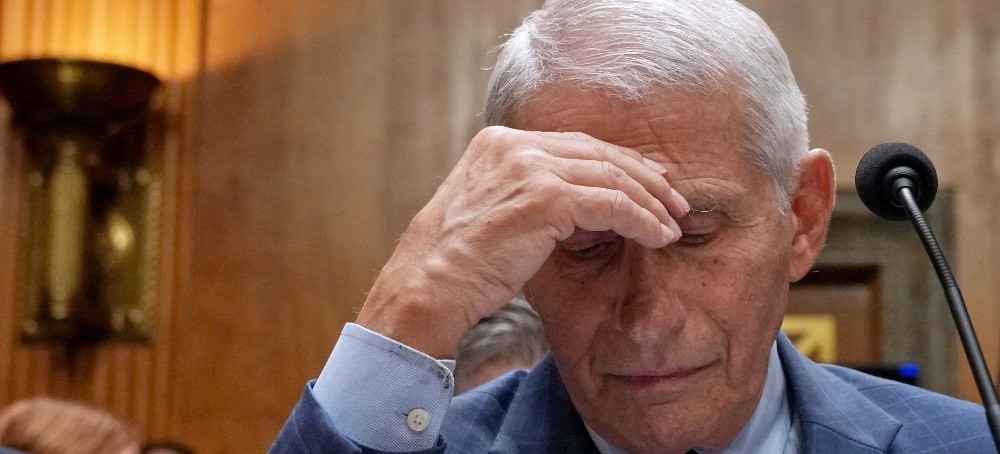 Dr Anthony Fauci at a Senate hearing on 29 July 2026. (photo: Allison Robbert/AP)
Republicans are trying to scapegoat the infectious disease expert, even as they have gutted healthcare amid outbreaks of measles, cyclosporiasis and Ebola
A US Senate committee will vote on Thursday morning over whether to hold Fauci in contempt of Congress after the physician and former public health official invoked his fifth amendment rights during a Senate hearing last week focused on Fauci’s actions during the Covid pandemic.
The invocation of the worst days of the Covid pandemic come as midterms loom and the administration struggles to address several infectious outbreaks, including cyclosporiasis and Ebola.
Rand Paul, a senator, released contemporaneous notes that Fauci took during his time in public office, which Paul called Fauci’s diary, that reveal the confusion and fear of the time and illuminate the private episodes of a man who became known as America’s doctor.
“By focusing entirely on one human being and by calling him all sorts of names, including ‘evil’, and by calling for him to be jailed, it abdicates Republicans’ own responsibility in the US response to the pandemic, which was under President Trump,” said Gavin Yamey, director of the Center for Policy Impact in Global Health at Duke University. “I think that this is all aimed at riling up the base ahead of the midterms and at washing their hands of any culpability themselves in the mass death event of Covid.”
And it comes after substantial cuts to the public health infrastructure; misinformation has spread at the highest levels of the government, and growing outbreaks of measles, whooping cough, cyclosporiasis, Ebola, and more.
“This is an extraordinarily good way to distract people from the very deliberate destruction of the US public health system,” Yamey said.
Like most Americans, Miller turned to Fauci for advice during the pandemic. As communications director for then-vice president Mike Pence, she was involved in the White House Covid-19 response. Fauci, who served as the director of the National Institute for Allergies and Infectious Disease (Niaid), was also the chief medical adviser to seven presidents over three decades.
Fauci described Miller warmly, writing that she was “great (tough, smart, but great)” on 25 March 2020, and that they “laugh at each other” in the situation room on 6 May 2020.
When Miller tested positive for Covid, Fauci called to check on her several times a day. “She is very anxious about getting very ill since she is 10 weeks pregnant. Tonight she had an anxiety reaction. I calmed her over the phone,” Fauci wrote on 9 May 2020. Later, Fauci wrote that he had directly contacted Miller’s pediatricians to discuss the baby’s care.
It is perhaps not surprising that Miller would turn to Fauci, as many others in the country also relied on his advice and insight during a deeply uncertain and terrifying time.
But her actions contrast with the intensity and speed at which Covid was politicized – and the extent to which Fauci would draw conservatives’ ire, even years later.
In February and March 2020, Miller was reassessing communications from the Covid taskforce, and Fauci was told to stand down on media appearances until he received clearance again.
“That’s the episode that got tagged ‘muzzling Fauci’,” said Céline Gounder, editor-at-large for public health at KFF Health News and a member of the Covid transition team under Biden.
Soon after “deciding how much of Dr Fauci the public gets”, Miller was getting regular check-ins from Fauci on her own health, Gounder pointed out. “The same expertise: she’s rationing public access, but it’s available to her in private.”
By April 2020, the pandemic was already being heavily politicized. The administration released plans for states to reopen, and President Trump posted a series of tweets encouraging supporters to “LIBERATE” blue states such as Minnesota, Michigan and Virginia.
In late April, nearly half of Republicans (47%) surveyed by Pew Research Center said the pandemic was “made a bigger deal than it really is”. By June, that figure was 63%, and it rose to 66% in September. Republican attention to pandemic coverage went from 48% in March to 43% in late April to 35% by early June, while Democrats did not see any such changes.
Spring 2020 looked similar across America; schools, for instance, were closed at about the same rate in red and blue states. But that changed by the fall, when “local partisanship predicted which districts would remain remote better than local Covid incidence did”, Gounder said. Those decisions were made not by Fauci, as he’s been accused, but by about 13,349 public school districts, she pointed out in her newsletter, Underlying Conditions.
“The more interesting story to me is who had private access to federal scientific expertise, what that access was worth in 2020, and what those same people have said about that expertise since,” Gounder said. She also pointed to early access to experimental treatments for Covid for Trump and his inner circle, nearly two months before they were available to the public.
“A president publicly minimized a virus he was privately treated for with a drug the public couldn’t get,” Gounder said.
Even after conservatives began publicly opposing his recommendations, the Millers still turned to Fauci for support.
Fauci recounted speaking with Miller multiple times in October 2020, after her husband tested positive for Covid and she was traveling. “Spoke to her at Houston airport and after she landed,” he wrote on 6 October 2020.
“Am on phone frequently with Katie and Stephen,” Fauci wrote on 31 December 2020.
Katie has since come out forcefully against Fauci.
On the Covid taskforce, “Fauci cared more about virtue signaling than science,” Miller wrote in September 2025 in an apparent reference to wearing a face mask.
In June, she said “he should be in jail”.
After Fauci’s notes were made public, Miller claimed Fauci used the pandemic to “maximize his popularity”, and she endorsed calls to prosecute him. She told Notus she kept Fauci close so that he “did not leak against me or my husband”, though she didn’t specify what Fauci might leak.
“Dr. Fauci was neither my friend nor my doctor, but a work colleague who weaponized my pregnancy and child for his gain to aggrandize himself,” Miller posted on Thursday, adding that “this man should be in prison”.
Fauci has led the US through epidemics and pandemics over the decades: anthrax attacks in 2001, HIV, Sars, Ebola, Covid-19, and more, and he co-authored one of the most esteemed internal medicine textbooks.
“We lose a lot when we see Republicans vilify Tony Fauci,” Yamey said.
The US wasn’t unsafe because of Fauci’s leadership, Gounder said. “It wasn’t safe to leave home because a novel airborne virus was circulating in a population with no immunity, no vaccine, and no treatment.” And the Trump administration’s politicization and mismanagement “raised the toll”, she added.
The trials facing Fauci make it less likely that others will step forward to guide public health, now or during a crisis.
There were 1,499 harassment events across 583 local health departments between March 2020 and January 2021, and 222 officials left the field because of the targeting, Gounder pointed out. Some 71% of the public health workforce reported at least one symptom of burnout and 20% reported near-constant symptoms in a 2024 survey.
Three senior CDC leaders resigned last August over politicization of the agency, and one was fired for refusing to “rubber stamp” Robert F Kennedy Jr’s anti-vaccine policies. The same month, a man fired more than 180 rounds into the US Centers for Disease Control and Prevention (CDC) campus because of misinformation about the Covid vaccine. He killed a police officer, David Rose.
“If you’re 40 and choosing between US government service and industry, that’s now part of the math, not just the vast differences in compensation,” Gounder said.
Yamey said he worries “that’s going to put future public health leaders off”. And there is an overwhelming amount of work to be done in addressing current public health crises and decades of repair to come.
“But we will get there,” Yamey said. “We will all roll up our sleeves and build back, and hopefully build back better.”