What Women Saw in Graham Platner. Once Again, a Man Fails Them.
Rebecca Traister New York Magazine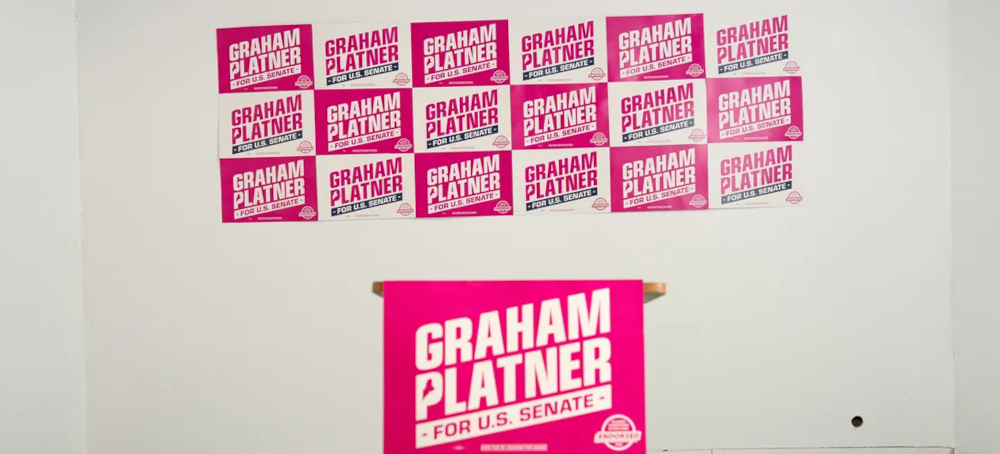 Graham Platner campaign posters. (photo: Mel Musto/Bloomber)
But contrary to the gloating perception in some quarters of social media, these voters were not necessarily celebrating what leftist Matt Stoller called “a rejection of Dem HR lady politics.” At a town hall two days later, girded for Graham bros, I was instead surrounded by white-haired ladies cheering their hearts out, adding their names to a homemade sign reading WE ARE YOUR GRAHAMILY. On television, Platner can look skeezy, like he has a pornstache, but in the dozens of rooms I’ve seen him in this year, he comes off as an apple-cheeked kid who might remind white resistance moms of their very good boys — a young man who hates war, supports Gaza, and wants to build a future that includes health care and housing.
The national narrative has offered a simplistic view of this crucial Senate race, pitting the oysterman Platner, working-class cosplayer and dirtbaggy avatar of the male left, against a hidebound Establishment. Now that his campaign has been suspended, the question of where women fit into that cartoonish proxy war has been less discussed and even less understood.
Platner certainly is a burly white guy, but a Times–Portland Press Herald–Siena poll taken in June — after the Times story about his former romantic partners but before Politico reported in July that he’d allegedly raped one of them, which Platner denies — showed him performing better with women (winning 52 percent) than with men (45 percent) and having no firm hold on the guys he was supposed to look like, with only 36 percent support from men without a college degree. By many measures, Platner was in fact the women’s candidate in the race.
This was true even when he ran for the Democratic nomination against Janet Mills, the 78-year-old sitting governor. Anxiety about Platner’s personal misdeeds, which included revelations that he had a Nazi-ish tattoo, was outweighed by recognition of Mills’s weaknesses and the vast damage done by five-term Republican incumbent Susan Collins, a woman who has enabled accused assaulters, including Donald Trump and Brett Kavanaugh, to hurt not only individual women but millions of them. And yes, the fact that many women supported Platner because they cared so much about women makes this juncture extra enraging, heartbreaking, and horrible.
Among the many hard lessons of the Me Too era was that when men abuse women, the blast radius is unfathomably wide. In Platner’s case, the concentric circles surely begin with Jenny Racicot, who claims Platner raped her at the end of their on-again, off-again relationship in 2021, and Lyndsey Fifield, who recounted her bad experiences with Platner to the Times only to be written off as a right-wing operator. The circles move out quickly: to the women on his campaign watching months of grueling work blow up in their faces, the endorsers and voters who supported him and are now being blamed and mocked for their perceived errors in judgment.
Establishment Democrats and moderate pundits are taking unseemly pleasure in wagging fingers at all those women who foolishly fell for Platner’s populist façade. A local writer named Shay Stewart-Bouley, who writes under the title Black Girl in Maine, has described being called “a Nazi sympathizer and a star-struck gullible tool” for interviewing Platner and writing about his outreach to Black and immigrant communities. Elizabeth Warren, labeled “Judas” for not endorsing Bernie Sanders in 2016, is getting roasted for having endorsed Platner this cycle. The Somali American community leader and Platner supporter Safiya Khalid wrote on Facebook that social media is “filled with ‘we told you so’ posts, finger-pointing and people treating this as though they had been vindicated.”
Easy-bake appraisals of women’s choices have been particularly irksome because, over the past ten months in Maine, where I live and vote, I have watched the women around me — of every age, race, and flavor of left-of-center Democrat — struggle mightily to come to sound conclusions about this complex race. I have heard from longtime friends of Mills’s who had to tell her directly that they were not supporting her even though they love her. I know women who voted for Platner while their husbands voted for Mills. I also have female friends who could not stand Platner and were cast as the wet-blanket enemies of fun, hope, and movement politics.
Me? I thought Platner was terrific. He was smart, inspiring, a generational talent on the stump. He made people feel good and hopeful in a time that wasn’t good or hopeful. I saw how he made them googly-eyed with irrational fanaticism, a quality that is irritating but also rare and powerful in politics.
Part of what I liked about Platner was that he sounded so much like some of the female politicians I have believed in and who have lost again and again and again. Women running for office are almost never able to make people googly-eyed. He said the same things they did but in a register that was received as inspiring, not hectoring; as populist, not professorial.
Platner understood that too. On a recent podcast appearance, he conceded that his self-presentation as a “relatively healthy white man that comes across in a very masculine way” permitted him advantages. He acknowledged Betsy Sweet, a Maine leftist who ran insurgent campaigns for governor in 2018 and Senate in 2020. “Betsy literally ran on pretty much everything I talk about,” Platner said. “And they went after her, called her a witch … Then I get to do it and people are like, ‘This sounds reasonable.’ That’s insane to me. But it is also a reality.”
He was right: It is insane and it is reality, and his ability to think that through is partly what led me to trust him. Well, the joke’s on me and the many other women who thought hard about this race and chose to take a risk on a guy who had a very bad history but very good ideas, a guy we hoped had grown. We can now be cheerfully jeered for being hypocritical dummies.
But it’s also pretty rich that many of those eager to remind us that they Told Us So are the same people who also Told Us in recent years that it was a feminist insistence on Me Too–ing too hard that got us where we are now — that an unwillingness to forgive good boys who made mistakes was what ultimately drove them to the manosphere and provoked the reelection of Donald Trump and his rape-forward Cabinet of monsters.
What’s a girl to do? Give a guy a break? Or not give him a break? Anyone who pretends Platner’s candidacy represented an easy moral and philosophical calculation is wrong. Figuring out how to maintain moral clarity is awfully hard in a world where half the potential political candidates start with a gender disadvantage and the other half are raised in a world that accustoms them to power over female bodies.
In our political system, women are too often forced to depend on men. And those men often catastrophically fail us. Which brings us to whatever happens next: We are in an emergency. Caused by Graham Platner. And, honestly, by Senate Minority Leader Chuck Schumer, who was criminally negligent in clearing the field for Mills, a candidate who was wrong for the moment, rather than one who could have offered a legitimate alternative to Platner.
It seems quite possible that the candidate chosen to replace Platner will be a woman. A woman who will be asked, as Kamala Harris was two years ago, to mount a terribly difficult campaign in a terribly short amount of time — knowing that no story about her will ever be told just about her but rather about her in relation to the men who got us into this mess in the first place.