What to Know About Public Executions, and Why They Stopped in the US
Victoria Craw The Washington Post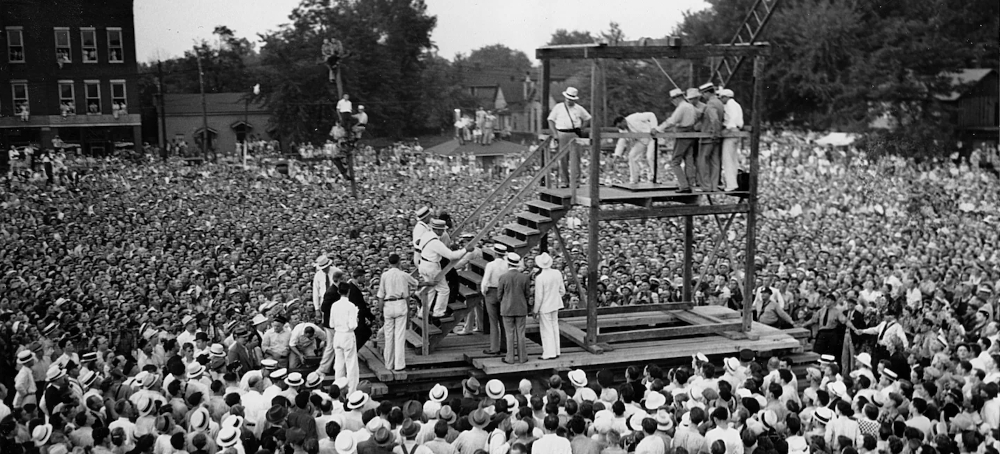 Rainey Bethea walks up the stairs with guards for his public execution, in this 1936 photo in Owensboro, Kentucky. (photo: AP)
Defense Secretary Pete Hegseth said the Fort Hood shooter's execution would be livestreamed, which would make it the first public execution in the U.S. in decades.
If carried out, it would be the first known time that U.S. authorities have broadcast live video of an execution to the public. It would also be the first public execution in the U.S. in decades, the first U.S. military execution since 1961, and the first military death by firing squad since World War II, according to the Death Penalty Information Center.
The announcement has raised many legal and ethical questions, including how such an event would be broadcast and who would be able to view it.
So when was the last time a public execution was carried out in the U.S. and what other countries do it? Here’s what to know.
When was the last public execution in the U.S.?
The hanging of Rainey Bethea in Kentucky in 1936 is widely considered the last high-profile public execution in the U.S, although there was a subsequent public execution in 1937 in Missouri.
Bethea, who was black, was publicly hanged for rape, after he confessed to the rape and murder of a 70-year-old white woman, Lischia Edwards, although he was never charged with murder, according to the nonprofit Death Penalty Information Center, which monitors capital punishment.
The hanging was carried out in a parking lot in Owensboro, Kentucky, to avoid damaging the courthouse lawn due to the crowds that were expected, the DPIC said.
Up to 20,000 people were estimated to witness his death. An image from the scene shows a large crowd surrounding the gallows to watch, and reports from the time described a carnival atmosphere.
Rachel Abbott, who witnessed it, told WKU Public Radio in 2016 she recalled watching it as a five year old and had nightmares about it years later. “I still have tears running when I think of it,” she said.
There was also a public execution the following year, when Roscoe “Red” Jackson was hanged in Missouri. About 500 townspeople watched the hanging, according to an AP report at the time. The DPIC identifies Jackson’s hanging as the last public execution in the U.S.
Why did public executions stop in the U.S.?
In the U.S., the spectacle surrounding Bethea’s hanging contributed to the end of public executions, according to the DPIC.
Michael L. Radelet, professor emeritus at the University of Colorado Boulder, who is an expert in executions, told the Associated Press that concerns had grown as the executions grew into popular events and increasing numbers of people witnessed botched hangings, leading the policies to change.
But executions have still been made viewable to large numbers of people in certain high-profile cases. In 2001, the execution of Oklahoma City bomber Timothy McVeigh by lethal injection was made available to watch for selected people on CCTV.
While around 2,000 survivors and relatives were eligible to watch, most chose not to. Around 230 people did choose to view it, The Post reported at the time. Many of those that did opt to watch described it as a memorable but unsatisfying experience, with some describing feeling resentment at how his death appeared painless.
Which countries still have public executions?
There are limited public records about how many executions are carried out around the world, with some countries treating such data as a state secret, according to Amnesty International.
At least 17 public executions were carried out in 2025, according to the group’s latest death penalty report, including six in Afghanistan and 11 in Iran. Two public executions in Iran in 2026 were also reported by Iranian state media, and related to two men who were accused of killing four police officers during anti-government protests. Public executions in Iran are typically reserved for political prisoners, and carried out in a public square with cranes mounted on a truck serving as a gallows, the AP reported.
Media reports and the United Nations have also documented public executions in Somalia, while Human Rights Watch and British lawmakers have issued statements condemning public executions in Saudi Arabia.
Amnesty International has also received reports of public executions in North Korea, the group said in a 2009 report.
What are the controversies surrounding public executions?
On Thursday Defense Secretary Pete Hegseth said he wanted people to be able to watch Hasan’s execution “because people need to understand that there’s serious consequences for these types of things.”
Jon Yorke, a professor of human rights at Britain’s Birmingham City University, queried what safeguards would be put in place to ensure the content is not visible to children.
“My immediate reaction is this has taken us back to medieval times,” he said in an interview, describing it as “counterproductive” for Americans to witness such an event.
Yorke said the decision to end public executions has been also linked to the notion of preserving dignity in death, and this would be undercut by a live stream. “The state shouldn’t be seen to be acting with the same violence and trauma as the criminal,” he said.
Saul Lehrfreund, the co-executive director of the Death Penalty Project, a British-based non-governmental organization, said that filming the moment of a person’s death is generally considered unacceptable, because “it’s to do with the sanctity of being a human being and what that means.”
The documentation, and publicizing, of executions has long been controversial amid debate over practical and ethical considerations, and whether it is effective as a deterrent.
Public executions were carried out across the U.K. and Europe during the Middle Ages but were banned in England by the mid 19th century, amid concerns about large crowds becoming difficult to control and people viewing them as a form of entertainment rather than a deterrent.
Whether or not to document and publish images of the hanging of Nazi war criminals at the Nuremberg trials also sparked international debate in 1946, with the U.S. in favor of it and Britain opposed. Images of dead bodies later appeared in the public domain.
The death penalty has since been abolished in the United Kingdom, and all of the European Union.
The 2006 execution of former Iraqi President Saddam Hussein, which took place at the former military intelligence headquarters in Baghdad, was also controversial, particularly after covertly filmed footage of the execution spread online. The government described the release of the footage as a “mistake.”
What else is known about Hasan’s execution?
Hasan’s execution is scheduled for Dec. 3 in Fort Hood, Texas, the Acting Secretary of the Army said this week.
Hasan, an American-born Muslim, killed 13 people and injured 32 others at the Central Texas Army post where troops were preparing to deploy to Afghanistan. He was convicted of premeditated murder and sentenced to death in 2013.
Early Friday, the Defense Department declined to elaborate on plans for the scheduled execution, but said “details will follow.”