What Should We Do With Trump’s Monstrous Architectural Legacy?
Jan-Werner Müller Guardian UK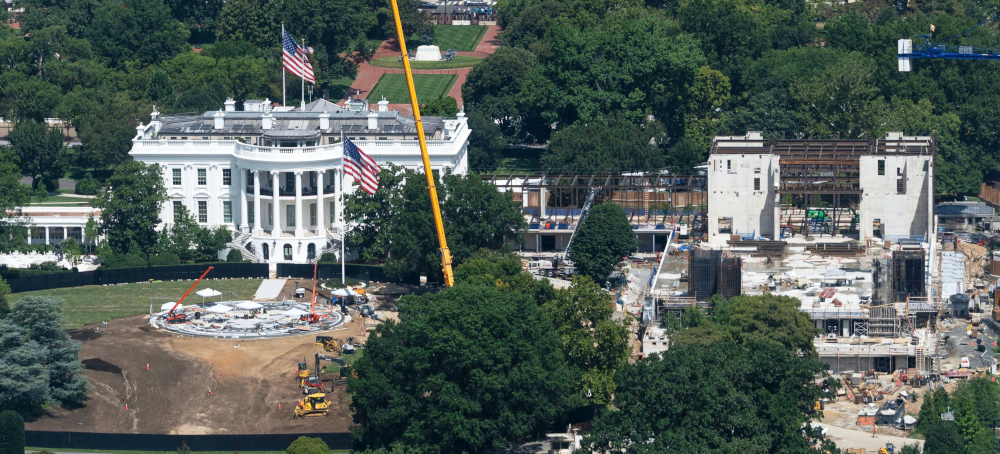 The built environment, and especially the civic landscape of a capital, is never just an afterthought.’ (photo: Manuel Balce Ceneta/AP)
Questions over Trump’s ballroom and other structures might not feel urgent. But when his reign ends, Trumpism must be repudiated
Some might dismiss the question as a bit of a luxury problem. After all, a war that also demonstrates the ongoing disempowerment of Congress keeps dragging on; ICE continues its cruel day-to-day work; Trump is trying every tactic to make the midterms go his way. But the built environment, and especially the civic landscape of a capital, is never just an afterthought. Buildings and monuments make values visible, as the philosopher Susan Neiman once put it. And the decision to leave Trump’s structures in place as if his reign had just been another normal era in US history is not neutral – just like leaving Confederate monuments in place is not neutral.
For those who dismiss talk of civic values made visible as all too idealistic, there is another, hard-nosed argument to consider: after all, for anyone around the globe ever to trust a US government again, Trumpism will need to be thoroughly repudiated. Without a clear distancing from his toxic reign – during which the whims and obsessions of one evidently incompetent conman wreaked havoc with old alliances – other countries might well conclude that the US has failed to learn any lessons. And the built environment is a prime candidate for making that distancing visible to the outside world.
The ballroom in particular has become a central symbol of Trump 2.0, as it combines core features of Trump’s governance: the shameless corruption, as private companies are invited to “donate” for the project; the sheer destructiveness, as the East Wing was brutally torn down without discussion, let alone permission – something that Trumpists might try to repeat with the Kennedy Center, as Howard Lutnick and others are threatening that it will have to be demolished unless Trump gets to “renovate” and have his name on it (notice the abuser’s logic of “if I cannot have it, no one can have it”).
Democrats, noticing the symbolic importance of the structure, have started to weigh in on its future: Gavin Newsom, the California governor, affirming that “we have to be builders” and not destroyers, would just leave things alone; Senator Chris Murphy has suggested that all “dirty” – which seems to mean: corrupt – projects under Trump might need to go; meanwhile, Senator Ruben Gallego wants to sell the ballroom off “piece by piece” (it is unclear whether that would be some sort of political performance art, intended as a comment on corruption, or an act of symbolic catharsis, copying the way people demolished the Berlin wall piece by piece).
The prior, fundamental question is whether a structure honors a particular person or at least affirms a set of political values. This was always the strongest reason why monuments of those defending slavery could simply not be left standing; as Neiman also pointed out, there was no way a Germany that still had Hitler street names – let alone Hitler statues – could have regained the trust of anyone. So, as painful as it might be for members of the Maga cult, no official building should bear Trump’s name, and no publicly funded statues of him must ever be erected – unless the country decides that we should honor a man bent on establishing autocracy in the US.
Then again, some republics have precisely not erased all traces of a tyrannical ruler because they wanted such traces to serve as a warning to future generations. Visitors to Venice’s most famous palace can marvel at portraits of all the doges, except one that is painted over with a black shroud; here the dishonor of the person – Doge Marino Faliero, who attempted a coup – is immortalized, and the moral meaning of history unmistakably clarified.
Political iconoclasm wants to leave remnants of an image in place to remind people why iconoclasm had been necessary in the first place. That is why some have suggested that problematic monuments should ideally not be removed at all, but come with explicit statements, such as plaques that disavow their initial political message – or even be legitimately vandalized, such that both original and acts of vandalism remain clearly visible.
Contextualization has a pedagogical impulse similar to that of museums; hence, there is something coherent about the congressman Jamie Raskin and the progressive politician Saikrat Chakrabarti suggesting the ballroom should at least partly be turned into exhibition spaces documenting corruption, autocracy and what Raskin described as attempts to “undermine and thwart popular democracy in American life” (though, as Raskin seeks to keep a space for dining, too, guests might end up awkwardly sipping champagne next to depictions of January 6).
Perhaps there is a more straightforward approach: the edifice could be named after Renee Good and Alex Pretti, the way some places in the south ended up testifying to those who fought injustice. This could teach a history lesson in a way that, for instance, turning the ballroom into a soup kitchen, as Alexandria Ocasio-Cortez has suggested, might not – worthy as that idea might also appear.