Voters Want What the Democrats’ Progressive Wing Offers
LZ Granderson Los Angeles Times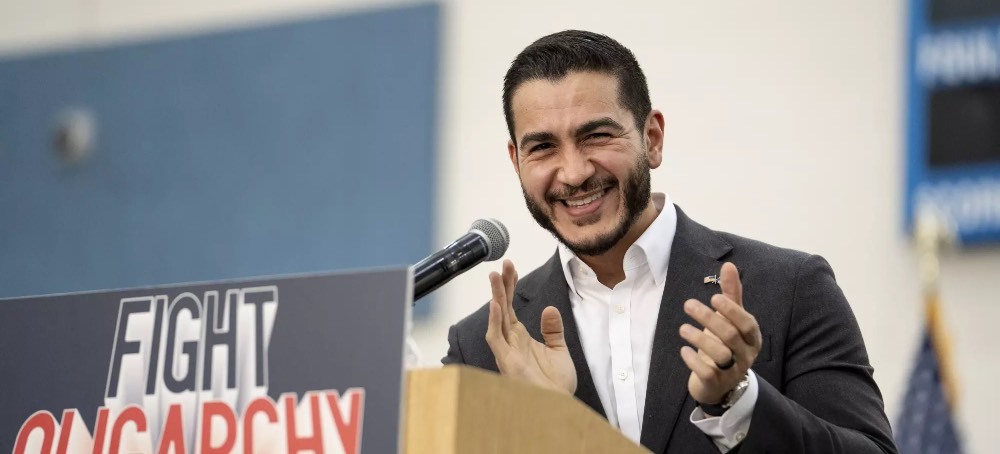 Abdul El-Sayed, a candidate in Michigan’s Democratic primary for Senate, speaks before Sen. Bernie Sanders at an event in May. (photo: Sarah Rice/Getty)
I am not sure whether it is excitement for El-Sayed or desperation for economic relief that is fueling the energy behind his candidacy.
What I do know is his name is the one I see more often on signs in lawns across the state.
“I don’t really believe in ideology. I have faith and everybody else brings evidence,” El-Sayed said when I asked him about the rise in democratic socialist candidates in these midterms. (For the record, his beliefs are also fact-based; he’s a Rhodes scholar and endorsed by Sen. Bernie Sanders.)
The emergence of the party’s left has caused some soul-searching, which El-Sayed considers overdue. The new Democrats are “calling the Democratic Party out on its hypocrisy,” he says, particularly elites who are “taking money from corporations and then come through and tell working people that they should support you because you’re less bad than the other guys. That’s uncomfortable to be called out on.”
And why are voters lining up behind these critical candidates in Democratic primaries? Because “they’re frustrated that this party takes money from the very same people that Republicans take money from to do a lot of the same things,” El-Sayed says. “When you have a bipartisan consensus that the best use of our foreign policy is to backstop the military of a foreign government, when you have bipartisan consensus that we cannot have guaranteed healthcare, at some point, part of me says, ‘Well, what are you actually about?’”
What progressives in Washington have struggled to grasp — particularly those long-term entrenched ones who are powerful fundraisers for the party — is that the people have moved on. Americans are not just fed up with pandering to Israel by politicians beholden to funding from the American Israel Public Affairs Committee. The people have moved on from this notion that things need to move slowly or worse yet, nothing can be done at all.
The current fear-mongering about democratic socialists overshadows the fact it started in the early 1980s, a time when Americans struggled to make ends meet. And the current scare framing is no different from what conservatives said when President Lyndon B. Johnson began a war on poverty in the 1960s, when President Franklin D. Roosevelt launched the New Deal in the 1930s to lift Americans out of poverty from the Great Depression or when President Cleveland tried to derail the populist movement in the 1880s or demonize the formation of the People’s Party in 1892.
Austerity is a tough message to receive in a state that has been hemorrhaging good-paying jobs since the 1980s. Meanwhile, Michiganders see the money being spent on wars in Ukraine and Iran; they see the billions the president has made since returning to the White House; they watched Elon Musk invest nearly $300 million to fund that return to office and in less than two years become the world’s first trillionaire.
This is what the voters in Michigan have been telling me for months. They bring up facts like these and they’re asking themselves: Why am I struggling? They’re wondering why the young people in their families can’t find a decent-paying job. And instead of looking at the same cast of characters in Washington to fix their problems, they are going to the ballot box with the hope of creating a brand new show. One where a medical emergency doesn’t send a family into bankruptcy.
That is what the 2025 election of Zohran Mamdani in New York City truly represents. It was never a threat to democracy; it was a challenge to the system that has enabled the top 0.00001% of the wealthy in the U.S. — around 35 households — to hold more wealth than the bottom 50% of Americans — roughly 65 million families.
Why hasn’t the Democratic Party stood against that all along?
“I think too often what happens is people get comfortable in these positions,” El-Sayed said. “They get pulled away from everyday people and they don’t remember what it’s like. This job is about humbling yourself to their experience and asking yourself: ‘How do I always remember that the whole point of any of this is to make your life better?’”