US to Ban Oil Imports From Russia
Jeff Stein, Tyler Pager and Anna Phillips The Washington Post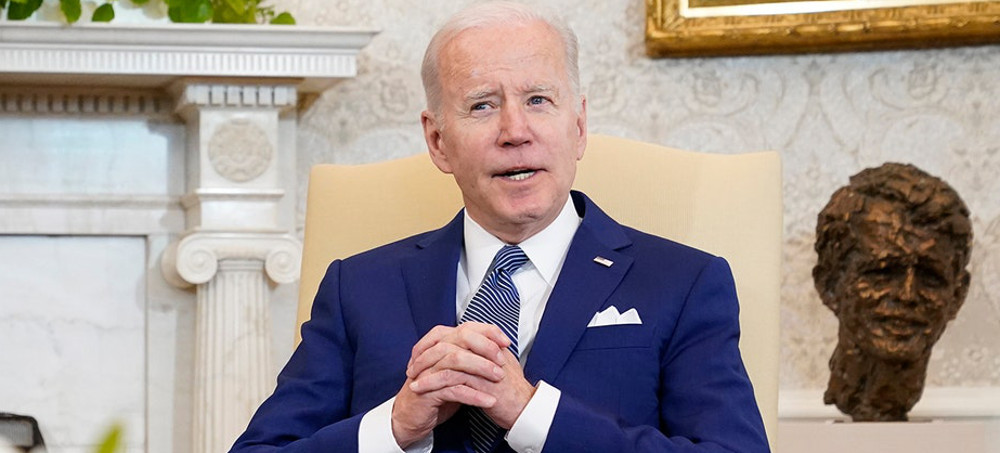 President Biden sits in the Oval Office of the White House, March 4, 2022, in Washington. (photo: AP)
08 March 22
President Biden on Tuesday acknowledged the pain higher costs were inflicting on Americans, but he said the U.S. and its allies had to economically isolate Russia
The move represents one of America’s most far-reaching actions to penalize Moscow since the beginning of its invasion into Ukraine. It would carry enormous geopolitical consequences, as the price of oil has already skyrocketed since Russia’s invasion of Ukraine, creating huge new costs for businesses and consumers.
“Americans have rallied to support the Ukrainian people and have made it clear we will not be part of subsidizing Putin’s war,” Biden said Tuesday, explaining why he was banning the imports.
Europe, which is far more dependent on Russian energy than the United States, announced Tuesday a plan to cut gas imports from Russia by two-thirds this year. If successful, this move would sharply reduce but does not completely sever energy ties to Moscow.
Collectively, the measures from both the U.S. and Europe will deprive Russian President Vladimir Putin of one of his government’s chief sources of revenue — but also risk a shock to the global economic system that could severely damage numerous domestic economies. Russian oil accounts for about a quarter of the European Union’s oil imports, but just 3 percent of the United States’ imports.
Still, it comes as energy prices are surging. The U.S. government and its allies have faced a difficult trade-off in trying to find ways to completely isolate Russia while minimizing the economic spillover. Federal Reserve Chair Jerome H. Powell said last week that the consequences of Russia’s invasion into Ukraine could ultimately amount to a “game changer.”
In recent days, Biden and other world leaders appear to have acknowledged that the economic fallout is a necessary consequence for trying to punish Russia.
“This is a step that we’re taking to inflict further pain on Putin, but there will be costs as well here in the United States,” Biden said. “I said I would level with the American people from the beginning, and when I first spoke to this, I said defending freedom is going to cost us as well in the United States.”
He warned energy companies against “price gouging” and told them not to “exploit this situation or American consumers.”
Framing the rising gas prices as “Putin’s price hike,” Biden vowed to use his authority to minimize the impact on Americans and assailed companies that are trying to exploit consumers with price gouging.
The ban, which the White House first resisted, has gained momentum as Ukrainian president Volodymyr Zelensky has made personal appeals to policymakers in the U.S. and around the globe. The United States has already deployed a number of economic measures to hurt Russia, including imposing sanctions on its central bank and oligarchs close to Putin. The administration up to now had sought to protect global energy markets from the impact of banning Russian oil and gas, while keeping a wary eye on soaring gas prices in the United States. The national average gas price on Tuesday was $4.17 per gallon, according to AAA, up from $3.62 a month ago and $2.77 a year ago.
But the ongoing atrocities committed by Russia in Ukraine, as well as bipartisan pressure from Congress, quickly changed the administration’s calculus.
As the ban gained momentum in Washington, senior White House officials have over the last few days explored a range of measures to fill the gap left by a potential prohibition on Russian energy from the United States and other countries. These measures have included the massive scaling up of production of “heat pumps” for Europe, an additional release of U.S. oil reserves, and a gas tax holiday to protect American consumers, according to people familiar with the matter.
The White House is also considering a renewed push for its clean energy agenda, people familiar with the matter said, as part of an attempt to reduce America’s dependence on authoritarian petrostates.
Energy experts say many of these efforts could take months, if not years to materialize, and the short-term domestic consequences of the Russia oil ban could be severe. With oil prices already rising, the Dow Jones industrial average closed down around 800 points on Monday, a drop of about 2.4 percent. Commuters could see gas prices north of $5 per gallon if Europe joined the U.S. government in banning Russian energy exports, according to the preliminary estimates of Bob McNally, consultant and president of Rapidan Energy Group, an energy market research firm, and a former official in the George W. Bush administration.
Higher gas prices impact many sectors of the economy. Airlines raise their prices, passing along the higher costs to consumers. Drivers often change their behavior, cutting back on travel. And prices on products that are delivered by trucks also can increase, creating a new wave of inflationary pressures. Currently, Russia produces about 11 percent of the world’s oil, or roughly 10.5 million barrels a day.
If the U.S. and Europe banned the imports of Russian energy, “There will be a global recession,” McNally said. “It’s pretty much lights out for the global economy if we ban Russian oil exports … The only thing would be demand destruction, which would be bone-crushing price increases. I don’t see any way out.”
European officials on Tuesday announced they were planning to cut back on their imports of Russian gas but they stopped short of a complete ban.
After resisting for weeks, the Biden administration shifted in recent days toward preparations for the ban as the international outcry built over Russia’s brutal push into Ukraine. America’s ban is effective immediately. No new contracts will be allowed and existing contracts will have 45 days to end, a senior Biden administration official told reporters on a call.
The news that the White House was moving as soon as Tuesday to enact the Russia oil ban was first reported by Bloomberg.
“History is going to remember much better what we did or did not do to stand up for freedom than it is going to remember the inflation rate, or the price of gasoline, in the spring and summer of 2022,” said Larry Summers, a former Democratic treasury secretary who remains in close contact with senior White House officials.
As they moved closer to announcing the ban, senior Biden administration officials spent the last several days exploring drastic measures to protect the global economy from the potential fallout of even higher oil prices.
White House aides, for instance, have studied plans to dramatically scale up U.S. production of energy-efficient heat pumps that they hoped could be used in Europe if European leaders decided to cut its imports of Russian oil, said three people with knowledge of the matter who spoke on the condition of anonymity to discuss private deliberations. Biden officials have weighed whether these heat pumps could be produced through the Defense Production Act, an emergency national defense law, or through procurement programs at the Department of Defense, the people said. Some advocates close to the effort have compared the idea to the “Lend-Lease Act” program through which the U.S. sent critical supplies to the Allied nations that had been invaded by Germany in World War II.
Biden aides have also explored yet another release of the Strategic Petroleum Reserve — which would represent the third recent move to tap the nation’s oil reserves, although such a measure would likely be months away — and revived discussions about a gas tax holiday to help alleviate Americans’ price pressures at the pump, two other people with knowledge of the deliberations said.
After a ruling last month in which a judge barred the government from considering the cost of climate damage in its decisions, the Interior Department decided to indefinitely pause new lease sales and permit approvals.
Rising oil prices, and industry complaints, have put new pressure on the administration to reconsider that choice. White House press secretary Jen Psaki that took aim at the industry’s argument that the administration is throttling oil and gas production, noting Monday that the industry has 9,000 approved permits to drill on public lands that it has yet to use.
“So I would suggest you ask the oil companies why they’re not using those if there’s a desire to drill more,” she said, adding, “The U.S. produced more oil this past year than in President Trump’s first year … Next year, according to the Department of Energy, we will produce more oil … than ever before.”
Additionally, Biden has personally expressed support for recasting the administration’s clean energy proposals as part of an attempt to move America away from its dependence on authoritarian petrostates, according to two people aware of the president’s thinking on the matter.
“That’ll mean tyrants like Putin won’t be able to use fossil fuels as weapons against other nations, and it will make America the world leader in manufacturing and exporting clean energy technologies of the future to countries all around the world,” Biden said Tuesday as he made a renewed push for investments in renewable energy. “This is the goal we should be racing toward.”
John F. Kerry, the former secretary of state who is now Biden’s special presidential envoy for climate, has advocated internally for the administration to aggressively embrace the argument that its clean energy agenda represents a policy response to the Ukraine crisis. He has worked with other top officials behind-the-scenes in coordinating the effort for Europe to cut off Russian energy, an invaluable source of financial support for Putin.
“From my conversations across the administration, there is a determination that remains just as strong as ever to meet the moment on climate — to really double down on clean renewable energy,” said Tiernan Sittenfeld, senior vice president of government affairs at the League of Conservation Voters.
Biden administration officials have simultaneously launched an effort to explore what the administration can do to get other authoritarian countries to ramp up their production of oil — including by relaxing sanctions on Venezuela — to buffer the global economy from the blow.
Biden’s move to shut down Russian oil imports came after a week of mounting pressure from Capitol Hill, where calls for a ban were embraced by leaders of both parties, including Speaker Nancy Pelosi (D-Calif.).
The House was preparing to pass a bill banning Russian oil imports as soon as Tuesday, and even after the White House’s action, other measures aimed at Russia and Belarus could follow. The top Democrats and Republicans on the House and Senate committees overseeing foreign trade issued a joint statement Monday announcing an agreement on legislation that would strip Russia and Belarus of their current trade preferences and order U.S. diplomats to seek Russia’s expulsion from the World Trade Organization.