UN Plastic Treaty to Tackle Production, Packaging Design - Draft Resolution
John Geddie and Joe Brock Reuters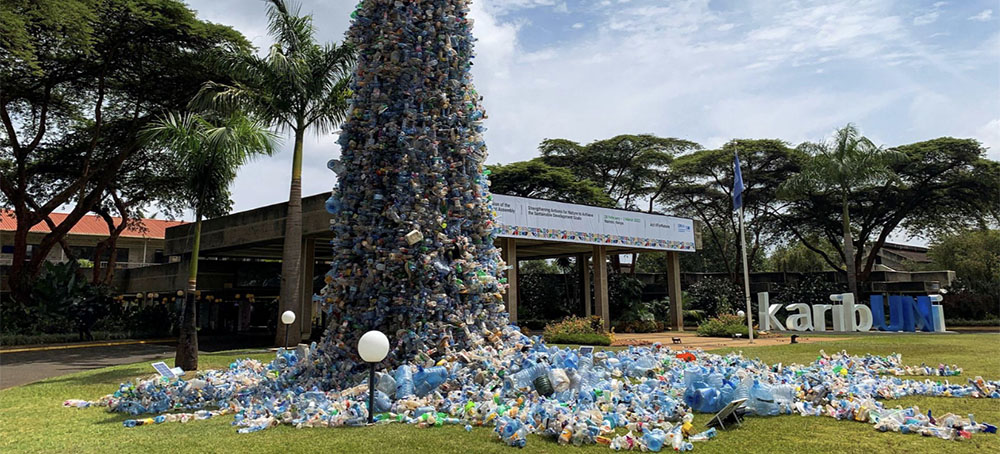 A 30-foot monument dubbed "turn off the plastic tap" by Canadian activist and artist Benjamin von Wong, made with plastic waste collected from Kibera slums, is seen at the venue of the Fifth Session of the United Nations Environment Assembly (UNEA-5), at the United Nations Environment Programme (UNEP) Headquarters in Gigiri, Nairobi, Kenya February 25, 2022. (photo: John Geddie/Reuters)
28 February 22
U.N. member states are meeting this week in Nairobi to agree plans for the first global agreement to tackle plastic pollution, a soaring environmental crisis that is destroying marine habitats and contaminating the food chain.
They hope to agree a full treaty within the next two years.
Going into the summit, the main sticking points were whether any agreement would be legally binding or voluntary, and if it would address plastic production and single-use packaging design or be confined to improving waste management and recycling.
A draft resolution, entitled "End plastic pollution: Towards an internationally legally binding instrument", said that the treaty should address "the full lifecycle of plastic", meaning production and design, as well as waste.
The draft text was finalised by technical experts in the early hours of Monday morning after a week of late-night negotiations. Government ministers and high-level officials joined the talks on Monday and were set to give final approval to the framework on Wednesday.
If the current draft were approved, it would be a setback for powerful oil and chemicals companies that manufacture plastic and had been working behind-the-scenes in an effort to keep talks focused on waste.
The draft resolution also recommended the treaty promote the sustainable design of plastic packaging so it can be reused and recycled, which would be significant for big consumer goods companies that sell their goods in single-use packaging.
An intergovernmental negotiating committee would be formed to agree the details of a full treaty with the goal of having an agreement ready for ratification in 2024, the draft said.
Inger Anderson, the Executive Director of the United Nations Environment Programme (UNEA), said on Monday that the informal talks had "yielded very significant results".
"I have complete faith that once endorsed by this assembly we will have something truly historic on our hands," Anderson told delegates at the official opening of the UNEA 5.2 summit.
"We all know that an agreement will only count if it is legally binding. If it adopts a full lifecycle approach, stretching from extraction to production to waste."