Trump's Wild Pursuit of Presidential Immunity
Amy Davidson Sorkin The New Yorker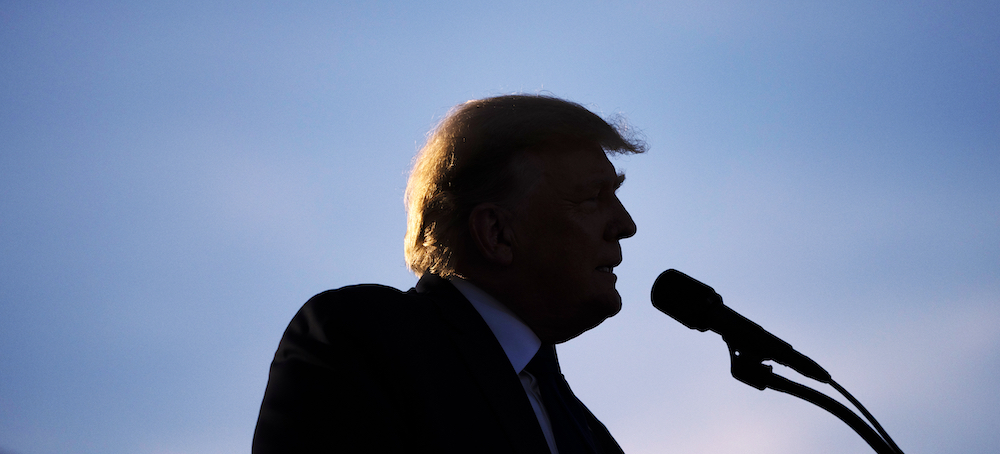 Donald Trump. (photo: MSNBC)
The former President has already lost the immunity case twice, but he has also won something.
This week, the case has been a torrent of briefs and motions. In the Monday filing, Trump asked the Court to keep the proceedings in the January 6th case—which Jack Smith, the special counsel, brought against him in federal court in the District of Columbia—on hold while he prepares what is known as a petition for certiorari. This petition would ask the Justices to overturn a ruling by a three-judge panel of the Court of Appeals for the D.C. Circuit, which rejected Trump’s claim that he is immune from the January 6th charges—and, indeed, from any and all criminal charges involving his “official acts” as President, unless he is first impeached and convicted. His lawyers contend that his immunity lasts forever. The Supreme Court could have rejected Trump’s request out of hand; instead, on Tuesday, Chief Justice John Roberts issued an order giving Smith a week to come up with a reply. Smith filed one late on Wednesday, Valentine’s Day. And Trump delivered his reply to Smith’s reply by the end of the day Thursday—which was also a day of heated hearings in two separate criminal cases against Trump, in Georgia and New York.
Trump has already lost the immunity case twice. In the trial court, Judge Tanya Chutkan ruled that the Presidency “does not confer a lifelong ‘get-out-of-jail-free’ pass.” After Trump appealed, a unanimous Court of Appeals for the D.C. Circuit panel wrote that, with regard to the January 6th case, “former President Trump has become citizen Trump.” But Trump has also won something. Smith’s brief ruefully notes that, when Trump first brought his appeal to the D.C. Circuit, “88 days remained of the seven-month period from indictment to the trial date”—which was then March 4th, the day before Super Tuesday. The appeal effectively stopped the clock. The March 4th date is now off the calendar. Setting a new date now depends entirely on the Supreme Court. To make matters even more complicated, the Supreme Court has also agreed to hear a case, Fischer v. United States, challenging prosecutors’ use of a law on the obstruction of official proceedings in the context of January 6th, which is the basis of two of the four charges that Smith has filed against Trump. Arguments in that case haven’t been scheduled yet. (The other charges are conspiracy to defraud the United States and to violate voting rights; Trump has pleaded not guilty.)
Smith, judging from the brief he filed on Valentine’s Day, believes that every day counts. The brief includes a plea that, if the Court finds that it must hear Trump’s appeal, it do so without delay. Smith offers a suggested expedited timetable for both sides to file briefs, which could get the case before the Court in March. That schedule is modelled on one used for another Trump case that the Supreme Court heard this month, Trump v. Anderson, on the question of whether the Colorado Supreme Court had properly ruled that he was disqualified from running for President. The Valentine’s Day and Thursday briefs include a furious back-and-forth about the rationale for moving quickly. Smith, who had earlier failed to get the Justices to take the case directly, says that “the public interest in a prompt trial is at its zenith where, as here, a former President is charged with conspiring to subvert the electoral process so that he could remain in office.” Trump’s lawyers call this “partisanship”—an attempt by Smith “to secure a conviction before the November election in which President Trump is the leading candidate against President Biden.”
The Supreme Court might want to take the case for reasons that are only tangentially related to the November election. Presidential criminal immunity is a surprisingly tricky area, and one that the Court has never fully adjudicated. The Supreme Court has recognized immunity from civil suits for official acts—those which fall within the “outer perimeter” of a President’s duties. There is also a recognition that, as Smith’s brief put it, “a sitting President has temporary immunity”—though not, of course, from impeachment. Though there has never been a case quite like this one, there are some pretty good clues that a President might not be immune to prosecution: in 1974, Gerald Ford gave Richard Nixon a pardon for any criminal acts that he may have committed while in office, and Nixon issued a statement accepting the pardon, which indicates that both men thought that, without a pardon, he might reasonably be pursued by prosecutors. In contrast, when Trump’s lawyer was asked whether he was arguing that even a President who used SEAL Team 6 to murder a political opponent would be untouchable unless he was impeached and convicted first, he said that he was. At his rallies and on social media, Trump himself has made even broader immunity claims, saying that a President needs outright impunity even for acts that “cross the line.”
And, because this is Trump, there are other outlandish claims thrown into his court filings. Trump is invoking double jeopardy to argue that his acquittal by the Senate in his second impeachment trial, on a single count of inciting insurrection, means that no court can ever put him on trial again on charges even related to the same underlying set of facts. That claim is far afield from established readings of the double-jeopardy clause of the Fifth Amendment of the Constitution, which says that no person shall “be subject for the same offense to be twice put in jeopardy of life or limb.” (And the impeachment clause specifically mentions that other charges can follow conviction.) The D.C. Circuit noted that, “perhaps recognizing that normal double-jeopardy rules disfavor his position,” Trump’s lawyers had invoked what they called “double jeopardy principles,” rather than the clause itself. In other words, Trump hadn’t quite said that he was covered by double jeopardy—just that his situation was double jeopardy-ish.
Still, the D.C. Circuit recognized that it was in new territory regarding immunity. And it came to a broad and important conclusion: that, even if a former President had immunity from civil lawsuits arising from his official acts, there was no parallel blanket immunity from criminal charges arising even from any “assertedly ‘official’ action.” The judges based this conclusion partly on their reading of Marbury v. Madison, a foundational case from 1803 that makes a distinction between the President’s “ministerial” and “discretionary” duties, saying that the latter cannot be examined by courts. Put in rough terms, the panel concluded that the President didn’t have the “discretion” to be a criminal. Perhaps above all, they were unwilling to accept a vision of executive power that, in their view, “would collapse our system of separated powers by placing the President beyond the reach of all three Branches.” They added, “We cannot accept that the office of the Presidency places its former occupants above the law for all time thereafter.”
Trump had asked too much. But what the judges were confronting was not only him but a Presidency and an executive branch whose powers have, arguably, grown beyond what the Founders envisioned. In Trump, we may be seeing the logical—or illogical—consequence of an existing shortage of limits on the Presidency. The D.C. Circuit’s ruling might provide a healthy rebalancing.
The three judges could have taken a narrower approach, by ruling that Trump has no immunity simply because his attempts to keep electoral votes from being properly counted were not official acts—that they were in furtherance of his reëlection campaign, not his White House duties. That is to say, in addition to President Trump and Citizen Trump, there is a third character, Candidate Trump. Such a ruling would have paralleled another case, Blassingame v. Trump, in which a D.C. Circuit panel provisionally allowed a civil suit against Trump, related to January 6th, to proceed despite Presidential immunity, on the ground that he was acting as an “office-seeker, not office-holder.” (The Blassingame case is now back with a lower court for additional fact-finding.) In Footnote 14 of their decision, the D.C. Circuit judges in the immunity case wrote that, because they had found that there was no official-act immunity, they didn’t have to address Trump’s “expansive definition of ‘official acts.’ ” However, they added that it was “doubtful” that all of the conduct underlying his indictment was truly official.
The Blassingame approach is in many ways a powerful one, too. It deals with fears, articulated in the D.C. Circuit ruling, about Trump’s “apparent contention that the Executive has carte blanche to violate the rights of individual citizens to vote and to have their votes count.” It is telling that Smith’s Valentine’s Day brief explicitly treats as a fallback an outcome in which the Supreme Court decides that ex-Presidents do have some immunity from criminal prosecutions, but that Candidate Trump does not; Smith says (also in a footnote) that “a sufficient basis for resolving this case” might be that “no immunity attaches to a President’s commission of federal crimes to subvert the electoral process.” Such a decision would allow the trial to proceed. And it’s equally telling that Trump’s lawyers, in their Thursday brief, reject “this gerrymandered approach to Presidential immunity, one that has the hallmarks of a bill of attainder.” Trump wants all the immunity.
It seems unlikely that a majority, even on this Supreme Court, would accept Trump’s wilder, dictator-like claims. But it’s quite possible that there are four or more Justices—the number it takes to agree to hear a case—who either have doubts about how the D.C. Court of Appeals defined the boundaries of Presidential (and ex-Presidential) immunity, or who simply think that the issue is so important that only they can settle the matter definitively. We may be headed for monthly landmark Supreme Court cases in which the former President and probable Republican nominee is one of the parties. And we’ll see if the Justices are up to the task.