Trump’s Weekend War Approach to Iran Might Never End
Russell Payne Salon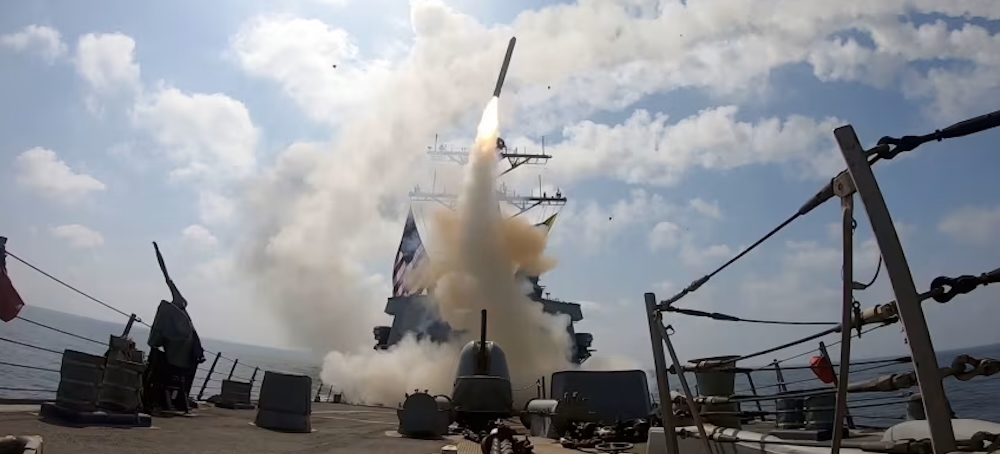 This image from video provided by US Central Command shows a missile being launched from a US Navy ship in support of Operation Epic Fury on February 28, 2026. (photo: US Central Command/AP)
Last weekend's burst of violence might be a preview of a long-term low-boil war with Iran
On June 27, the U.S. struck Iranian targets and in turn, Iran struck targets in Bahrain and Kuwait. Both sides accused the other of violating the terms of the MOU, signed on June 17, with Iran threatening to withdraw completely from negotiations if the U.S. continued its attacks.
While the Iran war has often been conducted during the weekend, when markets in the U.S. are closed and thus less likely to immediately react to developments, the exchanges at the end of June stood out because they came after the two sides signed a memorandum of understanding, which was supposed to stop fighting between Iran and the U.S., as well as their allies, while further negotiations continue.
Annelle Sheline, a research fellow in the Middle East program at the Quincy Institute for Responsible Statecraft, told Salon that this exchange of strikes may foreshadow a new stage in the war, in which there is a nominal ceasefire in place, but also numerous violations of that agreement.
Sheline used the example of the ceasefires between both Israel and Hamas in Gaza, as well as Israel and Hezbollah in Lebanon, as illustrative examples. Israel has been accused of violating the Gaza ceasefire, signed in Oct. 2025, more than 3,400 times, with violations continuing well into 2026. And in Lebanon, the ceasefire between Hezbollah and Israel in November of 2024 saw tens of thousands of alleged violations and hundreds of deaths in Lebanon as a result.
“We see this sort of model whereby Israel gets to keep firing, and yet the rest of the world sort of agrees to still call it a ceasefire,” Sheline said. “That’s what Israel did to Lebanon, that’s what Israel has done to Gaza since October, and I certainly agree that it seems plausible that we would have something similar playing out between the U.S. and Iran.”
“We see this sort of model whereby Israel gets to keep firing, and yet the rest of the world sort of agrees to still call it a ceasefire.”
Sheline noted that the persistent Israeli attacks on Lebanon have been a problem for the MOU as well, given that both Israel and Hezbollah are supposed to cease hostilities as part of the agreement, though this hasn’t happened.
Sheline says that she still maintains some optimism for the MOU, given that it has had buy-in from major regional powers such as Egypt, Saudi Arabia, Turkey and Pakistan and the fact that Vice President JD Vance has embarked on a quest to sell the agreement to the American people.
However, Sheline said, there are powerful incentives for both Trump, who might stand to save face by not reaching a real peace deal in the wake of the American defeat in the war, and, more importantly, Israel, with Israeli leadership seeing a peace deal with Iran as an unacceptable outcome.
“It seems very unlikely that Trump would commit ground troops and if Israel can’t get that, which it was hoping for, a low-boil conflict where they’re preventing the U.S. from reaching some kind of modus operandi moving forward or allowing Iran to normalize, is kind of their least worst option,” Sheline said.
Khury Petersen-Smith, the co-director of the Institute for Policy Studies’ New Internationalism Project, told Salon that the U.S. also has a long history of maintaining these sorts of “low boil” wars in the Middle East.
“Trump began last year with bombing Somalia, and then Yemen again for a few weeks, and then joining Israel for a day in the war last summer, and then Nigeria and the air strikes in the Caribbean,” Petersen-Smith said. “There’s been this kind of onslaught from the Pentagon that all comes in the context of the two-plus decades of the war on terror.”
Petersen-Smith said that, in the context of the global war on terror, the term low boil is useful because it describes a type of second stage that has been characteristic of recent U.S. wars.
“The U.S. launches a set of military operations that begin with these spectacular large-scale operations that are what usually come to mind when you think about a war, like the shock and awe operation in the invasion of Iraq,” Petersen Smith said. “And then, like in both Afghanistan and Iraq, they declare early victories of certain sorts, but then continue to involve themselves as these ongoing conflicts become much more complicated and the war just becomes really vague.”
In Petersen-Smith’s view, an open-ended military operation where the U.S. has declared an enemy and some goals, but where an endgame is unclear, is actually the default for American military operations in the past 20 years, and thus a plausible outcome for the war in Iran.
This model of long-term, low-boil conflict, Petersen-Smith noted, also fits snugly into American political culture, in which military funding is typically seen as a must-pass bill and is among the top priorities of the government and few politicians are willing to speak against such funding. The strongest evidence of this is Trump’s record-breaking $1.5 trillion proposed military budget, which is advancing steadily through Congress.
Tied to the military budget is an effort to integrate the American and Israeli militaries, which would further obscure the financial ties between the U.S. and Israel and establish a framework to integrate Israeli technology into American defense research and acquisition. An effort by Reps. Thomas Massie, R-Ky. and Ro Khanna, D-Calif., to remove this section of the bill was blocked from getting a vote.
Sheline said that this amendment to this year’s National Defense Authorization Act is “very likely” to be enacted and would serve to insulate elected officials from the political repercussions of voting to send military aid to Israel.
“Americans have made it quite clear that they do not want to continue to finance what Israel is doing, whether it is in Palestine or elsewhere in the region,” Sheline said. “This NDAA is very likely to enact this integration of the U.S. and Israeli defense industrial bases and move American funding from the category of funds that Congress votes on every year, to just another part of the Pentagon procurement process, which basically removes it from visibility.”