Trump's Energy Policy Is Going to Cost Us All
Bill McKibben Substack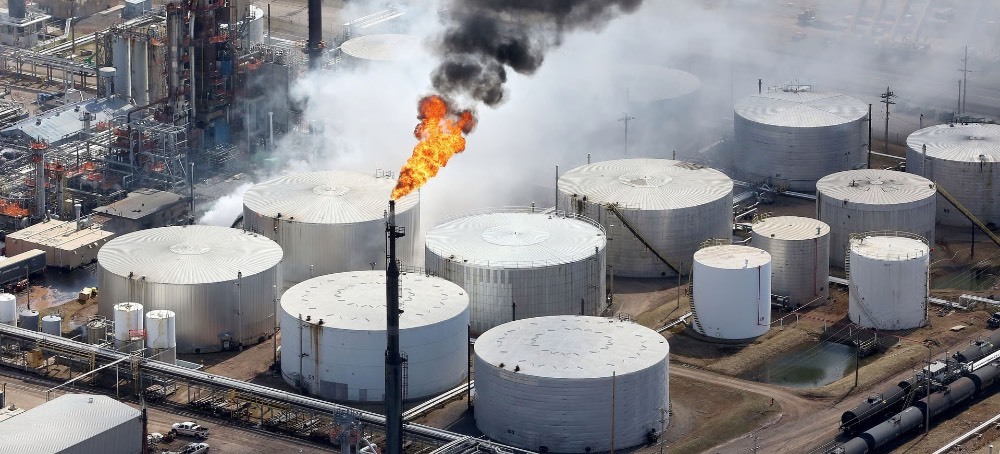 It turns out that the natural gas industry has been playing the pr game for a very long time. (photo: Getty)
That’s why the hydrocarbon industry’s growth story has been largely about natural gas. It’s used for many things—heating, cooking—but above all for generating electricity, and it’s on that ground that the fossil fuel industry has set out to build its market, stressing constantly that it is clean and cheap. Two important new reports in recent days make it clear how false those claims really are.
The first comes from a Center for Climate Integrity team led by Rebecca Leber and Rebecca John. Leber has a long record covering the industry—her 2020 report in Mother Jones about the industry paying Instagram influencers to plug natural gas was an early landmark in our understanding of pay for play social media, as well as the lengths the industry would go to in order to tell its fibs. (“#cookingwithgas makes food taste better,” says Camille, an LA-based foodie who poses artfully with her spatula, to her 16,700 followers.”)
But as they document in the new report, which should be read in full, this is a very old story. It turns out that the natural gas industry has been playing the pr game for a very long time. As far back as the 1950s, gas had a bad image: it was known to contribute to respiratory problems when burned indoors (more on that later!), and to local air pollution. And as scientists first started analyzing the greenhouse effect in the 1970s, most of the concern was about carbon dioxide, but there was a growing realization that methane—which is essentially what natural gas is—was the smaller but still important sibling greenhouse gas. And so the industry began doing what it did best, which is lying, or to use the technical term, “public relations.” They constructed a whole mythology around natural gas, turning it into the fossil fuel equivalent of the “other white meat.”
In the late 1980s, the gas industry and major oil companies started to brand gas as a “bridge fuel” — a clean-burning transition fuel to a renewable energy future. In reality, they planned a long-term future for natural gas, while simultaneously undermining renewables, obstructing the destination to which gas’ “bridge” was supposed to lead. Over the next 20 years, the industry effectively solidified the bridge fuel myth by co-opting the science and oversight originally intended to keep carbon and methane emissions in check.
Working together in a growing coalition that included the oil majors and ultimately several major environmental groups, the industry managed to temper concerns about methane using strategies crafted by the same firms that for decades undermined the scientific consensus about the harms of tobacco. AGA and allied groups aggressively challenged the science around methane through industry-funded studies and the creation of the objective-sounding Gas Research Institute.
But their approach was multi-dimensional. While muddying the waters on the industry’s methane problem, the gas industry was careful not to deny the issue of climate change outright, instead focusing attention on carbon dioxide. It paired this with relentlessly promoting the concept of gas as clean — certainly cleaner than coal or oil — and positioning gas as a bridge fuel and climate solution. In the process, the gas industry solidified partnerships with EPA with the explicit goal of fending off regulations in favor of voluntary emissions management, while also recruiting environmental organizations that would lend legitimacy to their arguments.
I want to highlight the effectiveness of this strategy with a story about…me. In 1988, before this campaign took off, I was writing The End of Nature, sometimes called the first book for a general audience on climate change. And in it I wrote:
A common suggestion is to replace much of the coal and oil we burn with natural gas, since it produces only about half as much carbon dioxide. But it natural gas—methane—escapes into the atmosphere before it burns, it traps solar radiation more efficiently than co2…As a result, switching to natural gas may have no effect on the greenhouse effect. It might even make it worse.
So give me credit for knowing this crucial science when I was 27.
But not really, because I think I more or less forgot it over the next two decades, as the gas industry rearranged the terms of the debate, and turned it into the lesser of two climate evils, the “bridge” to a future of cleaner energy. This argument was bought wholesale by politicians, especially Democratic ones—if you go read Barack Obama’s State of the Union addresses, most of them include a paragraph praising the fracking revolution as both an economic boon and a way to reduce greenhouse gas emissions; we were replacing coal with something cleaner. The Sierra Club’s leader, Carl Pope, barnstormed around the country with one of the fracking industry’s chief spokespeople, promoting this “solution” to the climate crisis.
And so it seemed novel to me when two Cornell scientists, Bob Howarth and Tony Ingraffea, about fifteen years ago, began publishing data showing that leak rates from fracking meant that natural gas was no cleaner than coal—the argument that had been there all along. I wrote some early pieces on their work for the New York Review of Books, and then published a long piece in the Nation that made the same point I’d made more than a quarter-century earlier.
Our combined emissions of methane and carbon dioxide have gone steadily and sharply up during the Obama years. We closed coal plants and opened methane leaks, and the result is that things have gotten worse.
I’ve made up for my forgetfulness, I think, by helping lead battles against fracking, and against the buildout of LNG export terminals; those of you who have been long subscribers to this newsletter got to participate in that latter fight, which we won in the Biden years and then lost in the Trump risorgimento. But if the PR campaign flummoxed me, imagine how well it worked on people who weren’t paying much attention at all (which included virtually everyone in political life, especially Democrats who saw natural gas as a way to have their green cake and reccycle it too). Many thanks to Leber, John, and their whole team for laying the story out in all its gory detail.
The other claim about natural gas is that it’s cheap—this is the formulation that “leaders” like New York governor Kathy Hochul are currently relying on as they link fracked gas and affordability as an excuse to cut back on moving towards renewables, and that data center developers are using to justify a buildout of natural gas generation.
But a report out this morning from the good folks at Oil Change International puts paid to all that. It makes clear that the industry is running out of the really cheap stuff—the fracked gas from the Permian and Appalachian shales that it’s been pumping for the last two decades. Many of those wells are playing out fast, and now it’s going to need to turn to the more “geologically complex” Haynesville shale of east Texas and Louisiana, and that will drive up costs—especially since more and more of the gas is, at least theoretically, going to be exported to Asia as the industry builds out massive shipping terminals along the Gulf of Mexico.
If industry succeeds in locking in unprecedented demand for U.S. gas by expanding exports and domestic consumption, U.S. supply may be pushed to its limits. Gas supply can only meet such high levels of demand if prices rise to cover the higher production costs of marginal gas supplies. This connects rising dependence on gas to rising energy costs. U.S. consumers and those in LNG-importing countries must push policymakers to reduce dependence on fossil fuels and accelerate the transition to reliable, affordable renewable energy
The numbers are fairly startling:
Between 2026 and 2040, the average wholesale price of gas could be 80 percent higher than during the past decade of U.S. LNG exports, a decade when energy price volatility was already causing hardship in the U.S. and LNGimporting countries. Prices could double relative to the 2020 to 2025 average by the late 2030s.
In other words, those politicians locking us in to natural gas are guaranteeing that our kids will spend much of their lives paying far more for energy than they should—and far more than people in the rest of the world will be spending. Because politicians in those countries are starting to wake up. A big piece in the Times yesterday described the ways that many governments are now trying to “unshackle” themselves from natural gas, after watching the supply dry up with the closure of the Strait of Hormuz. In the Philippines, for example,
the country’s largest solar project began delivering its first megawatts of power in March. That came two weeks after the outbreak of the Iran War, which pushed up energy prices and knocked out 20 percent of the global L.N.G. supply.
“That was fortunate timing. It was like fate,” said Emmanuel Rubio, the chief executive of Meralco PowerGen, the utility-backed power generation company that operates and invests in Terra Solar and gas- and coal-fired power plants in the Philippines.
For a country that imports nearly all of its fossil fuels, the solar project has proved that “we can actually be, to a certain extent, self-reliant,” he added.
The collection of lies around natural gas are collapsing in other ways, too. Another new study, this one from an Ohio team, went back to those fears around gas and indoor air pollution that dated all the way back to the 1950s, and what it found was truly startling. As Gary Fuller summarizes, replacing a gas stove with an electric burner—say, an induction cooktop, available online for $60—reduces childhood asthma dramatically. And when I say dramatically, I mean: better than the best medicine.
Ohio’s publicly owned MetroHealth began the study in December 2024 but funding was terminated early by the incoming Trump administration. It had been designed to investigate if replacing gas cooking improved asthma for 1,200 people living near Cleveland, Ohio.
Prof Ash Sehgal of Case Western Reserve University, the project’s leader, said: “We had completed the project at fewer than 100 households. As a result, over 1,100 households were unable to benefit. We also had to lay off about 20 project staff.”
The team finished the stove replacements that were under way and closed the project, but to the researchers’ surprise, the benefits could be clearly detected even in the scaled-down study of 72 homes.
Sehgal said: “We were surprised when we analysed the results and found a very large effect size. The improvements in asthma symptoms following stove change were similar to – or even greater than – those reported in clinical trials of commonly used asthma medications.”
Angela Bland, a 38-year-old resident of Akron, Ohio, said: “I didn’t realise my gas stove was the issue until I used the electric stove. I now need my inhaler way less often.”
If you want more on this study, check out Sammy Roth’s Climate Colored Goggles newsletter. He interviewed Segal too: “Our improvement was about twice as much as you typically see with medical treatment of asthma,” the researcher said. It truly is remarkable to think how much good we could do simply by dousing the campfire that most people have in their kitchen.
Anyway, to summarize: the natural gas industry is destroying the climate, and destroying people’s lungs, and it’s trying to lock us into this expensive practice for decades to come.
Any effort to slow it down is met with massive resistance. In Colorado, for instance, some towns have tried to prevent gas hookups in new buildings, requiring them to go all-electric. The industry has responded by organizing on behalf of a constitutional amendment called the “Right to Natural Gas,”which will go on the November ballot. As Maya McDaniel writes
The proposed amendment states that “producers and utilities have the right to sell natural gas to homes and businesses.” That could force changes to building codes that encourage electric heating and cooking, undoing progress towards electrification.
“Really, it’s just a cynical attempt to lock fossil fuel industry profits into the state constitution,” said Kelly Nordini, CEO of Conservation Colorado, an environmental nonprofit. “That’s bad for people’s pocketbooks, for clean air, for clean water; it has no provisions for public health or safety.”
Really, the first lucky break for natural gas came back in the 19th century, when it acquired that moniker, to differentiate it from “manufactured” or “town” gas, made by burning coal in the absence of air, and then piped through municipalities for street lighting and other tasks. These gasworks shut down as big deposits of naturally-occurring gas were discovered, hence the name.
I’ve taken to calling it ‘fracked gas’ in recent years, since that industry term for the new methods of liberating the fuel from tight rocks makes it sound almost as disgusting as it is. “Fossil gas” works too, or perhaps “asthma gas.” But our job is to make it a dirty word of some kind. The future depends on it.
+Scientists who once relied on federal funding are turning to Only Fans as a backup. Check out OnlyMarms from the Rocky Mountain Biological Laboratory, where you can gorge on
Unfiltered yellow-bellied marmot content from the Rockies” delivered as near-daily photos and videos of chubby, personable marmots (with charming names like Staple, Pawprint, and Cabinet) that give Jimothy the raccoon a run for his money. Viewers can leave monetary “tips” on each post, which are split between the platform and the poster.
Points for creativity, but it shouldn’t come to this
+A sad and powerful story from Bangladesh about how the cutoff of diesel due to the Iran war is devastating farmers who depend on the fuel to run their irrigation pumps. Peter Goodman writes:
For three days, he waited at the gas station in a crush of hundreds of villagers, as the temperature rose to 104 degrees. People tried to cut the line, and fights broke out, drawing police officers wielding batons. This, Dulal Hossain endured for the chance to buy diesel fuel.
He was tormented by worries about his rice plants, the source of most of his livelihood. The diesel he eventually carried home by bicycle, in a jerrycan strung from the handlebars, would fuel the pump that bathed his fields with groundwater. The pump was empty.
It was late March, the dry season in western Bangladesh, and a month after the United States and Israel unleashed war on Iran. Around the globe, energy prices were soaring as shipping was halted through the Strait of Hormuz. In South Asia, diesel was scarce. So crops were deprived of water.
For six weeks, Mr. Hossain, 68, pedaled between the gas station and his fields, bearing replenishment for his pump. He inspected his rice plants like a parent attending to an afflicted child. Their leaves were turning yellow. Stems drooped toward cracked soil.
He could not stave off calamity. When he harvested his rice last month, he wound up with barely one-fourth the usual volume. That was enough to feed his family, but left him nothing to sell. Short of cash, he cut back on meat and fish. He resorted to borrowing to buy seeds for growing vegetables.
“I’m going backward,” he said.
The only slightly hopeful coda I can offer to this story is that Pakistan—which once ruled Bangladesh—has switched a huge amount of its irrigation pumping to solar panels over the last two years, reducing the use of diesel by at least a third. If the world leaned into it, we could have those panels in Bangladesh too by the next planting season.
+Ed Mazria, who has been a powerful voice for green building and electrification for many years, has an important essay in Architect magazine detailing how much we could be saving, in both energy and cash
The Trump Administration has been loudly warning the American public about a so-called “Green New Scam”—a narrative it is using as cover to “permanently end” energy-efficient appliance and HVAC standards and roll back the 2024 International Energy Conservation Code (IECC).
Their message: Energy-efficient appliance and HVAC equipment standards “raise costs and disrupt consumer choice,” while updating to the 2024 IECC “would increase residential construction costs by more than $9.2 billion annually compared to the 2006 code levels.” This, they say, would saddle homebuyers with as much as $14,000 in extra construction costs with a 10- to 20-year payback period.
Simultaneously, they point to the energy demands of AI and hyperscale data centers to justify keeping aging coal plants open and incentivizing new fossil-fuel power plants, all while actively stifling clean energy development.
This administration’s narrative is the real scam. By relying on outdated and cherry-picked numbers, the administration is attempting to strip away policies that have in fact saved consumers trillions of dollars, all to prop up the flailing fossil fuel industry.
When you look at the facts—a jurisdiction transitioning from the 2021 to the 2024 IECC—the cost of the upgrade in a home purchase is roughly $2,000 to $3,000, according to analyses by the Department of Energy (DOE) and the Pacific Northwest National Laboratory (PNNL).
Furthermore, the annual energy savings pay off that initial cost in about 2.5 years. Better yet, if that $2,000 to $3,000 is rolled into a standard 30-year mortgage, the monthly utility bill savings exceed the slight increase in the monthly mortgage payment. The homeowner will usually see a net-positive monthly cash flow in the very first year.
Good news then, as Jan Rosenow reports, that the EU is embarked on a crash program to increase electrification. Under the new plans
electricity is to meet 46% of the EU’s final energy consumption by 2040. Getting there means to speed up 9x compared to the annual increase of the electrification rate since 1990.
Meanwhile, the redoubtable Auke Hoekstra has the numbers from Africa that demonstrate just how expensive it is to live without electricity. It’s worth reading this carefully:
Households without electricity spend $38 billion a year on fuel-based light, and per unit of useful light a kerosene wick costs up to 150 times more than an efficient bulb (Mills, 2005). A family burning kerosene pays $12 to $18 a year to light one room badly and fill it with smoke (CEIBS, 2024). The poorest customers in the world’s energy market pay its highest prices. Nobody designed that; it is simply what happens when the only light you can afford is the kind you buy by the bottle, week by week. Or maybe when nobody offered you an LED light on solar yet.
Solar, of course, is the answer here:
Currently three solar panels would cost about $200. The cheapest 2 kW off-grid inverters costs around $100. A five kWh battery will cost around $200 in a few years. $500 in total. Include streamlined financing and distribution and you are looking at around $700 for a family of on average seven people. $100 per person.
Such a setup could easily last 20 years and if people have to pay for it themselves they will take care of it and sell it if they don’t need it anymore or upgrade. So that’s $5 per person per year. Times 660 million people we are talking about 3 billion per year. Compare that to the $2.4 trillion in health damage alone and it is a truly paltry sum. If you care about nature and climate change it’s also the most effective intervention possible per dollar. And it aligns with our feeling of fairness. Very few people will say: these families don’t deserve $5 per person per year to solve their energy problems.
+European insurance exec Gunther Thallinger has been telling the truth about climate change for a long time, and his message is getting more and more urgent. Talking to reporters last week he said
Extreme weather events — such as the heat wave that just hit Europe — are making more and more assets too risky to insure, according to a director at Europe’s largest primary insurer.
“Certain locations and perils cannot be covered as we would wish them to be covered,” said Guenther Thallinger, who sits on the management board of Allianz, in an interview. “We cannot help it.”
Heat, floods, storms and wildfires “could become so frequent that they challenge traditional insurance models,” he said. “Risk-adequate pricing would not be affordable any longer.”
Those European fires keep getting worse, as French and Spanish authorities struggle to contain blazes even as the fourth extreme heat wave of the summer begins today. French firefighters reported yesterday that they had encountered their first pyrocumulonimbus or “fire cloud,” a phenomenon that has become fairly regular fare in Canada, Australia, and the American west. As Claire Moses reports
These large, fire-fueled thunderstorms, also known as pyroCbs, are created by intense heat from large blazes or volcanic eruptions. They produce lightning and burning embers that can spark more fires, and they generate high and unpredictable winds that fan the flames and spread the embers. But they rarely bring rain.
One pyrocumulonimbus generated more blazes over the weekend in one of the hardest-hit areas of France, Marc Vermeulen, the director of fire and emergency services in the Gironde region, said at a news briefing on Sunday.
Wildfires are so hot they can sometimes create their own weather systems. The smoke from the fires acts as a plume of heat rising fast into the atmosphere, according to Britain’s Royal Meteorological Society. That chimney effect sucks in air at ground level, feeding the blazes oxygen and pushing them into new terrain.
Meanwhile, it’s so hot in Japan that they’ve coined a new word for it: A kokushobi, or “cruel heat day” is when the mercury tops 40 degrees Celsius. As Kiuko Notoyo and Francesca Regulado report,
“Numbers are difficult to understand because people perceive them differently. By giving it the name ‘cruel heat day,’ people will understand it better just by hearing it, and they’ll feel that today is dangerous,” said Taro Kawasato, the assistant director of the Japan Meteorological Agency’s climate prediction division.
+Superb coverage from Emily Fishbein and Jauman Naw of how the repressive Myanmar government, and warlords along the Chinese frontier, are producing gruesome conditions in the rare earth mines.
The businesses carrying out this extraction face few consequences in Myanmar — in part because the industry operates in a legal grey area. Chinese companies extract rare earths in autonomous, militarized regions controlled by local ethnic armies, which protect mining operations while taking a cut of the profits. The mined material is then trucked across the border into China, where it is mixed and essentially laundered with rare earths from other sources and processed for use in global products.
The conflict monitoring organization Armed Conflict Location … Event Data, or ACLED, has ranked Myanmar’s war as the second-most extreme on the planet, and also the world’s most fragmented, with more than 1,200 distinct armed groups. Corruption and weak rule of law have further contributed to an explosion of criminal activity of all kinds. According to the Global Initiative Against Transnational Organized Crime, Myanmar has the highest levels of organized crime of any country in the world.
+If you’re feeling a bit hopeless, you could go to Collapse Camp in Germany—and perhaps feel oddly empowered. An organizer explains:
Collapse Camp has a broader thematic scope. It's not just about actual disaster relief. It's also about emotional recovery, self-defense, protecting demonstrations and left-wing spaces, providing a solidarity-based power supply , and preserving food, to name just a few examples. We were surprised ourselves during the organizing process by how many fantastic offers we received that we hadn't even considered at first.
Always relegating the idea of rational preparation for crises and disasters to the right-wing prepper camp is getting a bit retro. In a polycrisis and collapse, disasters are inevitable, and those who don't prepare will be left high and dry. Preparation, or "prepping," therefore comes in various forms: individualistic, fascist-style prepping, standard prepping (which, for example, the Federal Office of Civil Protection and Disaster Relief recommends), and now finally: solidarity-based prepping . And solidarity-based prepping isn't primarily about stockpiling supplies, but about building relationships.
Speaking of camping, EVs are now so popular in China that they’ve spawned a whole new craze: EV camping. As Julia Shong and K Oanh Ha report
In China’s fiercely competitive EV market, standout features sell cars. Beginning in 2022, manufacturers rolled out camping and napping options aimed at outdoor enthusiasts. These range from the ability to power lights while parked to dedicated “Camp Mode” settings that fold seats completely flat and regulate overnight cabin temperatures. EV maker Xpeng’s “Sleep Mode” even includes looping white noise tracks of a crackling bonfire, crashing waves and a heavy storm.
These high-tech cabins have also turned cars into an extension of the living room and bedroom in a society where privacy is hard to come by, as multigenerational households are common. “A lot of people are going to their cars to have a one-hour nap,” says Daniel Wu, head of global brand and marketing for XPeng. “After work they’ll stay in the car for about an hour before heading home, doing things they enjoy — for example, playing games — simply because it’s such a comfortable space.”
On Douyin, the “car‑camping life” hashtag has attracted 9.2 billion views, ranking among the platform’s most popular camping‑related themes. Tutorials explain how to convert EVs into campsites and suggest what gear to buy. EV rental bookings on the mainland during the Chinese New Year holiday this year surged six-fold compared with the prior year, according to local media, citing data from car rental platform Car Inc.