Trump’s Border Wall Extension Is Slated to Slice Through Some of Arizona’s Most Cherished Sites
Alisa Reznick KJZZ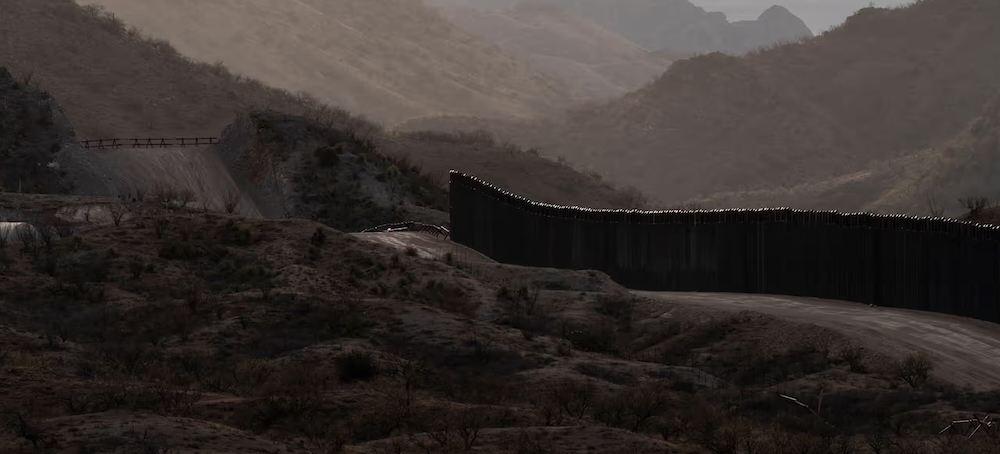 A border wall section. (photo: Cheney Orr/Zuma Press/Alamy)
It’s a tiny oasis that’s provided flowing water for thousands of years. Today, the spring drains into a human-made pond that sits about 200 feet from the Arizona-Mexico border inside Organ Pipe Cactus National Monument.
Vazquez would make this trip as a kid to visit family grave sites with her grandmother.
She’s 76 now, and she’s Hia-Ced O’odham — a tribe related to the Tohono O’odham but isn't federally recognized. Hia-Ced O'odham families used to live at Quitobaquito.
“Back then, the water was full, running,” she said.
A lot of things have changed since. In 2020, a 30-foot steel bollard wall was installed at Quitobaquito under the first Trump administration.
And now, federal authorities are planning to build there again — part of a mega-project that aims to install physical walls, roads, lighting and surveillance technology across the length of the U.S.-Mexico border.
Places like Organ Pipe are slated to see a double border wall.
Vazquez is one of a few dozen community members coming to visit Quitobaquito before that happens. She says she can't help think about how her grandmother would react.
“She would be doing everything to fight from them entering and disturbing that area. Because, that was their home,” she said.
Since last year, the Trump administration has awarded billions of dollars in construction contracts for its "Smart Wall," and work has been ongoing for months in various parts of Arizona.
Aaron Cooper is the director of a nonprofit in the nearby town of Ajo called International Sonoran Desert Alliance. He says he first heard about the possibility of a double wall last fall.
“And I’ve got to admit, I sort of dismissed them as ‘Oh, that sounds outlandish, unlikely at best, and pretty preposterous,’” Cooper said.
Cooper says top of mind are animals like the Sonoyta mud turtle and the Quitobaquito pupfish — two tiny, endangered species that are nearly extinct except for inside Quitobaquito and its pond. He says it’s not clear how wall builders will account for those species, or even where the wall will be built.
“We know very little. Information is not free flowing,” he said. “If a wall was constructed 200 feet north of the existing one, it would be in the pond. It would be in the retention pond.”
A spokesperson says Customs and Border Protection will work with federal agencies to protect Quitobaquito. And the second wall will be built within a 60-foot stretch of federally-owned land along the border called the Roosevelt Reservation.
The agency did not answer questions about how the new structure will fit inside that space alongside the existing wall, or if new roads, lighting and surveillance tech will also be added.
Tohono O’odham Nation Chairman Verlon Jose says his tribe is trying to work with the Department of Homeland Security to minimize harm and maintain tribal access. But, he says, like in 2020, the new wall probably can’t be stopped at the spring, because it's on federal land.
“The damage is done. And the damage will be done again with this secondary wall,” he said.
Contractors also plan to build wall along the 62 miles of border inside the Tohono O’odham Nation for the first time.
A lawsuit filed by the tribe to stop that wall segment went to federal court last month. Their attorneys argue the wall disregards the nation’s sovereign boundaries.
This month, as news spread that construction may soon begin, leadership placed no trespassing signs throughout the tribal nation and has threatened to charge contractors who try to enter.
Jose says so much of his tribe’s ancestral land, burial sites and sacred areas along the border have already been cut through.
“That’s the last piece of area that we’re trying to hold on to,” he said. “We have the basic human, O’odham responsibility to protect the land, and protect the people, and protect the animals.”
That's how protesters feel in the San Rafael Valley. It's a celebrated biodiversity hotspot southeast of Tucson that was left partially unwalled during the first Trump administration, allowing for the passage of wildlife and water.
Construction firm Fisher Sand and Gravel has been awarded more than a billion dollars worth of contracts for wall projects in Arizona, including one to build two parallel walls across the valley.
In July, contractors tore down three cottonwood trees in Lochiel, an remote border town in the San Rafael Valley, about 25 miles east of Nogales.
Environmentalists estimate the trees were up to 250 years old. Protesters like Kate Scott have been staging a tree-sit inside the last remaining tree for over a week now.
On a hot Thursday morning, Scott shielded her eyes from the sun and yelled up to another protester seated on a wooden platform high above us in the tree’s thick branches.
Remnants of the other cottonwoods sat piled up on the dirt road where big construction trucks barrelled past.
“We have a tree platform on the upper canopy of the last grandmother,” said Scott, who heads a southern Arizona environmental group called the Madrean Archipelago Wildlife Center. “And you have just heard a yellow-billed cuckoo in Mexico. But the yellow-billed cuckoo, which is a federally listed threatened species under the Endangered Species Act, has been in this tree as well.”
A law from the ‘90s allows DHS to waive a host of federal laws, including the Endangered Species Act, in the name of border security. The Trump administration has used that across the entire U.S.-Mexico border to streamline wall construction.
Scott says advocates hoped the old cottonwood grove would be spared, but the administration’s plan for a double wall changed that.
“That’s what really put the grandmothers in the sacrificial zone,” she said.
Now, she says, they’re trying to stop the work in this small corner and save the tree.
“I feel that our grandmother stands for our entire borderlands right now, and the destruction that’s happening,” she said.
Back at Quitobaquito, the group is quiet as a pair of tribal members sings at the edge of the pond. The steel bollard wall is stark against the orange light of the sunset behind them. Marlene Vasquez — the Hia-Ced O’odham elder — says standing here, she feels good. But she worries what will happen next.
“We need to go ask for help from our creator. Help us with our cause. Because we can’t make it without the water,” she said.
The National Park Service has closed the road to Quitobaquito in anticipation for new wall construction.