Trump Took His Status. ICE Took His Dignity. He Took His Life.
Adrian Carrasquillo The Bulwark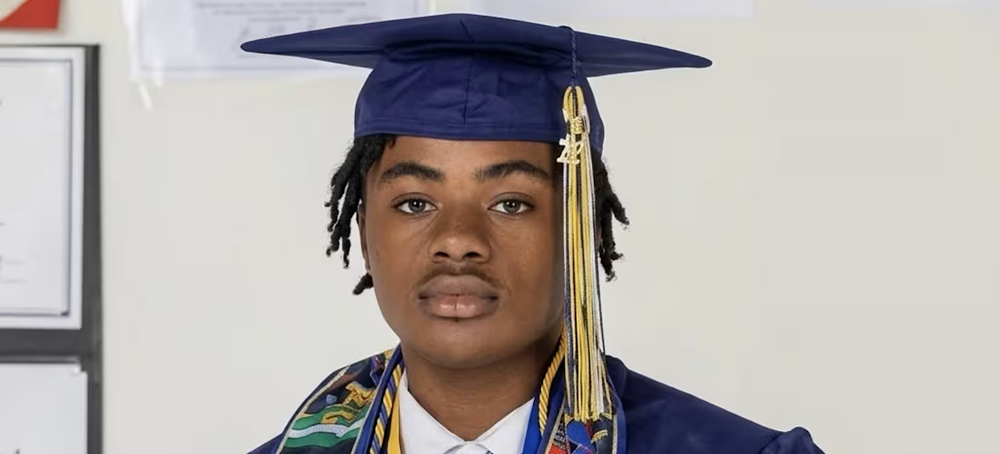 Pierre Damas Bel, 20, of Springfield, Ohio, expressed feeling “shame and humiliation” at having to wear an ankle monitor. The college student died by suicide days later. (photo: NBC)
This promising young Haitian immigrant was humiliated and tormented until he lost hope.
Pierre had big dreams for what he could achieve in America, and his Instagram account chronicles his successes—and his pride at making good on some of those dreams. He played high school soccer in Springfield, Ohio, where he was a member of the Junior Reserve Officers’ Training Corps (JROTC), went to prom, and received academic awards. He received a scholarship and was recruited to play soccer at Wittenberg University. After graduating from high school with honors, he posted a photo to Instagram with a caption that read, “No matter where you end up in life, never forget how far God brought you.”
He was the very image of a young person engaged in American civic life.
But he was systematically denied his dreams by a MAGA movement that didn’t see him as equal. They vilified his community. They attacked his immigration status. They pushed to strip it. And they prepared to deport him. A 6–3 Supreme Court ruling in late June cleared the way for the Trump administration to end TPS for 350,000 Haitians like Pierre, which it did on July 27. On July 29, he was fitted with an ankle monitor, an ordeal he also posted about on Instagram. He had come to the country to reunite with his family and pursue his education, not commit crimes. “Yet now I’m walking through the streets of the United States with a GPS monitor on my leg,” he wrote, “carrying a feeling of shame and humiliation.”
Because of the ankle monitor, Pierre had to give up the opportunity to play soccer at Wittenberg, so he instead enrolled at Wright State University, where he prepared to study neuroscience. He celebrated his accomplishments, posting a photo of himself on August 24 with a colorful sign that announced “FIRST DAY OF CLASS.”
Still, across social media and also in school and at work, Pierre had to explain to people that despite the ankle monitor, he was not a criminal. He described being deeply hurt when bullied by other students for having the device clamped on his leg. You can see in his pictures taken at Wright State how he tucked the ankle monitor into his pant leg to hide it.
With the threat of deportation looming, Pierre parked on the side of the highway in Springfield earlier this week and video-called his father. “Dad, I’m not feeling okay. I’m not thinking right because of the bullying,” he told his father, according to Pastor Carl Ruby, who read a statement from his father at a press conference on Tuesday at Springfield Central Christian Church. Pierre’s father told the young man to come home and talk. Instead, according to Pierre’s father, his son got out of his car and walked into traffic. He was struck by a tractor-trailer and killed. Police officers told Pierre’s father that he had thrown himself under the truck.
In the statement read by Ruby, Pierre Ronal Bel said his son felt “treated like an animal.” Beyond the humiliation of classroom bullying, he said that on the previous Friday, Pierre’s JROTC classmates had received their uniforms but he had not; Pierre believed the uniform had been withheld because of his ankle monitor.
At a press conference, faith leaders and Haitian community leaders blamed Pierre’s death on Trump administration immigration policy.
“It shouldn’t have to get to this point for this administration to understand that there is blood on their hands,” said a composed Yola Lamarre, Pierre’s friend and mentor. “Pierre was more patriotic than [the] hateful Americans . . . pushing this harmful, dehumanizing rhetoric,” she added, citing his JROTC membership and leadership on the soccer field.
Others felt similarly about the young man. Before his death, Pierre had posted on his Instagram account a series of letters from teachers, managers, and others, all testifying to his character. One, by a retired Marine captain, described Pierre as a “natural leader” who served as JROTC class commander, a role that made him responsible for the “technical development” of thirty-five cadets.
Each of the speakers at the church called for an end to the use of the ankle monitors. The devices have led to complaints “of pain, swelling, blisters or the monitors interfering with their ability to work” among the hundreds of Haitians forced to wear them, according to the Springfield News-Sun.
Vilès Dorsainvil, executive director of the Haitian Support Center, said he had been speechless after hearing of Pierre’s death, but he said it showed what Haitians have been through—and are continuing to go through.
“Last Sunday, we were having a peaceful [prayer service] asking to unshackle Springfield, and today we are living with the consequences of shackling,” he said. “I don’t know how many young people we have to lose before this administration understands.”
While in attendance, Pierre’s family did not appear before reporters. As the speakers gave their statements, a woman could be heard wailing.
Dorsainvil pleaded for human dignity to be respected by those carrying out Trump’s mass deportation program.
“You have the full authority to enforce your laws,” he said, “but, please, you don’t have to chain the people. You don’t have to destroy human beings.”
Trump Puts Haitians in Chains, Echoing Haiti’s Dark Past
The Trump administration is shackling Haitians, both in ankle monitors and literal chains during deportations—a move that is being turned into lurid, sadistic timeline content through photos and glossy videos shared and presumably produced by the Department of Homeland Security’s social media team.
The sight of black bodies in chains is shocking in America, not just because it evokes our own abominable history of slavery. It is disturbing to see contemporary law officers shackling the descendants of a nation born out of a revolt of enslaved people.
The Haitian filmmaker behind The Forgotten Occupation, a documentary about a two-decade-long American occupation of Haiti that began in 1915, is attentive to these dark echoes of Haiti’s history in the present.
“What makes the young man’s death more tragic, as someone who grew up in Haiti, I know the romantic relationship Haitians have with the U.S.,” director Alain Martin told me. “It is the model. I can only imagine the shock that this country is treating them this way.”
At a screening event in Brooklyn, a host from the Museum of Contemporary African Diasporan Arts described Martin’s documentary as a love letter to his grandfather. (The film is in fact framed as a letter to him.) But Martin is also critical of the romanticizing view his grandfather—and Haitians generally—have had of the United States, arguing that it too often elides America’s coercive and imperialistic posture toward the island nation.
Haiti was not just the first free black nation, the film explains, but the second free nation in the New World, full stop. The first was the United States. After over a century of Haitian independence, which was achieved in 1804, the United States under Woodrow Wilson (heeding American financial interests spooked by popular uprisings against the repressive Haitian government) occupied Haiti in 1915, promising to transform it into a model state. But the Americans’ iron-fisted approach to modernization meant there were chain gangs of Haitians building the country’s roads and often dying beside those roads from exhaustion.
These were the kinds of historical memories being evoked by the Trump administration’s treatment of Haitian immigrants.
“Seeing their legal status revoked, being placed in chains and shackles—this goes back to the occupation,” Martin said.
What We’ve Lost
I keep coming back to the big picture of what America has done here, what it has become: We welcomed Haitians into the United States and allowed them to remain via TPS. We had them take care of our grandmothers and children in places like South Florida. We let them become—we encouraged them to become—community pillars and economic drivers in places like Springfield, Ohio. And then in an instant we viciously turned on them. It speaks not just to a loss of hospitality and morality on America’s part but to the cruelty and callousness of the administration that engineered this, and the voters who supported it.
This horrible situation—the ugliness of the way TPS has been terminated for the Haitian community, brought home most brutally by Pierre’s death—forces us to confront the question of what type of country we want to be. We invited these people into our home, then shackled them, treated them like criminals, and then expelled them, violently and humiliatingly.
What will happen to them? is the first question we must ask. We are “sending them back to a country that’s unlivable,” Martin says.
And What does it say about us? must be our next question.
The character witness letters Pierre collected help us fill in some of the answers. He lost his life, his family is broken, and Springfield mourns. Other former TPS holders fear what comes next. But there is no doubt our country has lost something, too.
The letter from Pierre’s JROTC instructor commended Pierre for having done so much in such a short time, all while navigating an unfamiliar environment, language barriers, and a new culture.
“Mr. Bel exhibits the type of individual character that makes our society great,” the retired Marine wrote. “He has my highest endorsement and [utmost] confidence that he will make us proud and be value added to our nation.”
If only it were so.