Trump and Musk Cut Funding for Wildfire Mitigation — and Then the Northland Started Burning
Brian Martucci Minnesota Reformer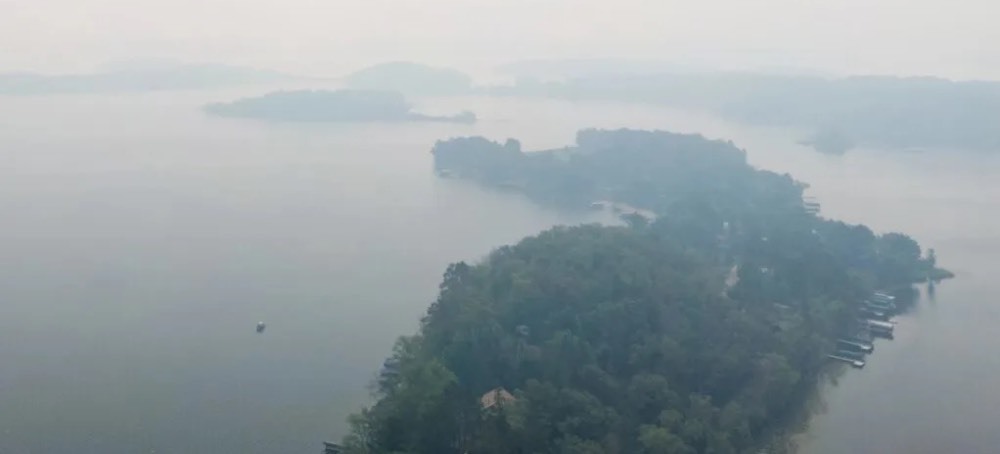 Smoke from wildfires in the Boundary Waters creates haze on Big Sandy Lake in McGregor on July 15, 2026. (photo: Lorie Shaul/KAXE)
Democratic elected officials say those setbacks left Minnesota ill-equipped to face the fires that have burned more than 60,000 acres in the Boundary Waters Canoe Area Wilderness since early July and repeatedly billowed smoke across the Great Lakes region and beyond.
"The Forest Service diverted forest management funds that Congress provided through the Bipartisan Infrastructure Law and the Inflation Reduction Act to pay for the Deferred Resignation Program," DFL Rep. Angie Craig told U.S. Forest Service chief Tom Schultz at a July 22 congressional hearing. Craig is the highest-ranking Democrat on the House Agriculture Committee.
The move had "obvious consequences: the Forest Service treated 23% fewer hazardous fuels acres last year compared with 2024," Craig added.
The Forest Service did not respond to a Reformer request for comment.
The Boundary Waters have seen several major fires since a 1999 derecho left tens of millions of mature trees to decay — or burn — on the forest floor. Repeated droughts made worse by climate change have also encouraged the spread of spruce budworm, a native insect that can weaken or kill spruce and fir trees, leaving yet more fuel in the wilderness. These natural conditions exacerbated what some conservationists say were decades of misguided forest management practices, which favored fire suppression at all costs over the beneficial, low-intensity fires that periodically sweep the Northwoods.
Forest management today is a more holistic practice that combines selective tree thinning and prescribed burns with efforts to boost ecological diversity and protect "keystone" species, which in northern Minnesota include the towering white and red pines that make the Boundary Waters so special.
The delayed Forest Service grants would have supported prescribed burns and other fuel-reduction efforts on thousands of acres near the Echo Trail, which has borne the brunt of this year's fires. These "shovel-ready" projects "would have been effective in stopping or slowing down these fires," a former Forest Service official who retired in December told the Washington Post last week.
Citing current and former Forest Service officials, some of whom spoke anonymously for fear of retaliation, the Post reported that the grants were among countless earmarks paused or canceled by Elon Musk's DOGE, which aimed to cut federal spending and especially Biden-era programs connected to social justice or climate change.
Sen. Amy Klobuchar, the top Democrat on the committee that oversees the Forest Service, joined several high-ranking colleagues in signing a letter in February 2025 raising "significant concerns" about the funding pause and a separate hiring freeze that kept the agency from adding permanent and seasonal firefighters.
Craig, who is running against Lt. Gov. Peggy Flanagan in the DFL primary to replace retiring Sen. Tina Smith, said at the hearing last week that the agency lost about 16% of its workforce due to the DOGE cuts. Those losses put the agency on the back foot ahead of fire season, she said.
"'We only have so many resources to go around,'" Craig said, repeating a July 17 warning from National Incident Management Organization official Jason Loomis, who said his teams would need to focus equipment and personnel on protecting nearby communities and public infrastructure over the wilderness itself. By then, the entire Boundary Waters had been evacuated and closed to new entry.
"That would certainly suggest that the lack of staffing was at least partially related to the closure," Craig said.
The agency unfroze the two wildfire mitigation grants in December after state and local officials went to Washington to advocate for the funding, but not before requiring modifications to allow more of the thinned vegetation to be marketed for timber, the Post reported.
On a webpage touting "2025 Forest Service Accomplishments," the agency said it "strengthened America's timber supply and forest industry and exceeded timber targets" while launching a "long-term strategy for forest productivity and rural economic growth" that would see timber volume grow 25% by 2028 to 4 million board-feet, a level not reached since 1993.
State Sen. Grant Hauschild, DFL-Hermantown, whose sprawling district covers the Boundary Waters and surrounding state and national forest lands, told the Reformer in an interview that reducing wildfire risk requires a "multifaceted approach" that includes fuel reduction in vulnerable forests.
"One of the things we could have done is supported the federal grant to help clear the fuel around the Echo Trail," he said. "That's not to say we couldn't have done more than that…(but) we can't just have across-the-board cuts to Forest Service staff and we can't have cuts to grants that help with wildfire mitigation."
In last week's hearing, Craig accused Schultz of the Forest Service of redirecting large chunks of wildfire mitigation funding and reassigning hundreds of Forest Service staff without receiving congressional approval, which she said the law required.
Schultz pushed back, saying the agency was well within its rights.
"We did not receive approval because we did not think it was required by law," he said.