Trump Administration Allows Killing of Species Threatened with Extinction
Jake Spring The New York Times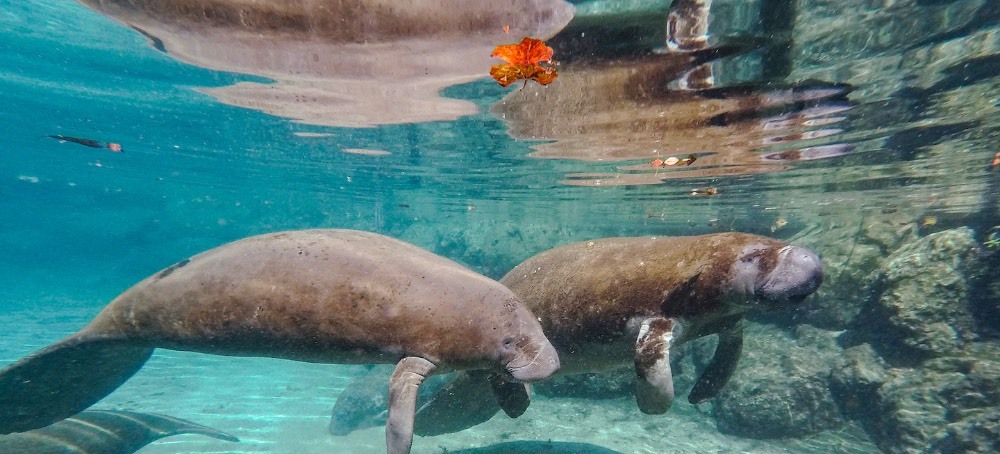 Florida manatees are seen last year in Three Sisters Springs in Crystal River, Florida. (photo: Patrick Connolly/Getty)
Regulatory changes to reinterpret the Endangered Species Act also demand that the U.S. Fish and Wildlife Service consider the economic toll of habitat protection.
That action — paired with another issued Friday that requires regulators to consider the economic toll of habitat protection — is part of President Donald Trump’s broad attempt to reinterpret the 1973 Endangered Species Act in ways that weaken protections for imperiled plants and animals.
In March, the administration convened the so-called God squad in a 15-minute session that decided oil and gas companies no longer need to abide by Endangered Species Act protections in the Gulf of Mexico. Last week, the administration repealed a decades-old rule so that habitat destruction will no longer be considered a “harm” to endangered species.
On Friday, the Fish and Wildlife Service rescinded what is known as the “blanket rule,” which was first instituted in 1975 and gave threatened species the same protections as endangered ones — broadly prohibiting illegally killing, trapping or harassing them.
The rollback would only apply to newly declared threatened species, such as the Florida manatee, whose case is still pending. Species that previously received the label would continue to have greater protections under the Endangered Species Act. Rescinding past protections or issuing new ones can now only be done for threatened species one at a time.
The agency issued the repeal alongside another rule on Friday that requires the agency to consider the economic harms of designating areas “critical habitat” to protect endangered species. Previously, the agency had discretion on whether to weigh those concerns.
The Interior Department said in a statement that the latest changes were necessary to “advance President Donald J. Trump’s directives to strengthen American energy independence, improve regulatory predictability, and ensure federal actions align with the best reading of the law.”
“For too long, the Endangered Species Act has been weaponized to stop almost any new project in America, driving up costs for families, weakening our competitiveness, and undermining our national security,” Interior Secretary Doug Burgum said in the statement.
Clay Samford, an attorney for the environmental law firm Earthjustice, called the new rules “bad for imperiled wildlife and for wild lands.”
“It’s part of this administration’s push to reduce protections for public lands and wildlife that are enjoyed by all Americans, in favor of narrow business interests,” he said.
Samford said the rule to factor economics into critical habitat decisions could affect situations like that of Hawaii’s ‘I‘iwi bird. The brilliantly colored red birds, also known as scarlet honeycreepers, are listed as threatened, but cattle ranchers have fought back against land being listed as critical habitat for the species.
Samford said that under the new rule, officials would be required to consider the ranchers’ claims in their decisions, making it far more likely that the agency would exclude their land from protections.
Both regulations were similarly changed in the first Trump administration and then reinstated under President Joe Biden.
The Property and Environment Research Center (PERC), a libertarian conservation think tank, praised the repeal of the blanket rule.
“For too long, the blanket rule treated threatened species the same as endangered ones, dulling incentives for recovery,” said Jonathan Wood, PERC’s vice president of law and policy. “By restoring a tailored approach, the Service can better reward progress and encourage proactive conservation.”
Outside groups generally petition the agency to consider individual species for protection under the Endangered Species Act. A backlog of more than 500 species are awaiting evaluation for listing as threatened or endangered, according to the U.S. Fish and Wildlife Service’s website.
Other animals being considered for protection that could be affected by the rule change include plants like the purple-flowered Aztec Gilia and Clover’s cactus, both found only in New Mexico.
The number of listings of threatened and endangered species has slowed as the Trump administration cuts the number of personnel able to make those analyses.
The Fish and Wildlife Service lost about 18 percent of its staff in the first few months of the second Trump administration, as compared with the final year of the Biden administration, amid wider efforts to shrink the government, according to data obtained by the Center for Biological Diversity, an advocacy group. That included 530 fewer staff biologists.
Fewer workers, along with new paperwork requirements to consider protections for species individually, is likely to add to the backlog, Samford said.
“It for no reason takes away a default protection system that has worked for 50 years and replaces it with a promise to do species-specific rules, when we know that this agency is overworked and understaffed and it can usually take a long time to do those rules,” Samford said.