Three Years After October 7, Israeli Strikes in Gaza Grind On and Deaths Climb
Rachel Chason The Washington Post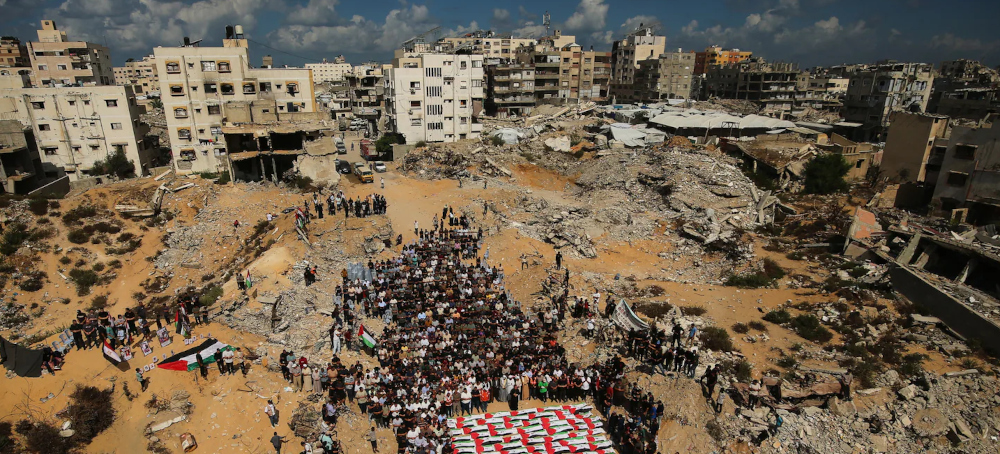 Mourners gather around a funeral in Gaza City on Thursday. (photo: Yousef Al Zanoun/AP)
She and her husband, Bahaa, and their children, were living in a tent in a crowded refugee camp in the Gaza Strip, after being displaced repeatedly during the Israeli military operation that followed the Hamas attack on Israel on Oct. 7, 2023.
Shortly after Trump proclaimed that the war had ended and “peace in the Middle East” had been achieved, Bahaa headed north to repair the family’s home, which had been damaged by Israeli airstrikes.
But the strikes did not stop. Less than six months after they moved back into their house, Asma’s world — and any illusions of peace she carried — shattered.
An Israeli airstrike on May 16 killed Bahaa in an instant. Their 10-year-old son, Mohammad, who was with him in their car, was left in a coma, half of the soft tissue on his face gone in the blast.
The Israel Defense Forces (IDF) said that Bahaa Baroud, 41, had been a “commander” at Hamas headquarters who planned attacks against Israeli soldiers and civilians and “posed an immediate threat.”
Asma said Israel’s allegations were false and that Bahaa had been a charity worker who dedicated his life to serving Gaza’s poorest residents.
The IDF declined to provide evidence of the allegations against Bahaa or to address questions about injuries to Mohammad.
Asma said she had worried about going back to the house, which was close to the “yellow line,” which separates the majority of Gaza still under Israeli control from the rest of the territory. But they were all tired of moving, she said.
“What were we supposed to do?” asked the soft-spoken 34-year-old. “We wanted to live normally.”
In the three years since the Hamas attack on Israel left more than 1,200 people dead, Israel’s military campaign in Gaza has killed 74,245 Palestinians, according to Gaza’s health ministry, which does not distinguish between combatants and civilians.
Of those deaths, 1,462 have been tallied since last October, when Trump declared, “after years of suffering and bloodshed, the war in Gaza is over.”
Officially, a peace process is underway, led by the Board of Peace that Trump established.
On the ground, however, little headway has been made, analysts say, with Gaza in limbo. Israel is quietly taking more territory while continuing its airstrikes. International attention — and diplomacy efforts — have dissipated.
“There is a ceasefire in name only,” said Hugh Lovatt, a senior policy fellow with the European Council on Foreign Relations, adding that the number of killings and injuries has increased in recent months. Israel’s government, led by Prime Minister Benjamin Netanyahu, does “not want to be seen as going easy on Hamas or Gaza” ahead of a national election on Oct. 27, he said.
Lovatt said that Israel is targeting “an expanding circle of Palestinians” who it says are connected to Hamas.
In the case of Mohammad, who doctors said emerged from the coma after 21 days but lost his left eye and will need multiple reconstructive facial surgeries, the IDF said in a statement that “measures were taken to mitigate harm to civilians, including the use of precision munitions and aerial surveillance.”
Israel “is not violating the ceasefire agreement, but is operating in accordance with it and with the directives of the political echelon, while the Hamas terrorist organization repeatedly violates the agreement,” the statement said.
A Hamas spokesman said that Bahaa Bahoud was a humanitarian worker and not connected to the group.
Asma now lives temporarily in Amman, Jordan’s capital, where her son receives medical care as part of a Jordanian program to treat sick and injured children from Gaza. She said that Israel’s claims are false — that Bahaa was a good husband and father whose work focused on providing humanitarian aid. If anything, she said, that may have made him more of a target.
“They don’t want life in Gaza,” she said. “Everyone is a target.”
Now, when Asma thinks about life before the war, she thinks of Friday afternoons grilling fish on the beach. She thinks about her Mohammad with his best friend, Nasser, and how much the two boys loved to ride bikes in the neighborhood.
She thinks about her son’s love of his Arabic lessons, his dreams of becoming a scientist and his love for his little sisters.
Over the course of the war, she said, their family escaped airstrikes in Gaza’s north, survived an Israeli siege at al-Shifa Hospital and lived through hunger and displacement for longer than she likes to remember.
“Often, it felt like the war was following us,” she said. “I didn’t have time to be scared. All I thought of was my children.”
Asked about the day that Bahaa was killed and Mohammad was injured, Asma’s steady stream of words faltered and her eyes filled with tears.
Mohammad, wearing a Pokémon T-shirt and a straw hat to cover his wounds sat next to her on a hospital bed, leaning into her side.
Strikes like the one that killed Bahaa and injured Mohammad are part of a “low-level violence” that has become normalized since Trump announced the ceasefire, said Amjad Iraqi, a senior analyst for Israel and Palestine at the International Crisis Group, a Brussels-based think tank.
“It’s rare for the targets to pose an immediate threat to Israelis in a way that would reasonably justify a strike,” Iraqi said. “Israel simply fires as it wishes, constantly going on the offensive.”
Because the United States largely controls the Board of Peace — which is charged with Gaza’s reconstruction — international scrutiny and diplomatic pressure have dwindled, he said. Palestinians control only about one-third of the territory in Gaza, he said, with Israel “inching forward and with no real pushback from the outside.”
Two types of killings have been most common in Gaza over the past year: of people, including civilians, often approaching their cars or homes, who are shot after getting too close to the “yellow line,” and of people targeted by Israel as militants, said Nasser Khdour, assistant Middle East research manager for Armed Conflict Location and Event Data, a U.S.-based monitoring group.
Khdour said that he had seen “no evidence” that Bahaa Baroud was a Hamas commander. He said that it is important to distinguish between Hamas militants and civilians, who have governed Gaza for nearly 20 years and noted that earlier in the war, Hamas established “emergency committees” charged with getting aid to residents, which were repeatedly attacked by Israel.
Asma, who gave birth to a baby girl months before the airstrike that killed her husband, spends her days shuttling between the hospital, where her son is receiving intensive treatment, and a quiet ground-floor apartment where she cares for her four children.
She said that she is grateful to the Jordanian government for helping her son get the care he needs and to the Palestinian Australian New Zealand Medical Association, the Australian nongovernmental organization that has funded her trip.
But she said that she and her children are constantly thinking about Gaza, even as it feels like the rest of the world moves on.
“I am here, but my mind is there,” she said. “The longer this goes on, the more people forget.”
For Mohammad, recovery will be a long and daunting process involving multiple surgeries, doctors said.
Asked if he would like to go back to Gaza, the shy 10-year-old was clear.
“Absolutely,” he said, sitting up straighter. “That is home.”
He said that he misses his friends, his bike, his school and his freedom.
Asma said she misses her mother, her sisters and the sea and that Gaza will always be home, despite the danger and uncertainty about whether this war will end in her lifetime. She said she has no doubt she will return, but also has accepted a sad truth.
“I know that every day I live there,” she said, “I will be afraid.”