
These US Coal Plants on the Ohio River Shut Down Years Ago. Now, Residents Say Their Waste Is Destroying Lives
Stephen Starr Guardian UK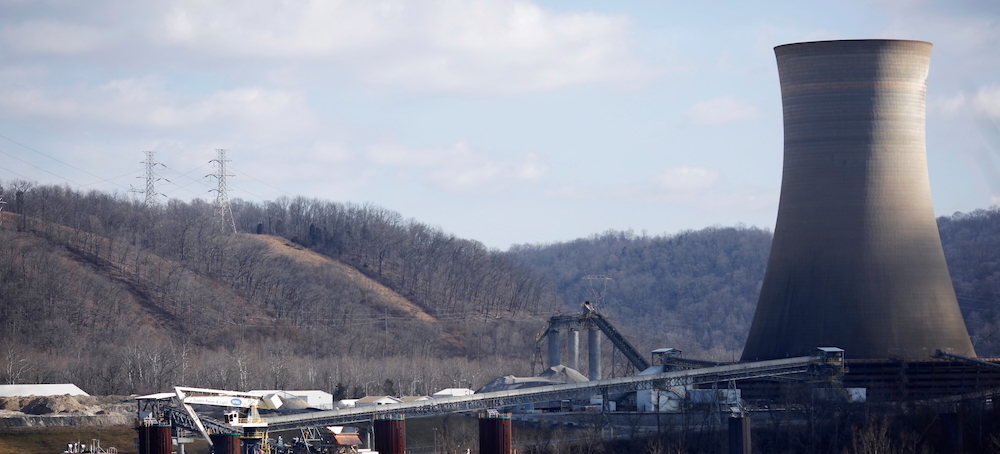 A shuttered coal-fired power plant along the Ohio River in Aberdeen, Ohio on 21 February 2019. (photo: Luke Sharrett/WP/Getty Images)
Landfill owner’s data show lithium above groundwater standards near the drinking water source for millions
The speeding vehicles are headed for a massive, 1,400-acre landfill filled with coal ash and other hazardous materials and owned by Dynegy Zimmer LLC, a subsidiary of Vistra Corp The Zimmer landfill has been a dumping ground for dangerous waste from coal-powered plants dotted around the Cincinnati region for decades.
For residents Brian and Rhonda Brittain, the sight of the trucks fills them with fear and anger.
“Everything that’s coming out of [the landfill] is coming right through this pipe and into this pond,” says Brian, pointing to a neighbor’s watering hole surrounded by a half dozen livestock.
“These people raise cattle to feed their family.”
He and his wife, Rhonda, have been battling sulfuric odors and concerns about environmental hazards associated with the landfill.
But as bad as the smell can get, that’s no longer their main concern.
“The smell is only the warning system,” says Brian.
Their property abuts the Little Indian Creek, a waterway upon which the landfill was constructed and which flows into the Ohio River four miles downstream.
In consecutive rounds of testing conducted this year and for several previous years, Dynegy Zimmer’s own reporting showed “statistically significant levels above the applicable groundwater protection standards” for lithium at the landfill.
Millions of people downstream in Cincinnati and Louisville depend on the Ohio River for drinking water.
While coal-powered electricity plants have been phased out in recent years, their presence has cast a long, dangerous shadow in the form of coal combustion residual (CCR) landfills.
The residual material, typically made up of ash, boiler slag, silica and other waste substances, contain dangerous constituents that can cause cancer and neurological illnesses.
Communities along this stretch of the Ohio River have been suffering with the fallout for years.
While the national incidence rate of lung and bronchus cancer is 51.8 per 100,000 residents, in Clermont county, it’s 69.6. In the neighboring Hamilton county, from where much of the waste being dumped comes from, the rate is 62 per 100,000.
A five-minute drive from the landfill down to the banks of the Ohio River lies the defunct William H. Zimmer power plant, shuttered in 2022 and which took 20 years to build but operated for only three decades.
A further five-minute drive down the Ohio River, the Beckjord coal-powered electricity plant operated for 75 years before being shut down in 2014.
Now county administrators are suing former operator Duke Energy, and Missouri-based Commercial Liability Partners, a company that specializes in tearing down former industrial plants and the plant’s current owner, after suffering 12 years of pollution that’s seen heavy metals detected in at least 20 water wells.
According to local media, unlined holding ponds at the Beckjord facility contain billions of pounds of toxins, and residents have stopped drinking tap water as a result. County authorities now face a $30m bill to build a new water treatment plant with the capability of removing the pollutants. The county has already spent tens of thousands of dollars on legal fees.
Commercial Liability Partners is the biggest property taxpayers in Clermont county. But earlier this year, authorities revealed the company owed the community more than $640,000 in delinquent taxes.
Texas-headquartered Vistra Corp, a $44bn energy giant, has been hit with fines and lawsuits across the country for market manipulation, chemical fires and explosions and a host of other pollution violations. In 2023, Dynegy Midwest Generation, a Vistra Corp. subsidiary, settled for $400,000 in a case where it was accused of dumping coal ash near a river at a facility in Illinois.
“The Zimmer landfill, because of its status as a legacy landfill, hasn’t had to meet the same safety and design standards that landfills being built today [have],” says Thom Cmar, an attorney at Earthjustice, an environmental protection nonprofit that tracks coal ash contamination across the country.
“When it was designed and constructed, there were no barriers put in place that would ensure that the coal ash waste disposed there did not come into contact with ground water,” adds Cmar.
Vistra has also availed itself of billions of dollars of federal government grants. Trump and former House Democratic leader, Nancy Pelosi, are among the company’s high-profile purchasers of its shares this year. Last year, it settled for $38m following charges of market manipulation.
“Unfortunately, states like Ohio have always been deferential to the utility industry and a lot of states where coal-burning is an industry have been willing to let [them] take the lead in setting the safety standards and best practices that they follow,” says Cmar.
Emails sent by the Guardian to the Ohio Environmental Protection Agency (EPA) asking if it would facilitate an independent testing of water inside the Zimmer landfill were not responded to.
A Vistra spokesperson declined to respond to the same question but says coal ash is currently not being dumped at the landfill.
“Since 2007, the site has accepted inert, limestone-based byproducts from the Miami Fort power plant, which are classified as non-hazardous waste under applicable regulations. These materials consist primarily of naturally occurring substances, including silica and river sediment,” says Jenny Lyon, of Vistra Corp.
“We recognize residents’ concerns about odors and take them seriously … Vistra has invested in multiple systems and processes to manage and minimize odors.”
However, silica and many other naturally occurring substances are dangerous to human health in certain quantities. In the 1930s, at least 764 West Virginia miners died after exposure to high levels of silica dust.
In Ohio, concerns with Vistra are not limited to the environment.
According to the Clermont county auditor’s website, Vistra Corp, through its subsidiary Dynegy Zimmer has amassed dozens of parcels of property totaling more than 3,400 acres of land (the equivalent of around one-quarter of the island of Manhattan) in the Brittains’ Washington township. Locals say that corporate property ownership has caused financial strain on the community and access to a local cemetery has been restricted due to the presence of the landfill.
“When they devalued their property, the township had to pay money back to Dynegy Zimmer. We lost a lot of money that was already in the budget,” says Rhonda Brittain, referring to $139,000 that schools, libraries and other entities in Clermont county had to repay to Vistra Corp in 2023.
Rhonda’s husband Brian, a diesel engine mechanic, believes the land buy-up effort is an attempt to keep the public away from the landfill and to hide the dangers within it.
“It seems like nobody wants to spend any money to cure this problem, but they were just given a ton of money [a $4.2bn loan from the department of energy] for a plant outside Cleveland,” he says.
“But you can’t spend money here to try to fix it?”
Increasingly, however, environmental groups and residents are fighting back.
In Illinois, a lawsuit forced Dynegy in 2023 to move around three million cubic yards of coal ash that was leaching into a major waterway, although the project is still awaiting approval from Illinois’ EPA.
Here on the banks of the Ohio River, the Brittains are also taking on the fight.
“I got into this issue because I have grandchildren [and] four of them live with us,” says Brian.
“We are just asking that they spend the money to fix it. We know they have it.”

