There’s a Terrible Reason Why This Ebola Outbreak Is Different
Jill Filipovic Slate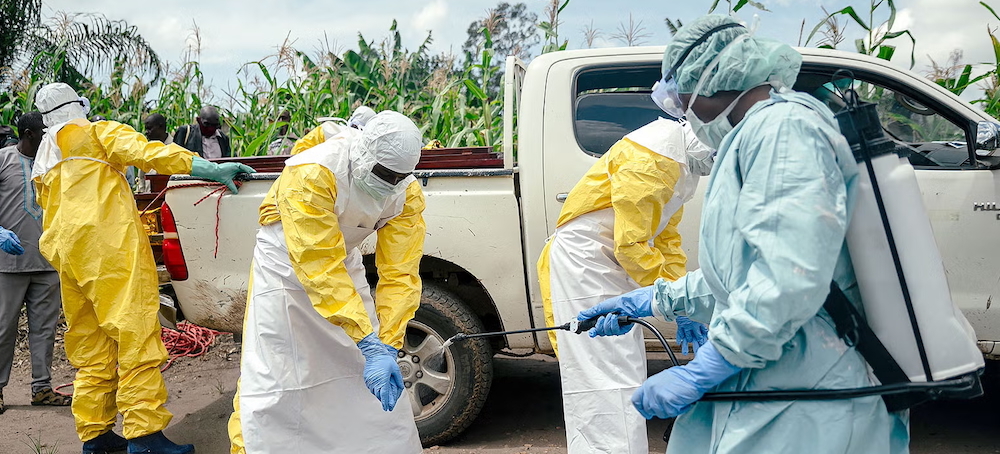 "This Ebola outbreak threatens to be the worst in history." (photo: Jospin Mwisha/AFP/Getty Images)
In fact, this Ebola outbreak threatens to be the worst in history. Case numbers have shot up at an unprecedented rate. This species of Ebola, the Bundibugyo virus, is harder to detect, and there is no vaccine for it. It is hitting one of the most volatile regions of one of the world’s most fragile states. And it comes during a time of unprecedented retreat of the world’s most prosperous nations from the world’s most vulnerable—a move led by the United States and exemplified by the dismantling of the U.S. Agency for International Development last year.
The demise of USAID did not cause this Ebola outbreak. But it is a gift to Ebola. It likely delayed its detection and hampered efforts to deliver tests and treatment to the affected areas. It has broken down meticulously constructed networks of trust and generally slowed the response to the virus.
“There are things that normally we would have in place that are no longer there,” a former USAID health official based in Nairobi told me. (She requested anonymity for fear of blowback.) Agency cuts have dampened “surveillance systems, early warning systems, and just the number of healthcare workers.”
A strong, united front could have made this epidemic a manageable outbreak. Instead, it is an active and unpredictable emergency with the potential to kill thousands and destabilize a region that is both already fragile and core to many of America’s interests, from national security to economic prosperity.
The current Ebola outbreak originated in Mongbwalu, a mining town in Congo’s Ituri province. This is a region long strained by war, with armed groups battling for control over both the territory and the mines on it, where workers spend long days in the sweltering heat digging for gold. Entire economies spring up around these mines: The workers, some of whom are children, need things to eat and places to sleep; the gold needs panning and processing; women are often employed cooking, cleaning, or selling sex. Congolese mining towns tend to be porous and migrant-heavy, rough, difficult places to live in some of the country’s roughest, most difficult areas, where there is plenty of reason to distrust outsiders. Sexual violence is endemic. Some 7 million people are displaced within Congo, mostly in the eastern provinces, of which Ituri is one. Hundreds of thousands more Congolese have fled to neighboring Uganda and Burundi. Since the first Ebola case of this outbreak was confirmed less than a month ago, cases have been detected in Goma, a rebel-held Congolese city that borders Rwanda, and in Kampala, the Ugandan capital—each more than 350 miles away from Mongbwalu.
Mongbwalu is remote. But until last year, you would have found USAID workers in Goma and Kampala.
It’s hard to overstate the reach of the behemoth that was USAID. Before Elon Musk announced that he had spent a February weekend “feeding USAID into the wood chipper,” the agency employed more than 10,000 people across the world and worked on more than 5,000 distinct programs. These included initiatives addressing pandemic preparedness and outbreak response, health security, and infectious disease treatment. But USAID’s disease surveillance system was largely shut down along with the organization. So were its transport systems: If this were happening two years ago, the agency likely would have managed the conveyance of Ebola samples from suspected outbreaks to Kinshasa, Congo’s capital, where they could be tested. For this outbreak, though, there was no USAID to facilitate the transfer, and the samples were moved at the wrong temperature, causing significant delays in even confirming that an outbreak was occurring. The World Health Organization got wind of a potential problem in early May, but it has also had its funding cut by the U.S., which withdrew from the agency in January. According to reporting in the New York Times, “American officials did not learn of the outbreak until Thursday, nine days after the World Health Organization did, and almost a month after the first person died.”
Sure: It’s not just this breakdown that set things up to be as bad as they are now. Part of the problem was the sheer enormity of the initial outbreak, which quickly strained available stocks of tests, medications, and PPE, not to mention hospital beds and healthcare workers’ time. “We’ve never seen an Ebola outbreak start at that size before,” said Trish Newport, the emergency program manager for Médecins Sans Frontières, better known in the U.S. as Doctors Without Borders, and the deputy manager of the group’s Ebola programs during the 2018–20 outbreaks in eastern Congo. “And so no one had stocks. You usually have stocks for what would last for 10 days or 20 days to deal with 10 patients or 20 patients, not to deal with that level and so much geographic spread.”
But that initial shock explains only so much, she added. “You need to have the capacity to scale up to what is needed,” she said. “And this is the part that is challenging.”
The U.S. withdrawal from international agencies and the strain USAID’s end put on surveillance and response systems were key to allowing Ebola to spread unchecked, several experts told me. There “are things like the sample transport networks that we would have had in place for other disease issues [that] could have been used,” the former USAID official told me. “It’s not just that we cut global health security programs; it’s that we cut malaria programs and we cut PEPFAR programs and we cut all of those other things that had this infrastructure in place where, when an emergency happens, you can use the existing infrastructure that we have built for other disease areas.”
She gave the example of the mpox outbreak in Kenya a few years back, which was most prevalent along the border with Uganda, and mostly affected what aid workers call key populations: marginalized or otherwise vulnerable groups, which in this case included sex workers and men who have sex with men. Even where USAID didn’t have a physical presence, it had implementing partners in health facilities across the continent and was often paying health workers’ salaries. “So when we need to train people quickly, we already know them,” the former official said. “It’s not that hard to say, ‘Hey, there’s this new disease that’s coming from Uganda. These are the signs and symptoms to look for. This is how you screen. This is what to do. This is how you raise the alert if you have a suspected case.’ All of those systems were put in place in facilities where we were already operating, and we had a whole network of community volunteers, especially among key populations—which is an issue for Ebola in a mining town as well.”
Now, she said, “all of that is lost.”
And it wasn’t just USAID’s 10,000 workers who were lost in the shutdown. The agency maintained networks of contractors and subcontractors, often smaller local groups that employed local community members. And USAID workers and affiliated organizations built relationships with other nongovernmental organizations and their employees, creating a vast web of experts and workers who could share information and mobilize as needed.
Core to these networks are community health workers, some of whom were on USAID’s payroll, and all of whom have been crucial to vast health improvements across sub-Saharan Africa. I’ve seen community health workers in action in Kenya, Ethiopia, Ghana, and Malawi, among many others, as well as in Congo’s Ituri province, not far from the town where this current outbreak occurred. The details shift from region to region, but the basics remain: A person, usually a woman, goes from house to house in her own community, offering basic health screenings (wrapping a measuring tape around a baby’s arm to check for malnutrition, for example), encouraging preventive health services (tracking childhood immunizations, reminding parents about when to head to the clinic for vaccinations, sharing information about family planning, distributing malaria-preventing mosquito nets), managing chronic illnesses (making sure patients are taking their medications for HIV or hypertension), and assessing symptoms to tell people whether they should head to the hospital immediately, go to a clinic in the morning, or stay put. These workers are on the front lines of any disease outbreak, able to sound the alarm if a cluster of strange symptoms crops up in their communities and able to tell skeptical patients to seek care and trust an unfamiliar system. But now USAID no longer pays or supports them, leaving the U.S. government largely without access to the information those workers have, and without influence over the information they could share.
Community distrust and misplaced fears have been two of the most challenging aspects of this current outbreak. People in Mongbwalu are used to outbreaks of tuberculosis and malaria, the initial symptoms of which are similar to those of Ebola, but both of which are much more treatable. When people with these symptoms went to the hospital but didn’t come back, some people concluded that the hospital or its doctors were to blame. Traditional funeral practices in this region also involve touching the bodies of the dead; when health workers tried to block that from happening, residents only became more suspicious.
But that wasn’t the only reason locals sometimes directed their ire toward health workers.
In Congo, “people know what Ebola is,” MSF’s Newport said. “I mean, it’s the one country in the world where there has been the most Ebola outbreaks.” But in previous outbreaks, she said, people would get test results within 12 hours. This particular variant of the disease, Bundibugyo, is more difficult to detect than the more common Zaire variant. There have not been testing facilities outside Kinshasa—another gap USAID might have been able to fill. All of this means that people who show up sick to the hospital aren’t told what they’re sick with for days or nearly weeks in an area where outsiders are seen with rational skepticism.
Ituri, the epicenter of the outbreak, “is an area of armed conflict with many nonstate armed groups,” Newport said. “Access is also about community trust. I mean, we talk about armed groups, but we need to talk about trust, and trust comes with being able to tell people if they have Ebola or not. And if we don’t have lab capacity, we can’t actually tell them if they have Ebola or not.”
Communities also tend to be suspicious of outsiders who suddenly flood in to treat what they say is an emergency but that many locals see as a spectacular misuse of resources. Aid returning to Ituri with Ebola-specific funding would be more effective if public health aid simply hadn’t left in the first place. Newport recalls Congo’s 2018–20 Ebola outbreak, during which she managed much of MSF’s response. There was one heavily affected community that revolted whenever the group tried to enter. “Every time the people in Ebola Response tried to go there, there was violence,” she said. “We went there, and we actually asked why. Why is there all of this violence? And they said, ‘You tell us to wash our hands, and we actually don’t have access to water, and you tell us to go seek healthcare, but we actually don’t have healthcare here. We have children dying of malaria and diarrhea.’ ” So MSF first had to manage the basic issue of water, explains Newport: “We built wells.”
Once the community had clean water, they asked for basic medications in their health center. “We said, ‘OK, but then we have to put [Ebola] screening to make it a safe place. And if we put screening, people will be identified as suspect cases, and we will have to send them away to the isolation that’s hundreds of kilometers away,’ ” Newport said. “And they said, ‘OK, then we want an Ebola isolation in our community.’ And we built it with them.”
These efforts made the Ebola response take longer. But it made a response possible. With better global health, development, and humanitarian assistance—with an ongoing connection to these communities—these kinds of interventions could happen faster, even, ideally, before an outbreak occurs.
That moment has passed with this outbreak. For now, Newport says, the top priorities are lab capacity—the ability to get accurate test results—followed by a rapid and responsible scale-up of a humanitarian response that also addresses the more fundamental health needs of communities, supplying things like water and basic medications. There’s another reason that rushing in with aid on an ad hoc basis can be fraught: There need to be systems in place, as Newport puts it, “to make sure from the very start that we’re protecting the population and the patients from the humanitarian response.” Doing so ensures that the aid workers behave in a trustworthy way without abusing their power, such as, for example, demanding transactional sex, which has occurred during past crises, including Congo’s 2018–20 Ebola outbreak.
All of the experts I spoke with emphasized that responding well is necessary not just to save lives but also to contain the spread—a priority of governments the world over.
“I see other countries worried that Ebola will come to their country,” Newport said. “If we’re not able to test who has Ebola or not, if we’re not able to identify who are the close contacts of confirmed cases and do proper surveillance, yes, there’s the risk of spread of Ebola.”
Zooming out, the good news is that Ebola is not airborne and is not nearly as contagious as, say, COVID-19; a global Ebola pandemic is unlikely. And this is not the first Ebola outbreak the world has seen; there are many individuals and organizations who have responded to Ebola crises before and who, through trial and error, largely understand what works.
The bad news is that one of the most central and well funded of those organizations was USAID. Experts have been warning that dismantling global public health initiatives will end up hurting Americans, too, in the end. It’s only a matter of time before we find out exactly how.