The United States and Iran Are Equally to Blame
Marc Ash Reader Supported News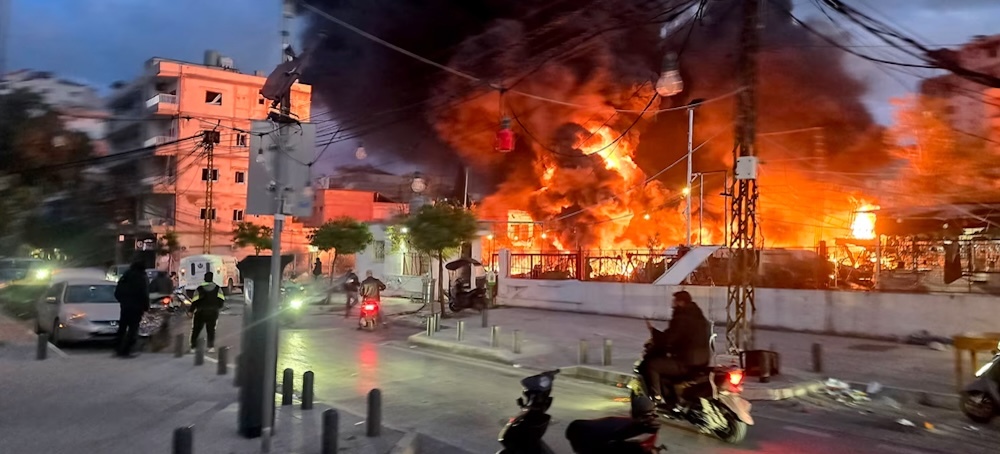 An Israeli air strike solar farm and electricity generation facility in Lebanon's ancient city of Tyre. (photo: CNN)
s it stands now the Strait of Hormuz and the vast swath of the world’s economy on which shipping oil through it depends is open, but on a provisional basis only. It can remain open or it may not depending on on a few key factors. Foremost likely being the war that isn’t a war, but clearly is a war in Southern Lebanon.
Equally obscure are the state of negotiations between the U.S. and Iran. The statements coming out of the White House seem intended to produce short term political effects rather than create an atmosphere conducive to meaningful progress. Iran on the other hand, while being quite capable of deception actually now reveals more detail in their statements than their American counterparts.
The current negotiations could accomplish quite a bit more than just a reopening of the Strait. The Strait is the current choke-point but the problem is obviously far larger. The U.S. has under the auspicious of defending its ally Israel provided a vast array of weapons that can not only be used for offensive purposes, but may and often are used to achieve political objectives.
Iran for its part has for decades labored to construct a network of well armed strike forces throughout the middle eastern region. Hamas, Hezbollah, the Yemeni Houthis and various paramilitary groups in Iraq. To underscore how important Iran considers those groups to its broader vision of Islamic fundamentalist ascendancy in the region Iran now ties directly to resolution of the war with the U.S. a cessation of Israeli war on Hezbollah in Lebanon.
The U.S. and Iran now find themselves in the uncomfortable position of being drawn directly into the conflict they have for generations financed from a safe distance. To see this conflict in the moment is to see the trees without seeing the forest. The challenge for the U.S. and Iran is not only to see each other but to see themselves. The road to a durable peace is a lasting and more importantly mutual commitment to deescalation. A limiting of arms not a race to further arm.
A long term remedy requires being open to win-win solutions. There are a lot of reasons why forging a long-term agreement with Iran at this juncture would seem improbable. None the least of which is that the Trump entourage has shown a willingness to kill, or allow to be killed Iranian negotiators as they engage in talks. In case the Iranians forgot that such a threat could be made real Trump today appears to have issued a new death threat to the Iranian envoys attending negotiations with U.S. counterparts in Switzerland.
According to FoxNews reporter Trey Yingst Trump in addressing the Iranian assertion that they would close/re-close the Strait of Hormuz said, "You close it and you won't have a country … You won't even make it back to your fucking country.” So the the path to even more complex negotiations appears difficult indeed.
But more complex negotiations, ones that solve or attempt to solve the broader underlying questions may ultimately prove the only way out. The quick fix Trump seems to be obsessed with may elude him. So what would a broader more durable and productive agreement look like?
The core of the conflict is the tension between Iran and Israel. Iran like the majority of of Islamic nations in the region does not want to Israel to exist. It has taken elaborate steps to create an ongoing threat to Israeli security. Israel for its own part has proven expansionist and militaristic to a fault. Iran backs and arms the groups that threaten Israel, the U.S. backs and arms Israel.
It is in the long term mutual best interests of the U.S. and Iran to find an accord. A commitment to mitigating or even reversing the regional arms race they each have long fostered. A grand rethinking as it were. This will be, at least initially seen as a bridge too far, an undertaking too complex to address the urgency of the moment and not adequately useful politically.
But the reality is that it might ultimately be the only way out of the Strait of Hormuz.