The Undoing of Nick Fuentes, the Far-Right Kingmaker Who Wasn’t
Nathan Taylor Pemberton Vanity Fair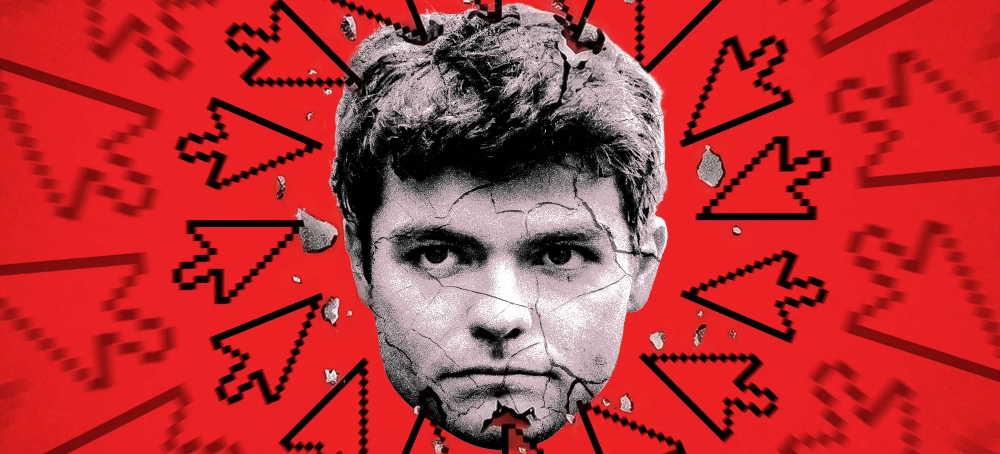 Nick Fuentes leads a movement of young men that could have a major say in Tuesday's midterm elections. (photo: Getty)
For close to a decade, the livestreaming extremist has led a growing cohort of young men toward what’s looked like the insidious post-Trump future of the right. But as his movement is consumed by nihilism and infighting, it’s become a fitting outgrowth of Trump’s own cult of personality. When reached for comment, though, Fuentes said he’s moving strategically.
The sheriffs that morning wouldn’t likely have known that the “Nick” in question was a reference to Nick Fuentes, the 28-year-old white supremacist streamer with some 1.2 million followers on X and one of the largest streaming audiences on the conservative news platform Rumble. They were even less likely to know that O’Brian, a longtime follower of Fuentes—or a “groyper,” as the faithful like to call themselves—says he was swatted because he recently questioned the streamer’s political tactics in a group chat.
“Usually the right fucks with people on the left,” O’Brian tells me on a phone call this past September. “But now the right is fucking with people on the right. Like, how do I explain to the cops that [they’d been called because] I’m not Nazi enough?”
In the world of anonymous online accounts that orbit Fuentes and share his radical “America First” political agenda, O’Brian was a central figure at just 21. Better known by his online handle, Chad Champion, he’d watched Fuentes’s streams from age 14, following him from platform to platform as he was continually banned. O’Brian started posting himself and grew into a far-right microcelebrity. He soon found himself welcomed into Fuentes’s small inner circle, the “groyper generals.”
But it’s not exactly clear where this so-called army is marching. With his increasingly massive following, Fuentes is positioned to be a kingmaker in conservative politics. He’s long spoken of remaking the Republican Party, and he seems to control a loyal voting bloc populated by one of the most coveted demographics in electoral politics right now: young men. But the culture O’Brian describes to me doesn’t sound like a vanguard of white nationalism or anything close to a political organizing operation like the Democratic Socialists of America. Rather, it sounds like most online communities: transient spaces anchored by a celebrity-like figurehead, in this case Fuentes, who, according to O’Brian, was more concerned with gaming and earning money from his nightly streams than true politicking. (A recent report in The Washington Post estimated he earned nearly $900,000 from “superchat” donations between early 2025 and March 2026.) Each night, after Fuentes’s shows on Rumble ended, O’Brian says a select few would be invited to play Fortnite with the influencer.
The community is highly deferential to Fuentes, O’Brian says, eager to gain his favor by clipping and posting moments from his show or attacking his critics online. It can verge into sycophancy as groypers grow consumed with “glazing” the leader, O’Brian adds, to the point that Fuentes has come to resent his own movement. “He hates all of those people,” O’Brian says, referring to Fuentes, “and everyone in the inner circle hated me because I wasn’t dick-riding him.” (Fuentes, when reached for comment, says: “I hate some of them, definitely.”)
But the real problems started for Chad Champion when things moved from online spaces to electoral politics. Earlier this year, Fuentes chose to endorse James Fishback, a groyper-adjacent character who’d embarked on a longshot bid to become Florida’s next governor. Polling at the time had Fishback in the single to low double digits. It was a test for Fuentes’s real-world clout, and it didn’t go well: Fishback went on to win just 10% of the Republican primary vote this past August.
O’Brian voiced his dissent in a relatively small groyper group chat—“the Chadites”—and his heresy was swiftly leaked to the broader community. “Nick is burning his reputation over this dude,” read one of O’Brian’s texts about Fishback. Fuentes was furious, says O’Brian: “Nick told me I was creating ‘problems’ for him.” Soon after, according to O’Brian, Fuentes called him “disloyal” and targeted him in his Telegram chat as an “antifa” collaborator. (Fuentes denies ever targeting O’Brian or labeling him “antifa.”) Soon after came the swatting.
While O’Brian challenged Fuentes, others have been menaced by his followers simply for trying to build public-facing careers as members of his movement, which has no apparent goals in electoral politics as a seismic midterm election cycle plays out. Unlike a certain political influencer from the opposite side of the spectrum, Hasan Piker, who’s ventured out across the country to harness his influence in service of leftist challengers in Democratic primaries, Fuentes has made little effort to insert himself or his online movement into the physical places where the messy work of political organizing unfolds. Mostly, he seems content to sit on stream in his basement, often describing his viewers as “incels” and “retards” while he rakes in their donations.
It’s left many in this world wondering what exactly Fuentes is chasing: Mainstream approval? Power? Online clout? Dollars? Pure chaos? Does he simply feel the tide going out on Trumpism in his young audience? When I reached out to see if Fuentes would like to comment on this story, he first replied over text: “Groyper gossip? Boooooo.” A few hours later, however, Fuentes called me to offer a more thorough response.
It wasn’t always like this. For some young conservative men, Fuentes’s America First movement became a far-right oasis over the last decade, a taboo-shattering community connecting through irony-pilled memes and a desire to aggressively reshape the American right.
To most outsiders, Fuentes’s vision is a horrifying glimpse at the most mutated strain of conservatism on the political spectrum, one shot through with sneering expressions of white nationalism, antisemitism, race science, and misogyny. There’s cheering approval for Adolf Hitler and fascism in general. In the past year alone, Fuentes has suggested that women are “the number one political enemy in America,” that America needs a “dictator,” that Black people “cannot actually sound out words,” and that political asylum seekers are “illiterate peasants.” In October, Vice President JD Vance seemed to reference Fuentes’s long-running hostility toward his wife, Usha, an Indian American. “Theres this podcaster, who goes obsessively at me and my family,” he said. Fuentes responded by calling Vance an anti-gay slur. When it leaked that he’d sat down for dinner with Donald Trump and Kanye West in 2022, the reports created a massive scandal for the former-and-future president. And when Fuentes and a crew of manosphere influencers including Andrew Tate and Clavicular were captured singing along to West’s “Heil Hitler” at a South Beach nightclub this past January, it was the reactionary right on parade.
Fuentes was born in Chicagoland in 1998 and was something of a typical conservative growing up. But he proved a formidable communicator of extreme ideas while attending Boston University, where in 2017 he launched the show that would make his name: America First With Nicholas J. Fuentes. He attended the Unite the Right Rally in Charlottesville a few months later, dropped out of school soon after that, and became a professional purveyor of far-right vitriol.
He was eventually banned from Twitter (as well as YouTube, Twitch, Facebook, Instagram, TikTok, and Reddit), and his podcast was removed from Spotify for hate-speech violations. But his 2024 reinstatement on Elon Musk’s X has mainstreamed Fuentes’s words and clips. His post crudely mocking a liberal slogan to mark Trump’s victory in that year’s election—“Your body, my choice”—became one of the most viewed political posts of all time. Ever since he appeared on Tucker Carlson’s show last fall, Fuentes has become a kind of mythic figure in conservative circles, representing both the future of the right and all that has seemingly gone awry. This past week, HBO’s John Oliver devoted a large part of a segment to Fuentes’s growing reach. “Fuentes has been inching closer and closer to mainstream Republicans over the years,” he said.
But even as the young men with whom Fuentes has influence begin to sour on the president, discerning the streamer’s political goals is increasingly difficult. Over the course of Trump’s second term, Fuentes has mostly played the part of surly dissident, whipping up controversy between the right’s wobbly coalitions. He’s been openly antagonistic toward the Trump administration, and perhaps the most consistent message he’s conveyed to his followers this past year has been the abandonment of the GOP altogether, urging them to “vote Democrat.” For the Ohio governor’s race, one of the rare contests that Fuentes has directly commented on, he’s come out in support of a female Democratic candidate, Amy Acton, over her Republican opponent, Vivek Ramaswamy, the Indian American entrepreneur who is a frequent target for the white nationalist right.
Meanwhile on X, many of Fuentes’s posts read like lusty-sounding fantasies about the coming onslaught awaiting Republicans this midterm election cycle. “I can’t wait for Republicans to get destroyed in the midterms and then everyone in the admin to be impeached,” reads one Fuentes post. His increasingly nihilistic streams often veer into political incoherence: He continues to engage in extreme racism and misogyny, said it would have been “better” for Kamala Harris to win in 2024 (to supposedly pave the way for “an American Hitler”), and now maintains the Trump administration is a “criminal enterprise.” His public statements have been laced with melancholy too. This spring he wrote in one post on X: “I’m getting really sick of politics honestly.”
For much of the past year, reports of doxxing, sustained harassment campaigns, and occasional swattings within Fuentes’s far-right faction have grown. These tactics once seemed reserved for the group’s perceived enemies on the outside, but they’ve increasingly become a way to punish or banish groypers deemed disloyal to Fuentes. Earlier this year, after CNN aired an interview with two men who self-identified as groypers, Fuentes brutally mocked the pair on stream—criticizing them for, among other things, their normie footwear. In the ensuing pile-on, both were savagely harassed across social media platforms, with groypers even calling for them to be doxxed.
Then there’s the more drastic case of Amy Dangerfield. A former “groypette” and content creator, Dangerfield earned the ire of Fuentes and his generals for the sin of attempting to organize a conference of America First politicians and streamers this past May. Her goal, she claimed at the time, was to bring Fuentes’s political agenda into the real world, and she invited a coalition of right- and left-leaning politicians and influencers to hash out the idea of an “America First” political agenda. The attempt backfired massively. On his Telegram channel, Fuentes claimed that Dangerfield was trying to subvert him, and referred to her as “Amy Dangerslut.”
The claim led to a torrent of stomach-churning abuse and harassment directed at Dangerfield and her husband. A story in The Washington Post described how a flood of torture images and doctored content were unleased against the former Fuentes devotee, all because she hadn’t received his blessing to stage a public event. Today, Dangerfield has largely stepped back from far-right politics and her once-promising streaming career.
For years, Fuentes has claimed that his primary objective is the slow takeover of the Republican Party. He often boasts that the groypers are “inside” the institutions of government, and recent reports in the media have traced how Fuentes’s ideas have permeated the young Republican cadre working in Congress and establishment think tanks such as the Heritage Foundation. Fuentes himself likes to brag about the fellow travelers he says are working within the Trump administration, and O’Brian tells me that he’s heard from groypers in DC that Fuentes has traveled there on occasion to meet with his young allies who work in the White House.
But many on the far right find this slow-burn strategy to be a fantasy—or cover for Fuentes’s unwillingness to take larger political risks. Some believe he actually wants to change lanes.
“I think that he saw that the market opened up following the assassination of Charlie Kirk, which is why he’s coming after everyone who is questioning that narrative,” Dangerfield says when I call her up to ask her thoughts. She’s referring to Fuentes’s clashes with Candace Owens over who killed Kirk and why. “I just think he wants to make his money and go mainstream.”
More sympathetic observers on the right think Fuentes’s disinterested approach to electoral politics is a deliberate choice. Aidan Thompson, who’s behind the widely read America First news platform, AF Post, tells me that Fuentes is holding back out of a sense of “responsibility” to his audience and a refusal to support a flawed GOP slate of candidates.
“I think Nick is tapping out because Trump and the party have just totally fucked him off,” Thompson says. “Like, why would you show up?”
When I eventually get Fuentes on the phone, he takes that tack. “I’ve been very open about why I’m not supporting Trump, and that’s because he started a war with Iran,” he says, claiming that many of his predictions about the second Trump presidency have ultimately come true: the war; a perceived failure to follow through on mass deportations; and that the administration is stocked with neoconservatives, America First’s internecine enemies on the right. “All of those things came to fruition,” Fuentes tells me.
He dismisses criticisms that he’s simply sitting out the midterms or trying to poison the GOP’s chances. “People say I’m just sour grapes over Trump or Peter Thiel,” he says, referencing reports that he pitched the latter for funding and failed. “But I’m very open about my problems with these people. It’s all ideological.” Fuentes goes on to explain his strategy is an attempt to correct a “generational mistake” by previous America First candidates like Pat Buchanan, whose followers ultimately lined up behind the Republican Party. Fuentes has instructed his followers to withhold their votes, estimating that this bloc could add up to some 3% of the general election vote. “We can exercise the veto, and I think that’s the source of our power,” he says.
As the midterms drag on with a sense of grinding doom for Republicans, all that might be too conceptual for a younger generation of conservatives hungry to see a far-right takeover of the party. Will Fuentes and his movement stay stuck on the internet, or can they break out? For her part, Dangerfield suggests the failed Fishback endorsement was evidence that Fuentes doesn’t have the “political pull he thinks he does,” while O’Brian is more blunt still: “He clearly can’t be the guy to take things to the next level.”