The Two Stooges Take Another Crack at Ukraine
Cathy Young The Bulwark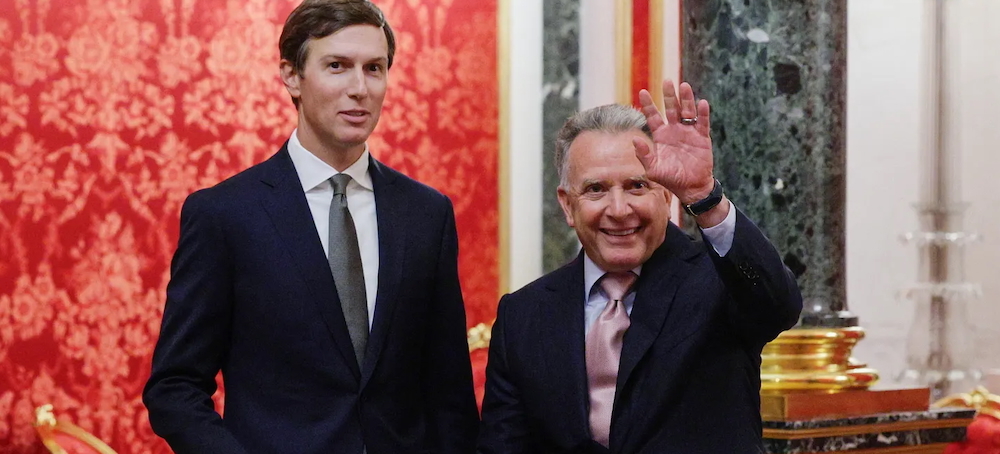 In a photo from Russian state-owned media, Jared Kushner and Steve Witkoff wait to meet Vladimir Putin on September 5, 2026. (photo: Gavriil Grigorov/Pool/AFP/Getty Images)
Russia’s imaginary victories meet Trump’s imaginary diplomacy.
Meanwhile, winter gets closer, and with it new hardships and dangers for Ukraine’s civilian population. Is there any chance of a breakthrough—at the frontlines or at the negotiating table?
LET’S START WITH THE OBVIOUS: It’s safe to say that in the entire known history of diplomacy, there has never been a more clownish team of envoys than Witkoff and Kushner. It’s hard to find as much unanimity on anything in the Ukrainian media and among the independent Russian punditry as there is on this pair: The contempt in which they are held is reflected in the widely circulating sobriquet Vityok i zyatyok, a pun involving a Russian nickname for “Victor” and a diminutive for “son-in-law.” (It’s untranslatable, but “the Two Stooges” would do nicely in English.) Witkoff’s cluelessness and obsequiousness with Putin have long been legendary, and this time he did not disappoint: “When we retire, we’ll have all these incredible stories and incredible memories, and yours will be right at the top of it all,” he gushed to the Kremlin autocrat.
Tweedledum and Tweedledumber reportedly came to Moscow with nothing but updates to the same old “peace proposals”—and came away with nothing beyond the usual verbiage about “constructive” and “candid” conversations. However, most Russian-speaking observers noticed one richly symbolic detail. At one point on their visit to Moscow, the envoys had dinner with Putin’s special envoy Kirill Dmitriev at a Moscow restaurant whose exterior featured the large slogan, “EVERYTHING FOR VICTORY!” It doesn’t seem especially suggestive of a desire for peace.
The Witkoff/Kushner trip to Ukraine was also notable mainly for the symbolism: The fact that it happened at all brought at least a semblance of balance to the blatantly skewed optics of their earlier missions: “Thank God they finally came to Kyiv too,” expatriate Russian journalist and fierce Putin critic Evgenia Albats remarked on her YouTube channel. The visit also brought Trump’s envoys into active contact with some outspoken Ukrainians. Perhaps most memorably, during the Witkoff/Kushner press conference with Zelensky, Ukrainian journalist and television host Dmytro Gordon asked Witkoff about his past meetings with Putin with a very undiplomatic bluntness:
Don’t you think Putin has been lying to you all along? Don’t you think that Putin, the Russians, and Russia understand only one language—the language of strength? And finally, aren’t you disgusted to sit at the same table with an international war criminal, a butcher of the Ukrainian people who is personally responsible for Ukraine’s tragedy?
“Told Witkoff the whole truth,” Gordon wrote on his Instagram page. Witkoff, of course, responded with platitudes about the need for better communication channels and the “respect” with which Putin has always treated him.
Albats believes, like many other observers, that the comeback of the Kushner/Witkoff diplomatic shuffle is largely intended for American domestic consumption: stuck in the Iran quagmire, Trump desperately wants to score some points somewhere before the midterms. It’s hard to say if that’s part of the calculus, given that Ukraine is not a particularly high priority for most American voters in 2026. However, there is no question that Trump tried to use Ukraine for deflection from Iran on Sunday when, on his trip to Ireland, he blamed Zelensky for “causing a shortage of diesel fuel” by continuing to order Ukrainian strikes on Russian oil processing facilities: “This isn’t done by the Middle East, this is done by what’s happening with Russia and Ukraine.” (He then doubled down on this claim.)
Even aside from the fact that the closure of the Strait of Hormuz as a result of the war in Iran is the principal factor in the spike in fuel prices, the sniping at Ukraine and Zelensky omits a key fact: Zelensky has repeatedly proposed an “energy truce” in which both countries would refrain from striking at energy-related targets, including power stations and fuel-processing facilities, at least for the winter months. The Kremlin, meanwhile, says only that “no talks are being held” on an energy truce.
Most likely, Putin believes that Ukraine has more to gain from such a truce—just as he believes, more generally, that time is on his side. In any case, the salient fact is that Moscow, not Kyiv, is rejecting a suspension of strikes on oil facilities (just as Putin is the one rejecting Zelensky’s proposals for a meeting).1 “Maybe Trump doesn’t know that,” Russian émigré military analyst Yuri Fedorov speculated, charitably, in a YouTube interview. But ignorance is hardly an excuse. It seems that every time Trump remembers that Putin is the problem, he promptly unremembers it. And, while his hostility toward Zelensky is at far lower levels than in early 2025, thanks partly to Zelensky’s considerable skills at Trump ego management, the Ukrainian president remains his scapegoat of choice.
Put that together with Kushner’s comments, which amount, at best, to a bothsidesism that treats Russian and Ukrainian goals in this war as equally legitimate—while stressing Ukraine’s unwillingness to give up land as the obstacle to a peace deal—and it seems clear that the Trump administration’s peace efforts remain favorable to the Kremlin. You don’t need to believe that Trump is literally on Putin’s payroll or in his pocket via blackmail; it can be simply his dictator-fanboy instinct, or his belief that Putin can offer him a better deal. Either way, it doesn’t bode well for a just peace.
WHAT NEXT? The reports that Ratcliffe is gearing up to take a more prominent role in the negotiations apparently have some Republican insiders thrilled. But while Ratcliffe will likely prove more professional than the Two Stooges, his handling of Russiagate-related inquiries, first as director of national intelligence in the first Trump administration and more recently as CIA director, leaves no doubt that he is, first and foremost, a Trump loyalist who will do his master’s bidding. Any real breakthrough would require a willingness to recognize that Putin, not Zelensky, is the problem—and to apply pressure accordingly. Zelensky has urged the House to pass the sanctions package named after the late Lindsey Graham and already approved by the Senate. That legislation would target Russia’s energy companies and financial institutions, as well as purchasers of Russian energy; but its passage is far from certain, and the fine print shows that the administration could gut it by waiving some sanctions while using it to impose tariffs on U.S. allies.
It will be a tough winter for Ukraine, whose air defenses are badly depleted (though still functional and shored up by some European assistance). But the Ukrainians have shown their grit and spirit through four winters. And while Putin may believe that time is on his side, there is plenty of evidence that his conviction is based largely on fake reports and imaginary victories. Recall all the times he supposedly took the town of Kupyansk earlier this year. His most recent claims of Russian gains in the Donbas have been equally fictional; in fact, Ukrainian forces appear to have made one of their most successful counterattacks near the ruined city of Lyman, cutting off a route that would have facilitated further Russian advances toward Slovyansk and Kramatorsk, the key cities Russia would have to seize to complete its seizure of the region.
When Trump and Putin met in Alaska last year, Putin was convinced that he could hammer Ukraine hard enough in the first months of 2026—both by plunging Ukrainian cities into darkness and cold and by biting off more Ukrainian land on the frontlines—to achieve two goals: weaken Ukraine’s will to resist, and reinforce Trump’s default belief that a Russian victory is inevitable. Neither of those things happened. It’s likely that he has now shifted his timetable to 2027. Ukraine is on track to thwart him again.