The Trump Administration Is Still Playing Games With Iran War Casualties
Chas Danner New York Magazine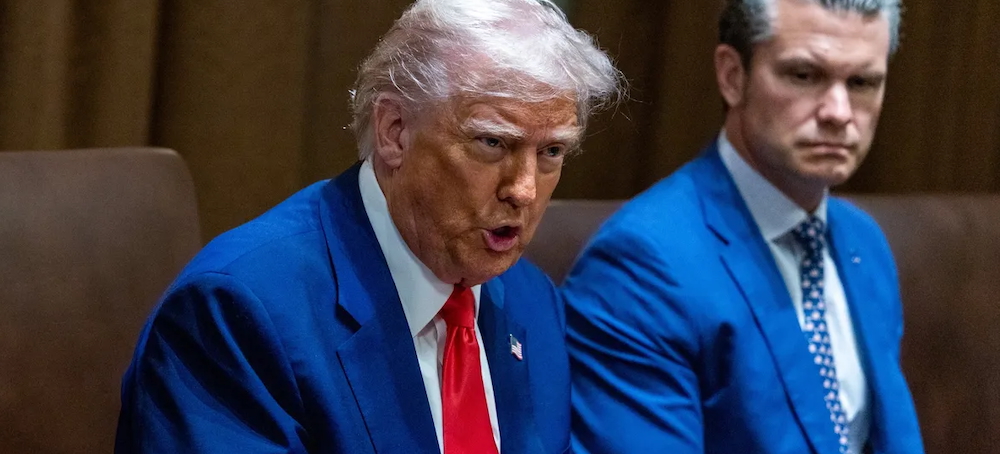 US President Donald Trump, left, and Pete Hegseth, US secretary of defense, during a cabinet meeting at the White House in Washington, DC. (photo: Shawn Thew/EPA/Bloomberg)
But two days later, the Pentagon changed the way it reported casualties from the war, separating them as before and after the cease-fire. It simultaneously revealed that there have been 207 American casualties in the latter period, since July 7 — constituting nearly a third of the total number of U.S. casualties and twice as many as it had confirmed a week ago. The Pentagon now generically classifies those casualties, including the four recent deaths, as having occurred during “overseas operations.” Trump and his administration have insisted the newest phase of the war is not part of the same war but a new conflict. Now they are trying to codify that.
The website discrepancy and subsequent reporting change are just the latest conspicuous examples of what appears to be an ongoing effort by the Pentagon and the Trump administration to downplay American casualties and other high costs of this very unpopular war.
A week ago, the Times reported the Pentagon had not disclosed recent Iranian attacks on U.S. bases, which injured dozens of servicemembers, and said U.S. military officials had dismissed the need to do so, citing operational security. Parnell attacked the Times and alleged it made “baseless and malicious” accusations for partisan reasons, insisting any “claims of concealment” were “fabrications meant to further distress the American people.” Not long after, he confirmed there had been nearly 100 U.S. casualties since the fighting resumed but said the “vast majority” of those injured suffered only “mild concussions” and the other injuries included “everything from minor sprained ankles during routine training to incidents entirely unrelated to combat operations.”
Increasingly during this war, the most credible information available is coming from independent sources; the U.S. government is disclosing less and less, and it’s obscuring what it does disclose.
Trump, meanwhile, has explicitly downplayed the casualty numbers while appearing to put pro-war words into the mouths of those killed.
On Tuesday, he bragged about how few war deaths there have been compared with other wars under other presidents. And after he attended the dignified transfer at Dover Air Force Base in Delaware on Wednesday, Trump said of the killed servicemembers that “all of them said very strongly, ‘We cannot let Iran have a nuclear weapon.’”
The Trump administration’s shadiness doesn’t apply just to American casualties but also to the ones it inflicted.
Last week, Iranian families held additional funerals for 32 of the 120 children killed in the February 28 U.S. air strikes on an elementary school in the southern Iranian city of Minab. The funerals were for children whose partial remains were only found and identified using DNA testing after a deeper excavation of the site. All the families could bury this week were small body fragments wrapped in white cloth. For one of the victims, no remains have been found at all. Makan Nasiri, a 7-year-old boy, might have been directly struck by one of the two U.S. Tomahawk cruise missiles that hit the school. They found only his shoe and part of his backpack.
All publicly available evidence indicates the U.S. was responsible for the school strike, a result of faulty intelligence and outdated targeting information. That was the conclusion of multiple reports, investigations, and analyses, including from the New York Times, CNN, the Associated Press, Just Security, Amnesty International, and, as recently as July 16, Forensic Architecture and Sky News. It’s also the conclusion of U.S. investigators, according to various reports.
But nearly five months later, the Trump administration still won’t acknowledge U.S. responsibility for the strike and the deaths, and people like Defense Secretary Pete Hegseth continue to dodge questions when reporters attempt to hold them accountable. They still say they’re waiting for the results of the investigation. Trump has also suggested Iran might have been behind the strikes and claimed the cruise missiles might not have been American. In a recent Fox News interview, Trump suggested that images showing Tomahawk-missile fragments at the site might have been AI-generated and said, “I don’t think anybody’s gonna ever be able to say what happened.” When it comes to his administration, that may as well be a promise.