The Tide Has Turned Along the Front Lines in Ukraine
Andrew E. Kramer The New York Times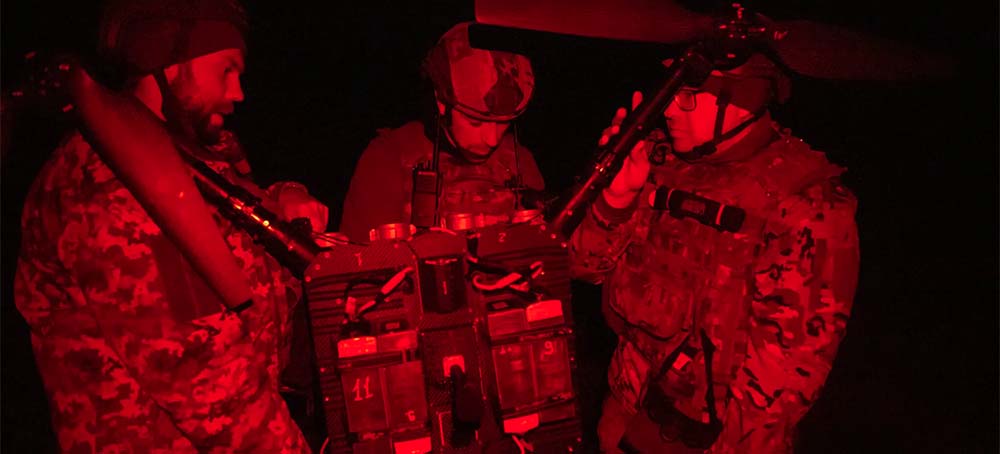 A team of Ukrainian soldiers armed a drone with bombs on Friday during a mission that destroyed a Russian armored personnel carrier on the front lines in the country’s southern Kherson region. (photo: Finbarr O’Reilly/NYT)
In the southern Kherson region, Ukraine now has the advantage in range and precision guidance of artillery, rockets and drones, erasing what had been a critical Russian asset.
"What a beautiful explosion,” said First Lt. Serhiy, a Ukrainian drone pilot who watched as his weapon buzzed into a Russian-controlled village and picked off the armored vehicle, a blast that was audible seconds later at his position about four miles away.
“We used to cheer, we used to shout, ‘Hurray!’ but we’re used to it now,” he said.
The war in Ukraine has been fought primarily through the air, with artillery, rockets, missiles and drones. And for months, Russia had the upper hand, able to lob munitions at Ukrainian cities, towns and military targets from positions well beyond the reach of Ukrainian weapons.
But in recent months, the tide has turned along the front lines in southern Ukraine. With powerful Western weapons and deadly homemade drones, Ukraine now has artillery superiority in the area, commanders and military analysts say.
Ukraine now has an edge in both range and in precision-guided rockets and artillery shells, a class of weapons largely lacking in Russia’s arsenal. Ukrainian soldiers are taking out armored vehicles worth millions of dollars with cheap homemade drones, as well as with more advanced drones and other weapons provided by the United States and allies.
The Russian military remains a formidable force, with cruise missiles, a sizable army and millions of rounds of artillery shells, albeit imprecise ones. It has just completed a mobilization effort that will add 300,000 troops to the battlefield, Russian commanders say, though many of those will be ill trained and ill equipped. And President Vladimir V. Putin has made clear his determination to win the war at almost any cost.
Still, there is no mistaking the shifting fortunes on the southern front.
Ukraine’s growing advantage in artillery, a stark contrast to fighting throughout the country over the summer when Russia pummeled Ukrainian positions with mortar and artillery fire, has allowed slow if costly progress in the south toward the strategic port city of Kherson, the only provincial capital that Russia managed to occupy after invading in February.
The new capabilities were on display in the predawn hours Saturday when Ukrainian drones hit a Russian vessel docked in the Black Sea Fleet’s home port of Sevastopol, deep in the occupied territory of Crimea, once thought an impregnable bastion.
The contrast with the battlefield over the summer could not be starker. In the Donetsk region of eastern Ukraine, Russia fired roughly 10 artillery rounds for each answering shell from Ukrainian batteries. In Kherson now, Ukrainian commanders say the sides are firing about equal numbers of shells, but Ukraine’s strikes are not only longer range but more precise because of the satellite-guided rockets and artillery rounds provided by the West.
“We can reach them and they cannot reach us,” said Maj. Oleksandr, the commander of an artillery battery on the Kherson front, who like others interviewed for this article gave only his first name for security reasons. “They don’t have these weapons.”
Falling rates of Russian fire also speak to ammunition shortages, he said. “There is an idea the Russian army is infinite, but it is a myth,” he said. “The intensity of fire has fallen by three times. It’s realistic to fight them.”
A main highway approaching Kherson city from the west has become a thoroughfare for Ukrainian artillery, with towed howitzers, truck-mounted howitzers and trucks laden with grad rockets rumbling by continually through the day.
American-provided M777 howitzers firing precision-guided shells and striking up to 20 miles behind Russian lines have forced the Russians to stage heavy equipment farther from the front. Ukrainian drones spot infantry but fewer tanks or armored vehicles near the front line, said First Lt. Oleh, the commander of a unit flying reconnaissance drones. “We hear a lot of rumors they are abandoning the first lines of defense.”
This firepower has tipped the balance in the south, raising expectations that a long-anticipated assault on Kherson is drawing near — though a swirl of apparent misdirection from military leaders on both sides has clouded the picture.
The terrain around the city — table-flat steppe with thin tree lines and little cover, and crisscrossed by irrigation canals that can be used as trenches — favors its Russian defenders. And Ukrainian commanders and officials have been dropping hints of an impending attack since the spring, only to have the fighting drag on.
But the city lies on the west bank of the Dnipro River, making its defenders reliant on bridges to Russian territory on the eastern bank that now lie within easy range of Ukrainian rocket artillery and, for the most part, are now unusable. That has made the Russian grip precarious. But President Putin has reportedly overruled his generals’ recommendations of a retreat to safer and more easily defended ground on the east bank.