The Supreme Court’s New Expansion of the Second Amendment Is Genuinely Deranged
Mark Joseph Stern New Republic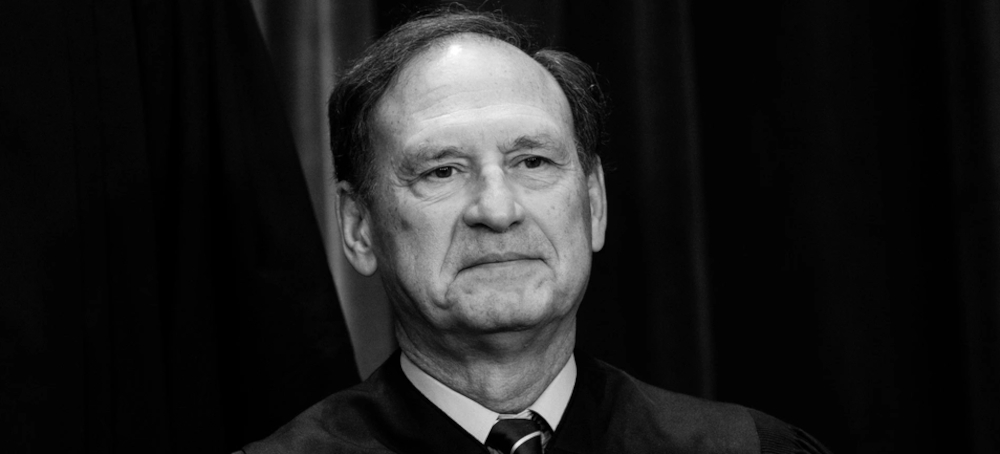 If Justice Alito wants the public to see the Court as apolitical, he should try meeting that standard himself. (photo: Doug Mills/The New York Times)
Wolford involves a Hawaiʻi law that prohibits individuals from carrying guns on private property unless the owner affirmatively consents. (California, Maryland, New Jersey, and New York have enacted similar statutes—all now likely invalid.) The state intended this rule to respect property rights by creating a default rule that nobody takes a firearm onto someone’s land without their permission. Gun advocates promptly challenged it under Bruen, the Supreme Court’s 2022 decision holding that a burden on the right to bear arms is unconstitutional unless it has enough “historical analogues” from the distant past. They claimed that Hawaiʻi could not identify a sufficient number of these “analogues” to justify its law.
There are key problems with this argument, as Justice Ketanji Brown Jackson explained in dissent. First, Bruen ostensibly compels courts to figure out what conduct the Second Amendment protected when ratified; if a contemporary law infringes on that conduct, it is presumptively unconstitutional. But, Jackson wrote, “there is no right to carry a gun onto private property without the permission of the owner.” The majority did not even contest this point, because it is uncontestable. Instead, Alito ratcheted up Bruen’s level of generality: Rather than asking if Hawaiʻi’s law actually burdens a concrete, well-defined right, he merely asked if it “hampers” an individual’s ability to take their gun anywhere they want. Because it does, he concluded, it must be supported by appropriate “historical analogues.”
Then, having defined the right to bear arms as broadly as possible, Alito demanded granular specificity from older statutes that echo Hawaiʻi’s. The state offered many; its list included 18th-century laws in Pennsylvania, Maryland, New Jersey, and New York that required permission from a property owner before carrying a gun on his land, as well as 19th-century laws in Florida, Louisiana, and Texas that restricted the unapproved carrying of guns on “the premises or plantations of any citizen.” Even under Bruen’s stringent standard, aren’t these statutes enough to shore up Hawaiʻi’s modern version?
No, Alito wrote, because each is “distinguishable” from Hawaiʻi’s. The state’s true goal, he asserted, is to enshrine “local attitudes” and “a Hawaiian tradition” that “disfavor the carrying of guns” in public to prevent violence. By contrast, the 1700s laws were mere “anti-poaching” rules meant to mitigate “harms and risks associated with unauthorized hunting.” So, under Bruen, they are not “relevantly similar” to Hawaiʻi’s in terms of “how and why” they were enacted. Meanwhile, the 1860s laws were post–Civil War “Black codes” meant to oppress former slaves. So Alito dismissed them as a “tainted artifact” that did not qualify as Bruen “analogues.”
Each of these moves infuriated Jackson. To start, she bemoaned the majority’s “boundless” Second Amendment that “presumptively protects” the right “to carry anywhere and everywhere.” Alito’s “newfound understanding of the first step of Bruen,” Jackson wrote, “obliterates any need for reference back to original meaning.” After Wolford, “judges are now free to insert any meaning they desire into the text of the Second Amendment and then demand the government provide analogues to fit that interpretation.”
As to those analogues: Jackson ridiculed Alito’s refusal to acknowledge that they show how “states routinely required affirmative consent for armed carry onto private property” at the founding. The 1700s statutes were not, in fact, limited to poaching, but were also meant to prevent “armed trespass, property theft or damage, and gun violence, whether intentional or accidental.” Lawmakers helpfully wrote down these aims, which Alito ignored. The purpose of these laws, Jackson wrote, was to “vindicate property rights” by mitigating “concerns associated with violations of those rights by armed individuals on private land.” That, of course, is precisely what Hawaiʻi seeks to do today.
And what about the Southern laws from the post–Civil War era that protected private property from armed trespassers? Jackson acknowledged that “confronting the origins of these laws is certainly uncomfortable. The Black Codes were ugly. And racist. And deplorable.” But that does not “automatically render these laws irrelevant to a fair assessment of the right to carry firearms.” If the majority chooses to “tether its Second Amendment analysis to facts about America’s past, it must contend with our nation’s entire history, warts and all.” Excluding laws that appear “ugly” to modern eyes empowers the court “to cavalierly pick and choose which parts of the historical record count,” giving it “discretion to cull the history” in “service of a single goal: preventing the government from responding to issues arising from the possession of firearms.”
There is a deeper problem with Alito’s highly selective approach: Virtually all of the laws that SCOTUS credits as relevant to the Bruen analysis were written by racist white men. As Hawaiʻi Supreme Court Justice Todd Eddins has written, “the people” who had the right to bear arms “excluded people based on gender and race.” These laws—not just those contained in the Black Codes—were written by and for heterosexual white males who held varying levels of animus toward women and minorities. Indeed, many of the nation’s earliest gun laws were explicitly motivated by racism. Why do these laws count under Bruen while the Black Codes don’t? How can today’s judges determine when legislatures harbored discriminatory intent when enacting gun laws centuries ago?
These unanswerable questions, like Wolford itself, show what a doomed endeavor Bruen has been from the start as an attempt to do law. Far from restraining judges, the decision gives them maximum latitude to cherry-pick history in service of their preferred outcome—which, for Republican appointees, is usually a ruling against gun safety. This approach to the Second Amendment is wildly inconsistent with state sovereignty and self-rule, allowing unelected judges to topple democratically enacted gun restrictions based on dilettantish historical divination. There is no law to be found in Wolford. It reads not like the work of a court, but of a super-legislature imposing its ideological hostility to firearm regulations on a citizenry that never consented.