The Putinization of the American Military
Paul Krugman Substack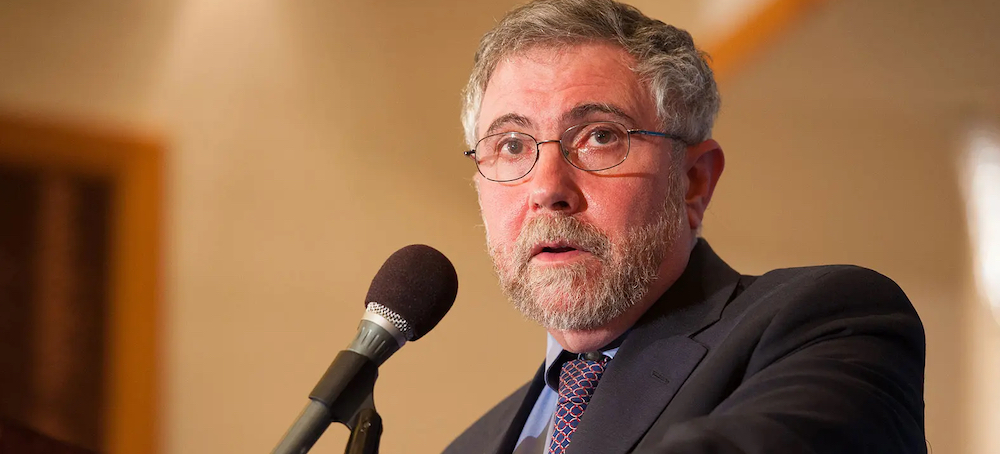 Paul Krugman. (photo: Commonwealth Club)
When poseurs and yes-men run a war
But the loss to Iran is different: it is the closest we have come to outright military defeat. U.S. forces pulled out of Saigon and Kabul, not because they had been beaten in battle, but because the domestic political cost of propping up client regimes became too great.
Granted, U.S. forces haven’t suffered any conventional defeats at Iranian hands either.
But all indications are that the main reason the Trump administration is again calling off major operations against Iran is that America is running critically short of ammunition.
So Trump isn’t backing down because his war of choice is extremely unpopular, although it is. Nor is he backing down because the economic costs of the closure of the Strait of Hormuz are too great, or because the fiscal cost of the war is skyrocketing, while the country faces enormous deficits and rising long-term interest rates. Trump says he doesn’t care about any of that. And in a way I believe him — because even a fully reopened Strait won’t recoup his standing with voters fast enough to salvage the midterm elections for Republicans.
No, most reports, like this one from the Wall Street Journal, say that Trump is backing down because military professionals have finally managed to convince him that U.S. stocks of advanced munitions are so severely depleted that the current rate of use will soon leave America critically weakened. Moreover, replenishing those stocks will take years once the shooting ceases.
For example, the Center for Strategic and International Studies estimates that the US has expended more than half of the Patriot missiles it had before the war, and that it will take until 2029 to replace them.
The administration’s response to such reports, exemplified by recent remarks by Mike Waltz, the US ambassador to the United Nations, is that
· Munitions aren’t depleted
· Anyone leaking the fact that they are depleted should go to jail
· It’s Joe Biden’s fault
Given the nature of Trump-speak, Waltz’s statement is in effect an admission that the U.S. military is now in deep trouble.
How could this happen? How could the best-equipped, most sophisticated military in the world have allowed itself to be humiliated by a third-rate power?
First of all, Pete Hegseth and Donald Trump began with an astonishingly stupid theory of war: the belief that performative masculinity is how you win. Hegseth literally believes that the secret of military might in an age of AI-enabled drones that can travel hundreds of miles is more testosterone.
Now, the idea that being manly and anti-woke makes an army strong was the reason that many on the American right admired Vladimir Putin before he invaded Ukraine. You might think that 1.4 million Russian casualties — 450,000 of them dead — and the spectacle of burning Russian oil refineries and factories would have disabused them of this notion. But no.
And the fixed belief that “lethality” is how you win surely led to basic inability to anticipate the blindingly obvious: that we have a limited supply of sophisticated weapons and that the Iranians would close the Straits of Hormuz.
The conduct of the Iran war has also been highly Putinesque.
There have been many reports that Russia’s disaster in Ukraine partly reflects the fact that Russian generals are afraid to tell Putin how the war is really going. Sure enough, the British newspaper The Telegraph reports on rumors that “the Pentagon” — presumably meaning Hegseth — has until recently been hiding the extent of the munitions shortfall from the White House. And it quotes insiders saying that Hegseth himself may not know what’s happening, because his policy of purging officers he doesn’t like has created a “culture of silence” in which people are “very loath to bring bad news to Pete.”
Indeed, a New York Times report recounts how Hegseth fired Admiral Lisa Franchetti as head of the Navy, replacing her with Daryl Caudle, who was not on the short list of officers recommended by senior Navy officials. But Caudle had the qualifications that Hegseth wanted: he signaled his lack of integrity and unfitness for command by supporting Hegseth’s attack on highly qualified female officers and hiring a MAGA insider.
I should add that Hegseth has been an equal-opportunity destroyer of the best and brightest in the U.S. military. In April he shocked and disgusted the military brass by summarily firing General Randy George, who was at the forefront of modernizing the military and learning from Ukraine’s brilliant use of inexpensive drones.
Simply put, we defeated ourselves.
True, this war was never winnable, and perhaps we should be thankful that U.S. defeat became obvious before Trump committed ground troops and needlessly sacrificed thousands of American lives. But we should also consider that this defeat shows how deeply and pervasively Trump and Hegseth have crippled the U.S. military. Their incompetence, corruption and irresponsibility have weakened us with incredible speed. And it will take many years for America to recover, if it ever does.